Question 3.2 · Inglés PAU Galicia Ordinaria 2021
Tema: Verdadero, falso o no se dice, con cita del texto (True/False/Not Given) · Del examen Ordinaria (2021)
Enunciado
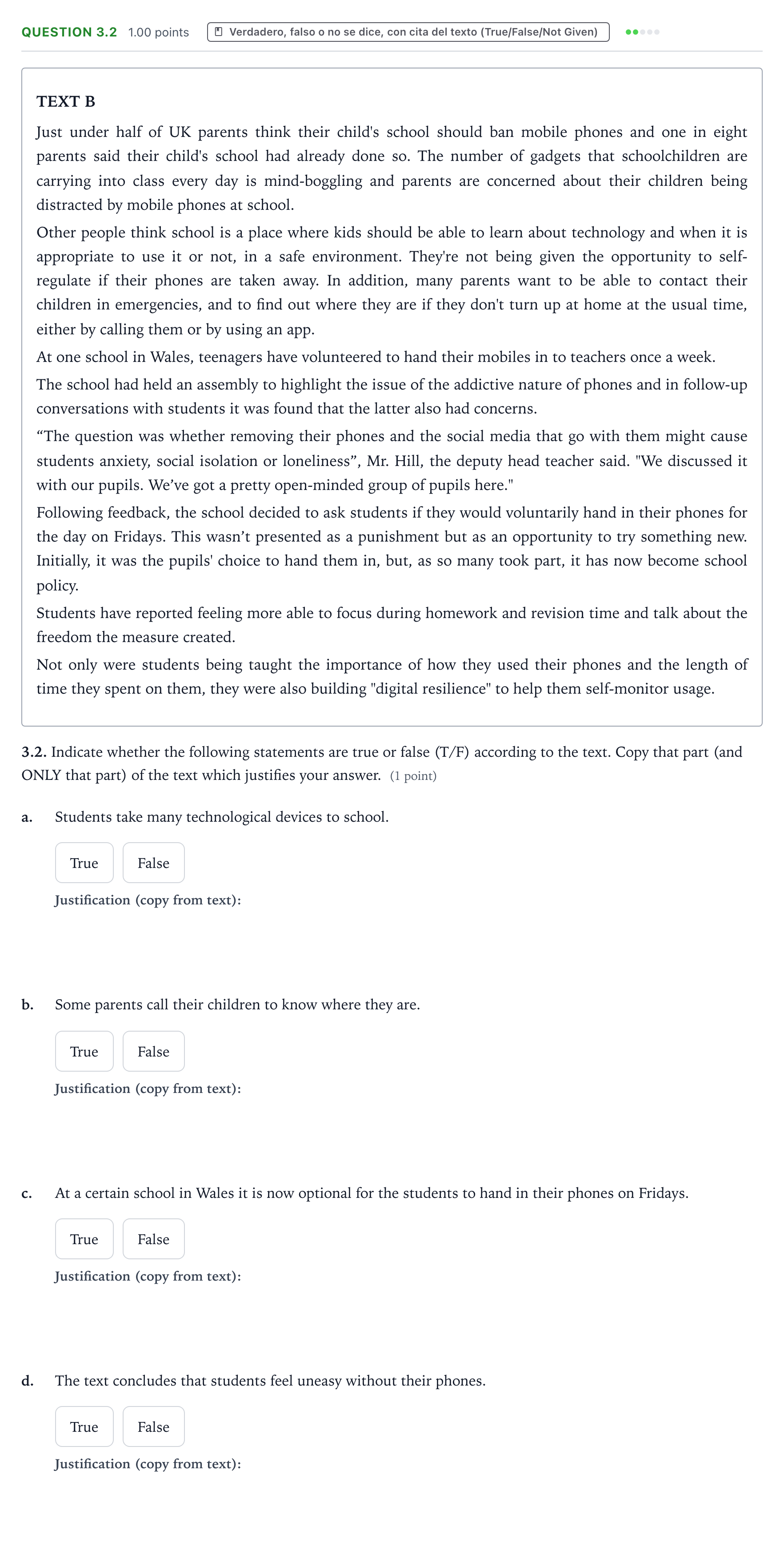
TEXT B
Just under half of UK parents think their child's school should ban mobile phones and one in eight parents said their child's school had already done so. The number of gadgets that schoolchildren are carrying into class every day is mind-boggling and parents are concerned about their children being distracted by mobile phones at school.
Other people think school is a place where kids should be able to learn about technology and when it is appropriate to use it or not, in a safe environment. They're not being given the opportunity to self-regulate if their phones are taken away. In addition, many parents want to be able to contact their children in emergencies, and to find out where they are if they don't turn up at home at the usual time, either by calling them or by using an app.
At one school in Wales, teenagers have volunteered to hand their mobiles in to teachers once a week.
The school had held an assembly to highlight the issue of the addictive nature of phones and in follow-up conversations with students it was found that the latter also had concerns.
“The question was whether removing their phones and the social media that go with them might cause students anxiety, social isolation or loneliness”, Mr. Hill, the deputy head teacher said. "We discussed it with our pupils. We’ve got a pretty open-minded group of pupils here."
Following feedback, the school decided to ask students if they would voluntarily hand in their phones for the day on Fridays. This wasn’t presented as a punishment but as an opportunity to try something new. Initially, it was the pupils' choice to hand them in, but, as so many took part, it has now become school policy.
Students have reported feeling more able to focus during homework and revision time and talk about the freedom the measure created.
Not only were students being taught the importance of how they used their phones and the length of time they spent on them, they were also building "digital resilience" to help them self-monitor usage.
3.2. Indicate whether the following statements are true or false (T/F) according to the text. Copy that part (and ONLY that part) of the text which justifies your answer. (1 point)
a.
Students take many technological devices to school.
True
False
b.
Some parents call their children to know where they are.
True
False
c.
At a certain school in Wales it is now optional for the students to hand in their phones on Fridays.
True
False
d.
The text concludes that students feel uneasy without their phones.
True
False
Solución
Según los criterios oficiales de corrección
3.2. Indicate whether the statements are true or false (T/F): a, b, c, d
Solución: a. True; b. True; c. False; d. False
a. Students take many technological devices to school. (Justification)
Solución: The number of gadgets that schoolchildren are carrying into class every day is mind-boggling
b. Some parents call their children to know where they are. (Justification)
Solución: many parents want to be able to contact their children in emergencies, and to find out where they are / either by calling them or by using an app
c. At a certain school in Wales it is now optional for the students to hand in their phones on Fridays. (Justification)
Solución: it has now become school policy
d. The text concludes that students feel uneasy without their phones. (Justification)
Solución: feeling more able to focus during homework and revision time and talk about the freedom the measure created
La explicación paso a paso, hecha con IA, es Premium. Premium
Resuélvelo aquí mismo: corrección automática, pistas y solución paso a paso.
‹ Question 1.2 · Ordinaria 2021 · Ejercicio 1 - 1.2 True/False · Ordinaria (2ª lengua extranjera) 2021 ›
Más ejercicios de Verdadero, falso o no se dice, con cita del texto (True/False/Not Given)
- Ejercicio 1.2 - True/False · Extraordinaria 2021
- Ejercicio 3.2 - True/False · Extraordinaria 2021
- Question 1.2 - True/False · Extraordinaria (2ª lengua extranjera) 2021
- Question 3.2 - True/False · Extraordinaria (2ª lengua extranjera) 2021
- Question 1.2 · Ordinaria 2021
- Ejercicio 1 - 1.2 True/False · Ordinaria (2ª lengua extranjera) 2021
- Ejercicio 3 - 3.2 True/False · Ordinaria (2ª lengua extranjera) 2021