Ejercicio 1.2 - True/False · Inglés PAU Galicia Extraordinaria 2021
Tema: Verdadero, falso o no se dice, con cita del texto (True/False/Not Given) · Del examen Extraordinaria (2021)
Enunciado
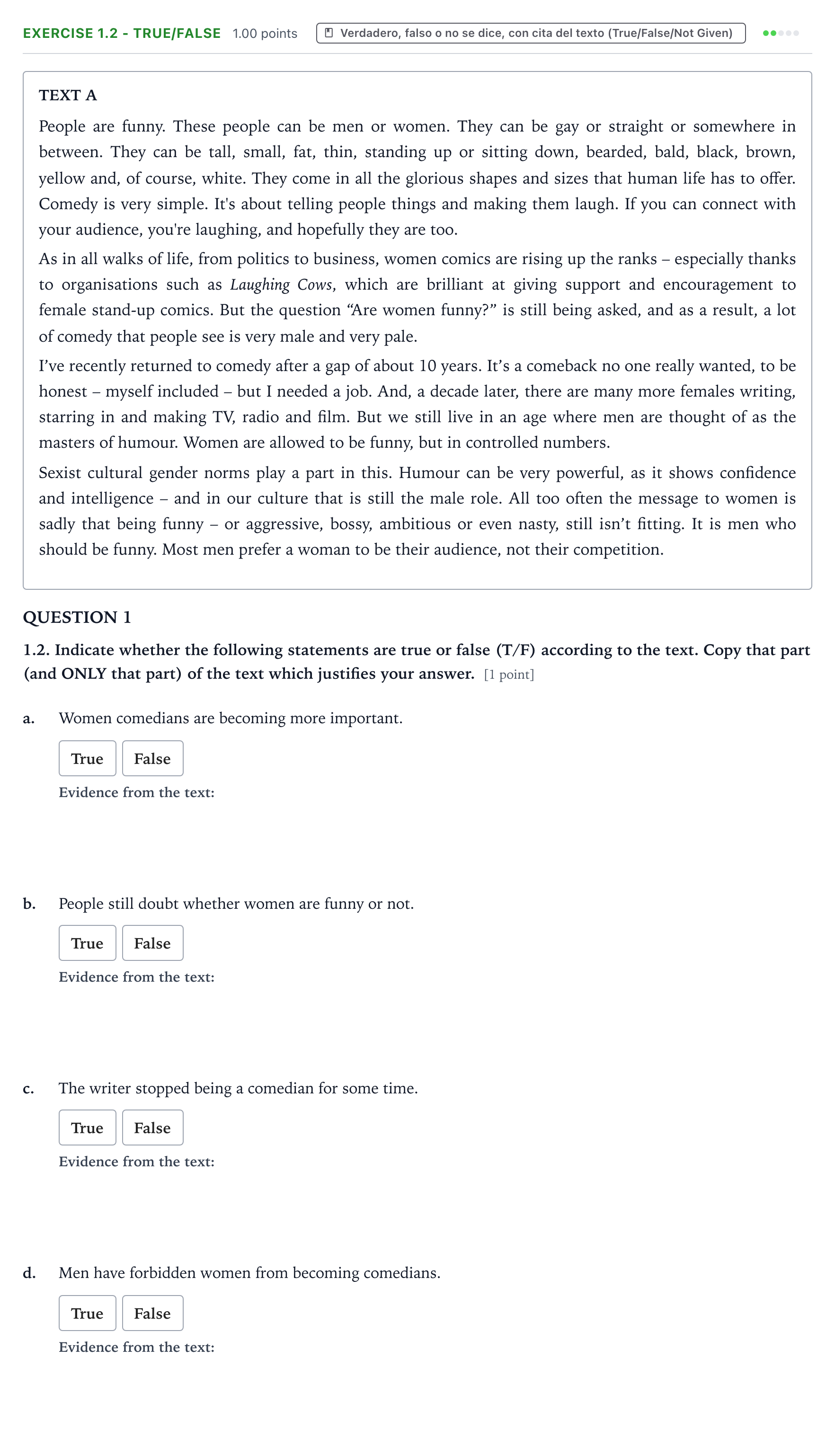
TEXT A
People are funny. These people can be men or women. They can be gay or straight or somewhere in between. They can be tall, small, fat, thin, standing up or sitting down, bearded, bald, black, brown, yellow and, of course, white. They come in all the glorious shapes and sizes that human life has to offer. Comedy is very simple. It's about telling people things and making them laugh. If you can connect with your audience, you're laughing, and hopefully they are too.
As in all walks of life, from politics to business, women comics are rising up the ranks – especially thanks to organisations such as Laughing Cows, which are brilliant at giving support and encouragement to female stand-up comics. But the question “Are women funny?” is still being asked, and as a result, a lot of comedy that people see is very male and very pale.
I’ve recently returned to comedy after a gap of about 10 years. It’s a comeback no one really wanted, to be honest – myself included – but I needed a job. And, a decade later, there are many more females writing, starring in and making TV, radio and film. But we still live in an age where men are thought of as the masters of humour. Women are allowed to be funny, but in controlled numbers.
Sexist cultural gender norms play a part in this. Humour can be very powerful, as it shows confidence and intelligence – and in our culture that is still the male role. All too often the message to women is sadly that being funny – or aggressive, bossy, ambitious or even nasty, still isn’t fitting. It is men who should be funny. Most men prefer a woman to be their audience, not their competition.
QUESTION 1
1.2. Indicate whether the following statements are true or false (T/F) according to the text. Copy that part (and ONLY that part) of the text which justifies your answer. [1 point]
a.
Women comedians are becoming more important.
b.
People still doubt whether women are funny or not.
c.
The writer stopped being a comedian for some time.
d.
Men have forbidden women from becoming comedians.
Solución
Según los criterios oficiales de corrección
1.2. Indicate whether the following statements are true or false (T/F) according to the text.
Solución: a. True; b. True; c. True; d. False
a. Women comedians are becoming more important. (Evidence)
Solución: ...women comics are rising up the ranks
b. People still doubt whether women are funny or not. (Evidence)
Solución: But the question “Are women funny?” is still being asked...
c. The writer stopped being a comedian for some time. (Evidence)
Solución: I’ve recently returned to comedy after a gap of about 10 years.
d. Men have forbidden women from becoming comedians. (Evidence)
Solución: Women are allowed to be funny, but in controlled numbers.
La explicación paso a paso, hecha con IA, es Premium. Premium
Resuélvelo aquí mismo: corrección automática, pistas y solución paso a paso.
‹ Question 3.2 - True/False · Ordinaria (2ª lengua extranjera) 2022 · Ejercicio 3.2 - True/False · Extraordinaria 2021 ›
Más ejercicios de Verdadero, falso o no se dice, con cita del texto (True/False/Not Given)
- Ejercicio 3.2 - True/False · Extraordinaria (2ª lengua extranjera) 2022
- Question 1.2 - True/False · Ordinaria 2022
- Question 3.2 - True/False · Ordinaria 2022
- Question 1.2 - True/False · Ordinaria (2ª lengua extranjera) 2022
- Question 3.2 - True/False · Ordinaria (2ª lengua extranjera) 2022
- Ejercicio 3.2 - True/False · Extraordinaria 2021
- Question 1.2 - True/False · Extraordinaria (2ª lengua extranjera) 2021
- Question 3.2 - True/False · Extraordinaria (2ª lengua extranjera) 2021
- Question 1.2 · Ordinaria 2021
- Question 3.2 · Ordinaria 2021