Question 3.2 - True/False · Inglés PAU Galicia Extraordinaria (2ª lengua extranjera) 2021
Tema: Verdadero, falso o no se dice, con cita del texto (True/False/Not Given) · Del examen Extraordinaria (2ª lengua extranjera) (2021)
Enunciado
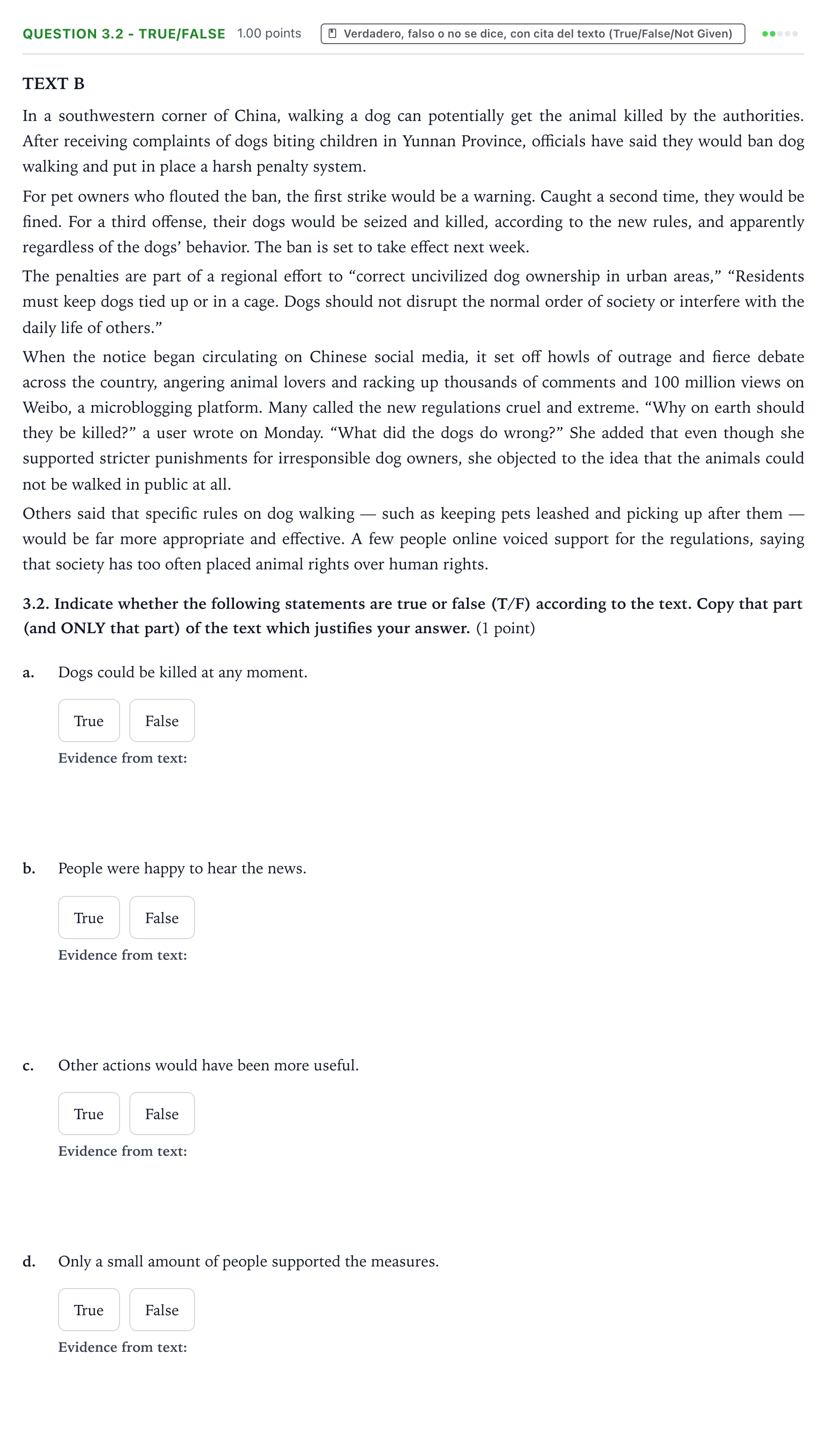
TEXT B
In a southwestern corner of China, walking a dog can potentially get the animal killed by the authorities. After receiving complaints of dogs biting children in Yunnan Province, officials have said they would ban dog walking and put in place a harsh penalty system.
For pet owners who flouted the ban, the first strike would be a warning. Caught a second time, they would be fined. For a third offense, their dogs would be seized and killed, according to the new rules, and apparently regardless of the dogs’ behavior. The ban is set to take effect next week.
The penalties are part of a regional effort to “correct uncivilized dog ownership in urban areas,” “Residents must keep dogs tied up or in a cage. Dogs should not disrupt the normal order of society or interfere with the daily life of others.”
When the notice began circulating on Chinese social media, it set off howls of outrage and fierce debate across the country, angering animal lovers and racking up thousands of comments and 100 million views on Weibo, a microblogging platform. Many called the new regulations cruel and extreme. “Why on earth should they be killed?” a user wrote on Monday. “What did the dogs do wrong?” She added that even though she supported stricter punishments for irresponsible dog owners, she objected to the idea that the animals could not be walked in public at all.
Others said that specific rules on dog walking — such as keeping pets leashed and picking up after them — would be far more appropriate and effective. A few people online voiced support for the regulations, saying that society has too often placed animal rights over human rights.
3.2. Indicate whether the following statements are true or false (T/F) according to the text. Copy that part (and ONLY that part) of the text which justifies your answer. (1 point)
a.
Dogs could be killed at any moment.
True
False
b.
People were happy to hear the news.
True
False
c.
Other actions would have been more useful.
True
False
d.
Only a small amount of people supported the measures.
True
False
Solución
Según los criterios oficiales de corrección
3.2. True/False selection for statements a, b, c, d
Solución: a. False; b. False; c. True; d. True
a. Dogs could be killed at any moment. (Justification)
Solución: “For a third offense, their dogs would be seized and killed”
b. People were happy to hear the news. (Justification)
Solución: “it set off howls of outrage and fierce debate across the country” / “angering animal lovers” / “Many called the new regulations cruel and extreme.”
c. Other actions would have been more useful. (Justification)
Solución: “specific rules on dog walking — such as keeping pets leashed and picking up after them — would be far more appropriate and effective.”
d. Only a small amount of people supported the measures. (Justification)
Solución: “A few people online voiced support for the regulations”
La explicación paso a paso, hecha con IA, es Premium. Premium
Resuélvelo aquí mismo: corrección automática, pistas y solución paso a paso.
‹ Question 1.2 - True/False · Extraordinaria (2ª lengua extranjera) 2021 · Question 1.2 · Ordinaria 2021 ›
Más ejercicios de Verdadero, falso o no se dice, con cita del texto (True/False/Not Given)
- Question 1.2 - True/False · Ordinaria (2ª lengua extranjera) 2022
- Question 3.2 - True/False · Ordinaria (2ª lengua extranjera) 2022
- Ejercicio 1.2 - True/False · Extraordinaria 2021
- Ejercicio 3.2 - True/False · Extraordinaria 2021
- Question 1.2 - True/False · Extraordinaria (2ª lengua extranjera) 2021
- Question 1.2 · Ordinaria 2021
- Question 3.2 · Ordinaria 2021
- Ejercicio 1 - 1.2 True/False · Ordinaria (2ª lengua extranjera) 2021
- Ejercicio 3 - 3.2 True/False · Ordinaria (2ª lengua extranjera) 2021