Ejercicio Option B - I * COMPREHENSION · Inglés PAU Andalucía Extraordinaria Reserva B 2013
Tema: Comprensión Lectora · Del examen Extraordinaria Reserva B (2013)
Enunciado
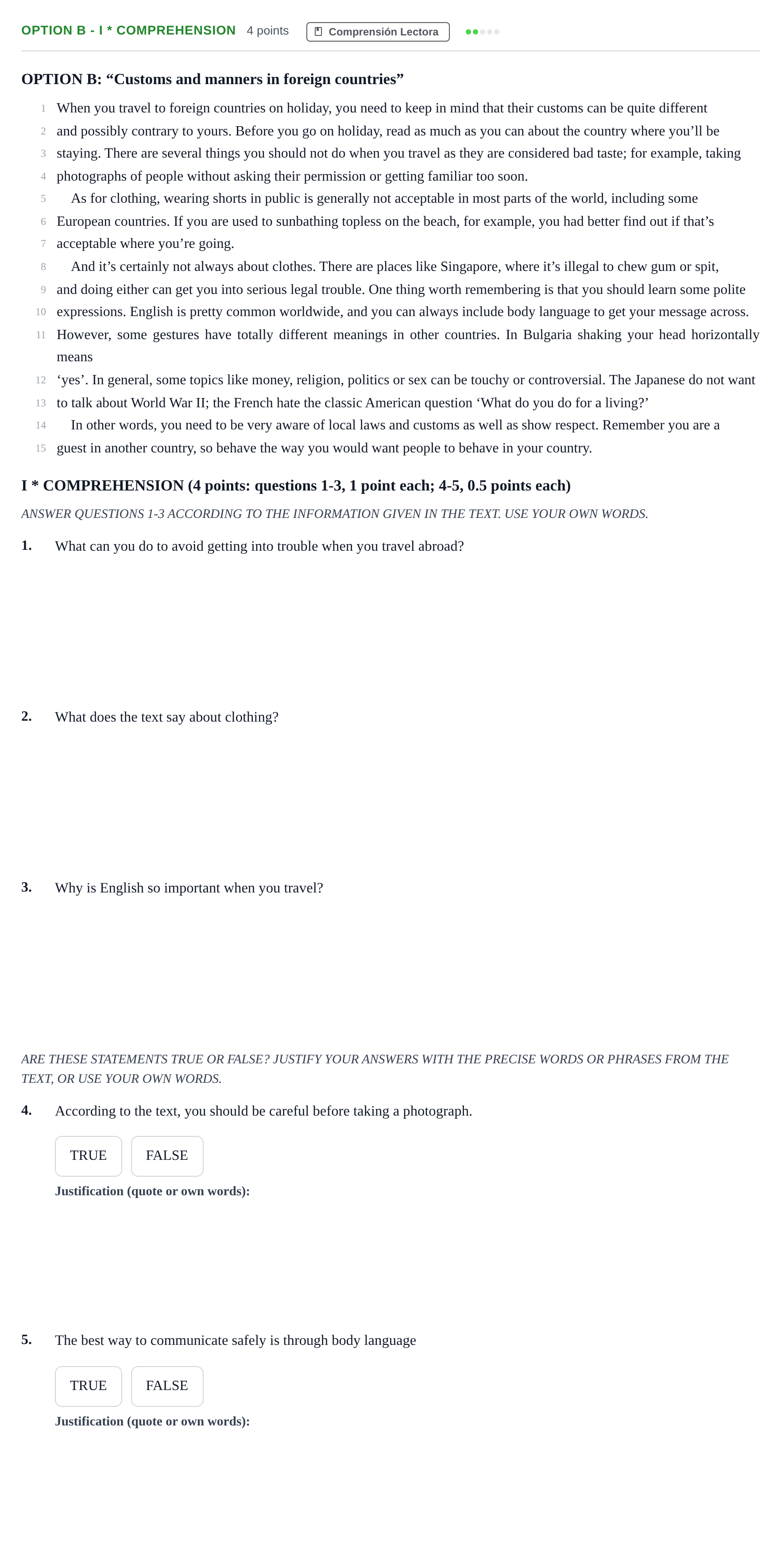
OPTION B: “Customs and manners in foreign countries”
1 When you travel to foreign countries on holiday, you need to keep in mind that their customs can be quite different
2 and possibly contrary to yours. Before you go on holiday, read as much as you can about the country where you’ll be
3 staying. There are several things you should not do when you travel as they are considered bad taste; for example, taking
4 photographs of people without asking their permission or getting familiar too soon.
5 As for clothing, wearing shorts in public is generally not acceptable in most parts of the world, including some
6 European countries. If you are used to sunbathing topless on the beach, for example, you had better find out if that’s
7 acceptable where you’re going.
8 And it’s certainly not always about clothes. There are places like Singapore, where it’s illegal to chew gum or spit,
9 and doing either can get you into serious legal trouble. One thing worth remembering is that you should learn some polite
10 expressions. English is pretty common worldwide, and you can always include body language to get your message across.
11 However, some gestures have totally different meanings in other countries. In Bulgaria shaking your head horizontally means
12 ‘yes’. In general, some topics like money, religion, politics or sex can be touchy or controversial. The Japanese do not want
13 to talk about World War II; the French hate the classic American question ‘What do you do for a living?’
14 In other words, you need to be very aware of local laws and customs as well as show respect. Remember you are a
15 guest in another country, so behave the way you would want people to behave in your country.
I * COMPREHENSION (4 points: questions 1-3, 1 point each; 4-5, 0.5 points each)
ANSWER QUESTIONS 1-3 ACCORDING TO THE INFORMATION GIVEN IN THE TEXT. USE YOUR OWN WORDS.
1.
What can you do to avoid getting into trouble when you travel abroad?
2.
What does the text say about clothing?
3.
Why is English so important when you travel?
ARE THESE STATEMENTS TRUE OR FALSE? JUSTIFY YOUR ANSWERS WITH THE PRECISE WORDS OR PHRASES FROM THE TEXT, OR USE YOUR OWN WORDS.
4.
According to the text, you should be careful before taking a photograph.
TRUE
FALSE
5.
The best way to communicate safely is through body language
TRUE
FALSE
Solución
Solución de AprenAI (no es la oficial)
1. What can you do to avoid getting into trouble when you travel abroad?
Solución: You can read as much as possible about your destination beforehand, learn about its local laws, customs and manners, and make sure to respect them.
2. What does the text say about clothing?
Solución: It says that wearing shorts in public is usually unacceptable in most places, and you should check if topless sunbathing on beaches is permitted before doing it.
3. Why is English so important when you travel?
Solución: Because it is widely spoken and understood across the world, making it very helpful to get your message across and communicate polite expressions.
Las soluciones de los 3 apartados que faltan y la explicación paso a paso son Premium. Premium
Resuélvelo aquí mismo: corrección automática, pistas y solución paso a paso.
‹ Ejercicio Option A - I * COMPREHENSION · Extraordinaria Reserva B 2013 · Ejercicio Option A - I * COMPREHENSION · Extraordinaria Titular 2013 ›
Más ejercicios de Comprensión Lectora
- Ejercicio Option A - I * Comprehension · Reserva B 2019
- Ejercicio Option B - I * Comprehension · Reserva B 2019
- Opción A - I. Comprehension · Extraordinaria Reserva A 2013
- Opción B - I. Comprehension · Extraordinaria Reserva A 2013
- Ejercicio Option A - I * COMPREHENSION · Extraordinaria Reserva B 2013
- Ejercicio Option A - I * COMPREHENSION · Extraordinaria Titular 2013
- Ejercicio Option B - I * COMPREHENSION · Extraordinaria Titular 2013
- Opción A - I * Comprehension · Ordinaria Reserva A 2013
- Opción B - I * Comprehension · Ordinaria Reserva A 2013
- Opción A - I * COMPREHENSION · Ordinaria Reserva B 2013