Sujet 1 - Partie 1 · Bac Anglais, monde contemporain Métropole remplacement 2024
Thème : Faire société – Unité et pluralité · Tiré du sujet Métropole France remplacement (2024)
Énoncé
Document A
How te reo Māori 1 is becoming a normalised aspect of popular culture, and why it matters
For many growing up in Aotearoa 2 in the 80s or 90s, the inclusion of te reo Māori in popular culture was largely limited to the All Blacks performing the haka on the international stage, despite it becoming an official language of New Zealand in 1987. […]
But in recent years, the inclusion of te reo in popular culture has made a positive shift, weaving the language into mainstream culture through books, film, television, radio and music. […]
In June this year, 1994 film The Lion King was adapted into te reo and praised as "embodying Māori indigeneity, it feels proximate, and you don't need to speak reo Māori to appreciate it". This month, Frozen Reo Māori will be released during Te Wiki o te Reo Māori 3.
Māori language adviser, translator and author Hēmi Kelly says the incorporation of the language in popular culture is an important shift, primarily because te reo is an official language of Aotearoa.
"We have a commitment and a responsibility as a country to ensure that [te reo] lives in every single part of our society. Language isn't confined to one space or one group of people."
Kelly has noticed more organisations and non-Māori are starting to learn the language and embrace it.
"It's important because what it contributes to is the normalisation of the language," he says. […]
Words such as kai, whānau, mahi and kia kaha are woven into everyday conversation and most New Zealanders know their meanings. The inclusion of phrases and words makes the language accessible to everyone, whether they feel comfortable speaking the language or not.
The journey to the normalisation of te reo in everyday New Zealand began with the Māori language petition, which was delivered to government with 30,000 signatures in 1972. The petition asked for active recognition of te reo Māori, which ultimately led to the Māori Language Act in 1987. The act gave the Māori language official language status in Aotearoa.
stuff.co.nz, September 14, 2022
1 native Māori language
2 "New Zealand" in te reo Māori
3 Māori Language Week
Document B
In New Zealand, 'Hello' Has Become 'Kia Ora.' Will That Save the Māori Language?
The New Zealand government has pledged to ensure 1 million residents are able to speak basic Māori by 2040—an effort to revive a language that UNESCO has classified as "vulnerable". The language has been incorporated into everyday life in ways both big and small. At sporting events, the national anthem is sung in both English and Māori language. Vodafone, the largest mobile network, changed the banner its cell phone users see on their screen from "Vodafone NZ" to "VF Aotearoa". The meeting rooms in Microsoft's Auckland office have Māori names, and Pic's, a popular peanut butter brand, has translated its labels. […]
The renewed interest in the Māori language also comes as New Zealand continues to wrestle with its colonial history—and representation for Māori culture. […]
The language of New Zealand's original inhabitants was still the country's predominant tongue at the beginning of the 19th century, but it was suppressed over the following decades to ensure that Māori children assimilated with the growing number of English-speaking colonial arrivals. "My grandparents weren't allowed to speak it, so they didn't pass it down to my parents and my parents didn't pass it down to me," says [36-year-old Kenny] Williams.
Today Māori people comprise about 16.5% of the population. But in 2013 only around 3.7% of the country's 5 million people spoke the language. Those who speak it fluently are an even smaller number.
But experts say over the last five or so years, the number of people trying to learn the language has increased markedly. In late 2019, hundreds of people were on a waiting list for language classes at Auckland University of Technology. Ara Institute of Canterbury, a vocational training school, says Māori language enrollment jumped 35% between 2018 and 2019.
Driving the revitalization are both Māori people embracing their language, and non-Māori New Zealanders who are learning it to gain a better understanding of their national identity, for professional reasons or from a sense of moral obligation, according to researchers at Massey University. Ella Henry, an associate professor at Auckland University of Technology, says that language classes at her university are split into about 50% Māori and 50% non-Māori students. […]
"The acceptance and celebration of Māori culture in wider society in New Zealand is playing a part in the language's revival," says Henry, of Auckland University of Technology.
Time, December 21, 2020
Document C
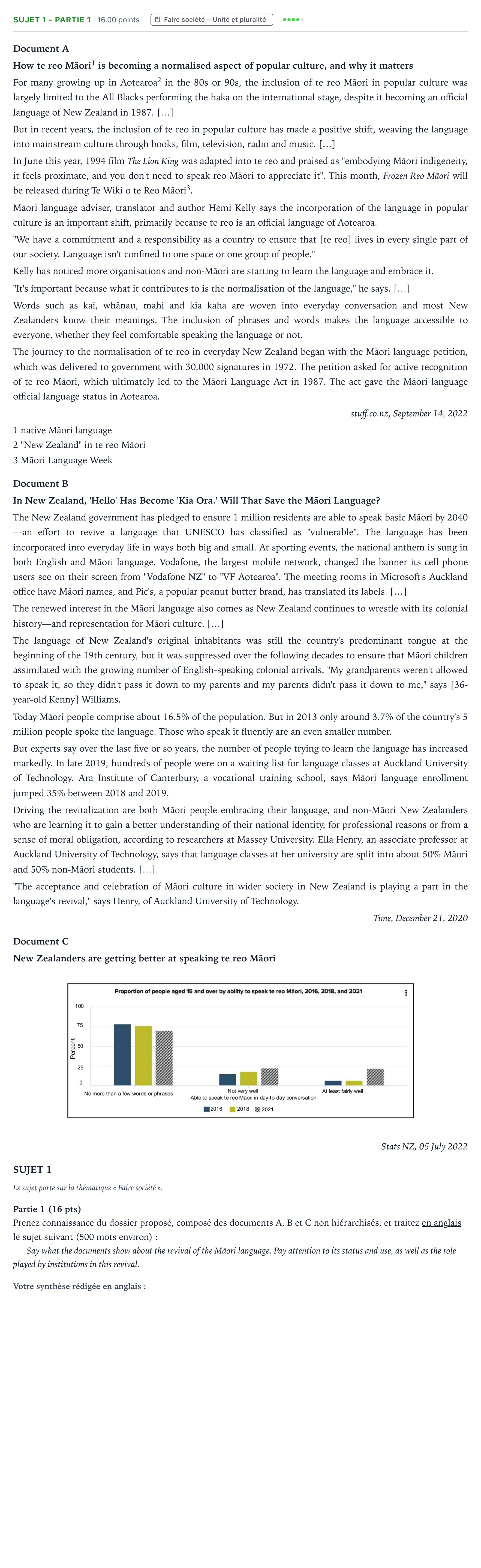
New Zealanders are getting better at speaking te reo Māori
Stats NZ, 05 July 2022
SUJET 1
Le sujet porte sur la thématique « Faire société ».
Partie 1 (16 pts)
Prenez connaissance du dossier proposé, composé des documents A, B et C non hiérarchisés, et traitez en anglais le sujet suivant (500 mots environ):
Say what the documents show about the revival of the Māori language. Pay attention to its status and use, as well as the role played by institutions in this revival.
Corrigé
Corrigé proposé par AprenAI (non officiel)
Say what the documents show about the revival of the Māori language. Pay attention to its status and use, as well as the role played by institutions in this revival.
Réponse : Sample synthesis (approx. 500 words): In post-colonial nations, the survival of Indigenous languages is closely linked to national identity and reconciliation. In New Zealand (Aotearoa), *te reo Māori*, once suppressed, is undergoing a cultural and institutional revival. The dossier comprises an article from *stuff.co.nz* (Doc A, 2022), an article from *Time* (Doc B, 2020) and a Stats NZ bar chart (Doc C, 2022). Together they show how the status, the everyday use and the institutional backing of the language are shaping a more inclusive society. Historically, the language was marginalised. Document B explains that Māori was still the predominant tongue at the beginning of the 19th century. It was then suppressed so that Māori children would assimilate with English-speaking settlers. Kenny Williams recalls that his grandparents "weren't allowed to speak it", which broke intergenerational transmission. As a result, although Māori people make up about 16.5% of the population, only around 3.7% of New Zealanders spoke the language in 2013. UNESCO classifies it as "vulnerable". Its status, however, changed thanks to civic mobilisation. A petition signed by 30,000 people in 1972 asked for active recognition of te reo. It ultimately led to the Māori Language Act of 1987, which made Māori an official language (Doc A). Yet Document A stresses that official status alone was not enough. In the 1980s and 1990s, the language remained largely confined to the All Blacks' haka. For translator Hēmi Kelly, being an official language creates "a commitment and a responsibility" to make it live "in every single part of our society". In recent years, this responsibility has translated into the normalisation of te reo in everyday use. The language now appears in books, television, radio and music, and in films such as *The Lion King* and *Frozen*, dubbed into Māori (Doc A). Words like *kai*, *whānau*, *mahi* or *kia kaha* are part of everyday conversation, and "kia ora" has replaced "hello" (Docs A and B). The language is also visible in public and commercial life. The national anthem is sung in both languages at sporting events. Vodafone became "VF Aotearoa", Microsoft's Auckland meeting rooms bear Māori names, and Pic's peanut butter labels have been translated (Doc B). Institutions play a decisive role in this revival. The government has pledged that one million residents will speak basic Māori by 2040 (Doc B). Universities and training schools face growing demand. Hundreds of people were on a waiting list at Auckland University of Technology in 2019, and enrolments at Ara Institute of Canterbury rose by 35% between 2018 and 2019. Learners are both Māori reclaiming their heritage and non-Māori. According to Massey University researchers, the latter are motivated by national identity, professional reasons or moral obligation, and classes are roughly half Māori and half non-Māori. Document C confirms this progress. Between 2016 and 2021, the share of people aged 15 and over knowing "no more than a few words" fell from about 78% to about 70%. Meanwhile, those able to converse "not very well" rose from about 15% to 22%, and those speaking "at least fairly well" rose from about 6% to about 21%, with a sharp jump in 2021. In conclusion, the documents show that the revival of te reo Māori stems from a combination of factors. Legal recognition gave it an official status, cultural and commercial normalisation spread it into everyday life, and institutional commitment supports its learning. Once a symbol of colonial suppression, the language is becoming a shared marker of national identity for all New Zealanders, even if fluent speakers remain a minority.
L’explication pas à pas, faite avec l’IA, est réservée aux membres Premium. Premium
Résous-le ici : correction automatique, indices et corrigé détaillé.
‹ Sujet 1 - Partie 1 · Métropole 2024 · Sujet 1 - Partie 1 · Métropole remplacement 2021 ›