Sujet 1 - Partie 1 · Bac Anglais, monde contemporain Métropole 2024
Thème : Faire société – Unité et pluralité · Tiré du sujet Métropole France (2024)
Énoncé
SUJET 1
Le sujet porte sur la thématique « Faire Société ».
Partie 1
[16 pts]
Prenez connaissance du dossier proposé, composé des documents A, B et C non hiérarchisés et traitez en anglais le sujet suivant (500 mots environ):
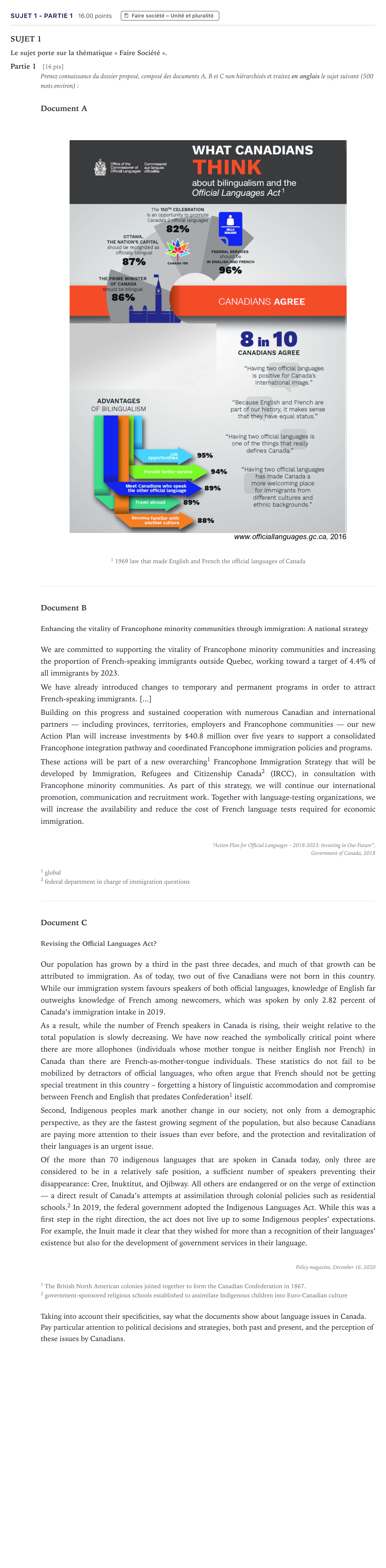
Document A
1 1969 law that made English and French the official languages of Canada
Document B
Enhancing the vitality of Francophone minority communities through immigration: A national strategy
We are committed to supporting the vitality of Francophone minority communities and increasing the proportion of French-speaking immigrants outside Quebec, working toward a target of 4.4% of all immigrants by 2023.
We have already introduced changes to temporary and permanent programs in order to attract French-speaking immigrants. [...]
Building on this progress and sustained cooperation with numerous Canadian and international partners — including provinces, territories, employers and Francophone communities — our new Action Plan will increase investments by $40.8 million over five years to support a consolidated Francophone integration pathway and coordinated Francophone immigration policies and programs.
These actions will be part of a new overarching 1 Francophone Immigration Strategy that will be developed by Immigration, Refugees and Citizenship Canada 2 (IRCC), in consultation with Francophone minority communities. As part of this strategy, we will continue our international promotion, communication and recruitment work. Together with language-testing organizations, we will increase the availability and reduce the cost of French language tests required for economic immigration.
“Action Plan for Official Languages – 2018-2023: Investing in Our Future”,
Government of Canada, 2018
1 global
2 federal department in charge of immigration questions
Document C
Revising the Official Languages Act?
Our population has grown by a third in the past three decades, and much of that growth can be attributed to immigration. As of today, two out of five Canadians were not born in this country. While our immigration system favours speakers of both official languages, knowledge of English far outweighs knowledge of French among newcomers, which was spoken by only 2.82 percent of Canada’s immigration intake in 2019.
As a result, while the number of French speakers in Canada is rising, their weight relative to the total population is slowly decreasing. We have now reached the symbolically critical point where there are more allophones (individuals whose mother tongue is neither English nor French) in Canada than there are French-as-mother-tongue individuals. These statistics do not fail to be mobilized by detractors of official languages, who often argue that French should not be getting special treatment in this country – forgetting a history of linguistic accommodation and compromise between French and English that predates Confederation 1 itself.
Second, Indigenous peoples mark another change in our society, not only from a demographic perspective, as they are the fastest growing segment of the population, but also because Canadians are paying more attention to their issues than ever before, and the protection and revitalization of their languages is an urgent issue.
Of the more than 70 indigenous languages that are spoken in Canada today, only three are considered to be in a relatively safe position, a sufficient number of speakers preventing their disappearance: Cree, Inuktitut, and Ojibway. All others are endangered or on the verge of extinction — a direct result of Canada’s attempts at assimilation through colonial policies such as residential schools. 2 In 2019, the federal government adopted the Indigenous Languages Act. While this was a first step in the right direction, the act does not live up to some Indigenous peoples’ expectations. For example, the Inuit made it clear that they wished for more than a recognition of their languages’ existence but also for the development of government services in their language.
Policy magazine, December 16, 2020
1 The British North American colonies joined together to form the Canadian Confederation in 1867.
2 government-sponsored religious schools established to assimilate Indigenous children into Euro-Canadian culture
Taking into account their specificities, say what the documents show about language issues in Canada. Pay particular attention to political decisions and strategies, both past and present, and the perception of these issues by Canadians.
Corrigé
Corrigé proposé par AprenAI (non officiel)
Taking into account their specificities, say what the documents show about language issues in Canada. Pay particular attention to political decisions and strategies, both past and present, and the perception of these issues by Canadians.
Réponse : Exemplary Synthesis: Canada's national identity has long been linked to its linguistic landscape. The dossier gathers three documents: an infographic from the Office of the Commissioner of Official Languages (Document A, 2016), an extract from the federal government's Action Plan for Official Languages 2018-2023 (Document B), and an analytical article from *Policy Magazine* (Document C, 2020). Together they show the political decisions taken to protect languages, the challenges these policies face today and how Canadians perceive these issues. First, the dossier highlights a long-standing political commitment to official bilingualism, rooted in the 1969 Official Languages Act, which made English and French the official languages of Canada. Document A shows that this choice enjoys broad public approval. 96% of Canadians think federal services should be offered in English and French. 86% believe the Prime Minister should be bilingual, and 87% want Ottawa recognized as officially bilingual. 82% see the 150th celebration as an opportunity to promote the two official languages. Eight in ten consider that having two official languages is positive for Canada's international image and truly defines the country. They also say it has made Canada more welcoming for immigrants. Bilingualism is also seen as a personal advantage: job opportunities (95%), better service (94%) and familiarity with another culture (88%). Document C recalls that this accommodation between French and English predates Confederation itself (1867). However, Documents B and C reveal that this balance is fragile and requires active strategies. Document C explains that the population has grown by a third in thirty years, mostly through immigration. Only 2.82% of newcomers spoke French in 2019. As a result, the number of French speakers rises but their relative weight declines. Allophones now outnumber people whose mother tongue is French. Detractors use these figures to argue that French should not get special treatment. Document B presents the government's response: increasing French-speaking immigration outside Quebec to reach 4.4% of all immigrants by 2023. It invests $40.8 million over five years in a Francophone integration pathway and a national Francophone Immigration Strategy. This strategy combines international recruitment with cheaper and more accessible French language tests. It is designed in cooperation with provinces, employers and Francophone minority communities. Finally, Document C shows that language issues are no longer limited to the English-French duality. Indigenous peoples are the fastest-growing part of the population, and Canadians pay more attention to their situation. Yet only three of the more than 70 Indigenous languages (Cree, Inuktitut, Ojibway) are relatively safe. The others are endangered, a direct consequence of past assimilation policies such as residential schools. The Indigenous Languages Act of 2019 is a first step. But it disappoints some communities, such as the Inuit, who want government services in their languages and not mere recognition. In conclusion, bilingualism remains a widely supported pillar of Canadian identity. Yet demographic change, immigration and the claims of Indigenous peoples force the country to rethink its language policies. The debate on revising the Official Languages Act shows that Canada must still invent a model in which official bilingualism and the revitalization of Indigenous languages can coexist.
L’explication pas à pas, faite avec l’IA, est réservée aux membres Premium. Premium
Résous-le ici : correction automatique, indices et corrigé détaillé.
‹ Sujet 1 - Partie 1 · Métropole 2025 · Sujet 1 - Partie 1 · Métropole remplacement 2024 ›