Sujet 1 - Partie 1 · Bac Anglais, monde contemporain Métropole 2025
Thème : Faire société – Unité et pluralité · Tiré du sujet Métropole France (2025)
Énoncé
Document A
Australia Day: The ‘quiet rebranding’ 1 of a controversial national holiday
On 26 January every year – which marks the 1788 landing of Britain's First Fleet in Sydney Cove – two competing stories about Australia are told.
One is of nation-building and achievement; the other is of the displacement and dispossession of Aboriginal and Torres Strait Islander people.
While many Indigenous Australians protest or sit the day out, 2 this year Dennis Kickett is co-hosting a celebration like few others. [...]
For the first time, his community of York near Perth will combine three days of Indigenous storytelling with the annual Australia Day festivities. It will include a BBQ with traditional bush tucker and the raising of Australian and Aboriginal flags to welcome new citizens.
Mr Kickett's aim is to use the gathering to explain what happened on 26 January.
“For us to move forward we all have to acknowledge the past. We live in the same community, and we're all striving for the same things,” says the 70-year-old, who made the decision with fellow Ballardong 3 traditional owners.
“There's no point segregating ourselves. On that date we will have an audience, so why not educate them?”
The Ballardong First Festival is one of hundreds of gatherings this weekend funded by the National Australia Day Council (NADC) – the body tasked with organising celebrations.
In recent years it has shifted away from patriotic pageantry towards events which “acknowledge past wrongs” and the “survival, resilience and enduring culture” of Indigenous communities. [...]
But as more people and businesses quietly opt out, 4 and annual “Invasion Day” protests gather steam, some experts say it's unclear if revamping Australia Day will help future-proof it.
The controversy stems from a debate over the appropriateness of celebrating Australia on a day when Aboriginal and Torres Strait Islander people began being stripped of their lands and cut off from their culture.
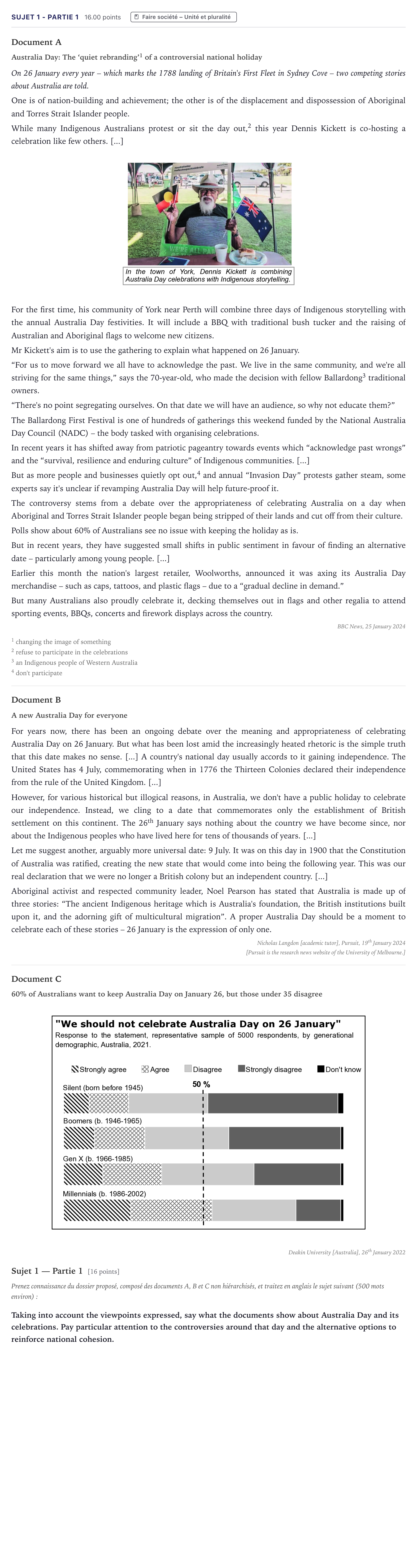
Polls show about 60% of Australians see no issue with keeping the holiday as is.
But in recent years, they have suggested small shifts in public sentiment in favour of finding an alternative date – particularly among young people. [...]
Earlier this month the nation's largest retailer, Woolworths, announced it was axing its Australia Day merchandise – such as caps, tattoos, and plastic flags – due to a “gradual decline in demand.”
But many Australians also proudly celebrate it, decking themselves out in flags and other regalia to attend sporting events, BBQs, concerts and firework displays across the country.
BBC News, 25 January 2024
1 changing the image of something
2 refuse to participate in the celebrations
3 an Indigenous people of Western Australia
4 don't participate
Document B
A new Australia Day for everyone
For years now, there has been an ongoing debate over the meaning and appropriateness of celebrating Australia Day on 26 January. But what has been lost amid the increasingly heated rhetoric is the simple truth that this date makes no sense. [...] A country's national day usually accords to it gaining independence. The United States has 4 July, commemorating when in 1776 the Thirteen Colonies declared their independence from the rule of the United Kingdom. [...]
However, for various historical but illogical reasons, in Australia, we don't have a public holiday to celebrate our independence. Instead, we cling to a date that commemorates only the establishment of British settlement on this continent. The 26 th January says nothing about the country we have become since, nor about the Indigenous peoples who have lived here for tens of thousands of years. [...]
Let me suggest another, arguably more universal date: 9 July. It was on this day in 1900 that the Constitution of Australia was ratified, creating the new state that would come into being the following year. This was our real declaration that we were no longer a British colony but an independent country. [...]
Aboriginal activist and respected community leader, Noel Pearson has stated that Australia is made up of three stories: “The ancient Indigenous heritage which is Australia's foundation, the British institutions built upon it, and the adorning gift of multicultural migration”. A proper Australia Day should be a moment to celebrate each of these stories – 26 January is the expression of only one.
Nicholas Langdon [academic tutor], Pursuit, 19 th January 2024
[ Pursuit is the research news website of the University of Melbourne.]
Document C
60% of Australians want to keep Australia Day on January 26, but those under 35 disagree
Deakin University [Australia], 26 th January 2022
Sujet 1 — Partie 1 [16 points]
Prenez connaissance du dossier proposé, composé des documents A, B et C non hiérarchisés, et traitez en anglais le sujet suivant (500 mots environ):
Taking into account the viewpoints expressed, say what the documents show about Australia Day and its celebrations. Pay particular attention to the controversies around that day and the alternative options to reinforce national cohesion.
Corrigé
Corrigé proposé par AprenAI (non officiel)
Taking into account the viewpoints expressed, say what the documents show about Australia Day and its celebrations. Pay particular attention to the controversies around that day and the alternative options to reinforce national cohesion.
Réponse : A structured synthesis in English (~500 words) analysing the conflicting perspectives on Australia Day, the generational divide, and proposed alternatives for national cohesion.
L’explication pas à pas, faite avec l’IA, est réservée aux membres Premium. Premium
Résous-le ici : correction automatique, indices et corrigé détaillé.
Sujet 1 - Partie 1 · Métropole 2024 ›