Sujet 2 - 1re partie · Bac Anglais Métropole 2026
Thème : Synthèse du dossier — Arts et débats d'idées · Tiré du sujet Métropole France (2026)
Énoncé
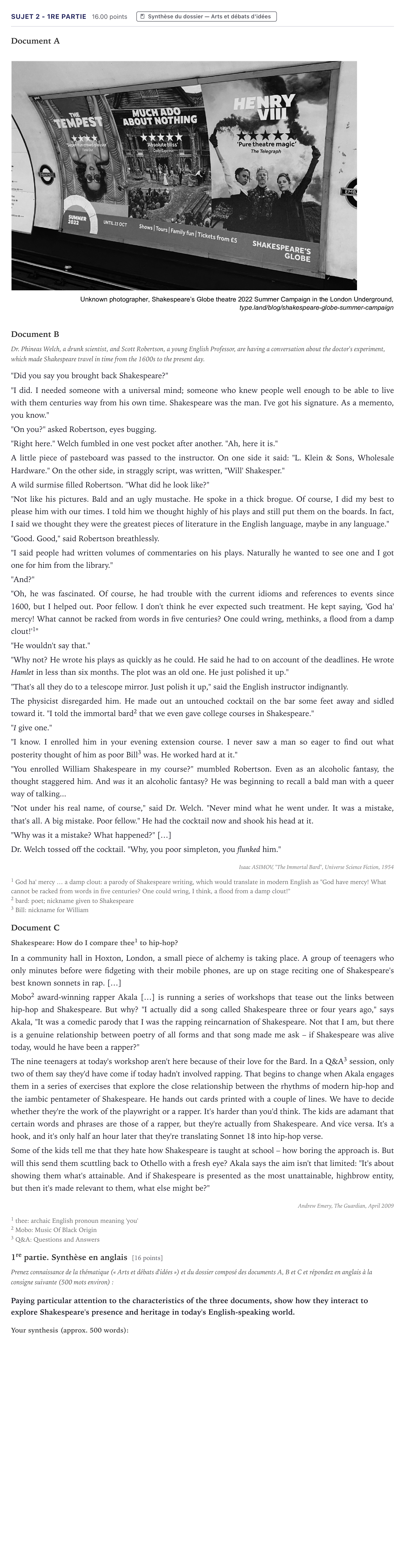
Document A
Document B
Dr. Phineas Welch, a drunk scientist, and Scott Robertson, a young English Professor, are having a conversation about the doctor's experiment, which made Shakespeare travel in time from the 1600s to the present day.
1 "Did you say you brought back Shakespeare?"
"I did. I needed someone with a universal mind; someone who knew people well enough to be able to live with them centuries way from his own time. Shakespeare was the man. I've got his signature. As a memento, you know."
5 "On you?" asked Robertson, eyes bugging.
"Right here." Welch fumbled in one vest pocket after another. "Ah, here it is."
A little piece of pasteboard was passed to the instructor. On one side it said: "L. Klein & Sons, Wholesale Hardware." On the other side, in straggly script, was written, "Will' Shakesper."
10 A wild surmise filled Robertson. "What did he look like?"
"Not like his pictures. Bald and an ugly mustache. He spoke in a thick brogue. Of course, I did my best to please him with our times. I told him we thought highly of his plays and still put them on the boards. In fact, I said we thought they were the greatest pieces of literature in the English language, maybe in any language."
15 "Good. Good," said Robertson breathlessly.
"I said people had written volumes of commentaries on his plays. Naturally he wanted to see one and I got one for him from the library."
"And?"
20 "Oh, he was fascinated. Of course, he had trouble with the current idioms and references to events since 1600, but I helped out. Poor fellow. I don't think he ever expected such treatment. He kept saying, 'God ha' mercy! What cannot be racked from words in five centuries? One could wring, methinks, a flood from a damp clout!' 1 "
"He wouldn't say that."
25 "Why not? He wrote his plays as quickly as he could. He said he had to on account of the deadlines. He wrote Hamlet in less than six months. The plot was an old one. He just polished it up."
"That's all they do to a telescope mirror. Just polish it up," said the English instructor indignantly.
30 The physicist disregarded him. He made out an untouched cocktail on the bar some feet away and sidled toward it. "I told the immortal bard 2 that we even gave college courses in Shakespeare."
" I give one."
"I know. I enrolled him in your evening extension course. I never saw a man so eager 35 to find out what posterity thought of him as poor Bill 3 was. He worked hard at it."
"You enrolled William Shakespeare in my course?" mumbled Robertson. Even as an alcoholic fantasy, the thought staggered him. And was it an alcoholic fantasy? He was beginning to recall a bald man with a queer way of talking...
40 "Not under his real name, of course," said Dr. Welch. "Never mind what he went under. It was a mistake, that's all. A big mistake. Poor fellow." He had the cocktail now and shook his head at it.
"Why was it a mistake? What happened?" […]
Dr. Welch tossed off the cocktail. "Why, you poor simpleton, you flunked him."
Isaac ASIMOV, "The Immortal Bard", Universe Science Fiction, 1954
1 God ha' mercy … a damp clout: a parody of Shakespeare writing, which would translate in modern English as "God have mercy! What cannot be racked from words in five centuries? One could wring, I think, a flood from a damp clout!"
2 bard: poet; nickname given to Shakespeare
3 Bill: nickname for William
Document C
Shakespeare: How do I compare thee 1 to hip-hop?
In a community hall in Hoxton, London, a small piece of alchemy is taking place. A group of teenagers who only minutes before were fidgeting with their mobile phones, are up on stage reciting one of Shakespeare's best known sonnets in rap. […]
5 Mobo 2 award-winning rapper Akala […] is running a series of workshops that tease out the links between hip-hop and Shakespeare. But why? "I actually did a song called Shakespeare three or four years ago," says Akala, "It was a comedic parody that I was the rapping reincarnation of Shakespeare. Not that I am, but there is a genuine 10 relationship between poetry of all forms and that song made me ask – if Shakespeare was alive today, would he have been a rapper?"
The nine teenagers at today's workshop aren't here because of their love for the Bard. In a Q&A 3 session, only two of them say they'd have come if today hadn't involved 15 rapping. That begins to change when Akala engages them in a series of exercises that explore the close relationship between the rhythms of modern hip-hop and the iambic pentameter of Shakespeare. He hands out cards printed with a couple of lines. We have to decide whether they're the work of the playwright or a rapper. It's harder than 20 you'd think. The kids are adamant that certain words and phrases are those of a rapper, but they're actually from Shakespeare. And vice versa. It's a hook, and it's only half an hour later that they're translating Sonnet 18 into hip-hop verse.
Some of the kids tell me that they hate how Shakespeare is taught at school – how boring the approach is. But will this send them scuttling back to Othello with a fresh eye? Akala says the aim isn't that limited: "It's about showing them what's attainable. And if Shakespeare is presented as the most unattainable, highbrow entity, but then it's made relevant to them, what else might be?"
Andrew Emery, The Guardian, April 2009
1 thee: archaic English pronoun meaning 'you'
2 Mobo: Music Of Black Origin
3 Q&A: Questions and Answers
1 re partie. Synthèse en anglais [16 points]
Prenez connaissance de la thématique (« Arts et débats d'idées ») et du dossier composé des documents A, B et C et répondez en anglais à la consigne suivante (500 mots environ):
Paying particular attention to the characteristics of the three documents, show how they interact to explore Shakespeare's presence and heritage in today's English-speaking world.
Corrigé
Corrigé proposé par AprenAI (non officiel)
Paying particular attention to the characteristics of the three documents, show how they interact to explore Shakespeare's presence and heritage in today's English-speaking world.
Réponse : Introduction William Shakespeare remains arguably the most influential figure in English literature. However, the nature of his legacy is constantly debated: is he an untouchable monument confined to academic study, or a popular artist whose works continue to speak to ordinary people? The three documents in this dossier explore Shakespeare’s enduring presence in the contemporary English-speaking world. Document A is a 2022 London Underground advertising campaign promoting summer productions at Shakespeare’s Globe; Document B is an excerpt from Isaac Asimov’s satirical science-fiction short story “The Immortal Bard” (1954); and Document C is an article by Andrew Emery from *The Guardian* (2009) reporting on educational hip-hop workshops led by the British rapper Akala. 1. Shakespeare: Between Highbrow Institution and Accessible Entertainment The documents first highlight how Shakespeare has been elevated to an intimidating, institutionalized status. In Asimov’s story, the academic world treats the Bard with almost sacred deference: professors like Robertson teach specialized courses, while libraries are filled with "volumes of commentaries." This reverence is precisely what alienates younger generations, as Document C shows: teenagers confess they "hate how Shakespeare is taught at school" because he is presented as an "unattainable, highbrow entity." In contrast, both the promotional campaign (Doc A) and contemporary artists (Doc C) seek to reclaim Shakespeare as accessible popular culture. The poster in the Tube advertises tickets "from £5" and uses catchy reviews such as "super-fun crowd pleaser" or "pure theatre magic." Placed in an everyday public space, it reminds commuters that theatre is a lively communal celebration, which echoes Shakespeare’s original purpose for the audiences of his time. 2. Deconstructing the Myth through Irony and Modern Rhythms Furthermore, the texts challenge the reverent image of the playwright. In Asimov’s text (Doc B), irony is used to demystify Shakespeare. Brought into the twentieth century by a time-travel experiment, "Will" turns out to be an ordinary working playwright who wrote under tight deadlines and borrowed existing plots. Ironically, when he is enrolled anonymously in a college course about his own work, he is "flunked": modern academic over-interpretation has lost touch with the man himself. Similarly, Akala’s workshops (Doc C) strip away the elitist image by revealing the parallels between Elizabethan verse and urban music. The teenagers discover that both iambic pentameter and rap rely on rhythm, wordplay and storytelling. When they mistake Shakespeare’s lines for rap lyrics and vice versa, they realize that Shakespeare was, in a way, the popular poet of his day. Conclusion Ultimately, these three documents show that Shakespeare’s heritage does not survive thanks to sterile academic idolatry. It survives because his work keeps being performed, reinvented and appropriated by new audiences: Globe spectators reached through an Underground campaign, readers of a satirical science-fiction story, and young Londoners rapping his sonnets. Through their different natures (an advert, a fiction and a press article), the documents suggest that the best way to honour the Bard is not to place him on a pedestal but to make him live again, accessible and relevant, in today’s English-speaking world.
L’explication pas à pas, faite avec l’IA, est réservée aux membres Premium. Premium
Résous-le ici : correction automatique, indices et corrigé détaillé.
Sujet 1 - Partie 1 · Métropole 2024 ›