Sujet 1 - 1re partie : Synthèse · Bac Anglais Métropole 2022
Thème : Synthèse du dossier — Arts et débats d'idées · Tiré du sujet Métropole France (2022)
Énoncé
Document A
This document is an excerpt from Me, the autobiography of Elton John, British singer, songwriter, pianist and composer born in 1947. He is one of the best-selling music artists of all time.
It was my mum who introduced me to Elvis Presley. Every Friday, after work, she would pick up her wages, stop off on the way home at Siever's, an electrical store that also sold records, and buy a new 78 1. [...] She told me she'd never heard anything like it before, but it was so fantastic she had to buy it. As soon as she said the words Elvis Presley, I recognized them. The previous weekend I'd been looking through the magazines in the local barber shop while I was waiting to have my hair cut, when I came across a photo of the most bizarre-looking man I'd ever seen. Everything about him looked extraordinary: his clothes, his hair, even the way he was standing. Compared to the people you could see outside the barber shop window in the north-west London suburb of Pinner, he might as well have been bright green with antennae sticking out of his forehead. I'd been so transfixed I hadn't even bothered to read the accompanying article, and by the time I got home I'd forgotten his name. But that was it: Elvis Presley.
As soon as Mum put the record on, it became apparent that Elvis Presley sounded the way he looked, like he came from another planet. Compared to the stuff my parents normally listened to, 'Heartbreak Hotel' barely qualified as music at all, an opinion my father would continue to expound upon at great length over the coming years. I'd already heard rock and roll – 'Rock Around The Clock' had been a big hit earlier in 1956 – but 'Heartbreak Hotel' didn't sound anything like that either. It was raw and sparse and slow and eerie. Everything was drenched in the weird echo. [...] As 'Heartbreak Hotel' played, it felt like something had changed, that nothing could really be the same again. As it turned out, something had, and nothing was.
And thank God, because the world needed changing. I grew up in fifties Britain and, before Elvis, before rock and roll, fifties Britain was a pretty grim place. I didn't mind living in Pinner – I've never been one of those rock stars who was motivated by a burning desire to escape the suburbs, I quite liked it there – but the whole country was in a bad place.
Elton JOHN, Me, 2019
1 a 78: a type of vinyl record.
Document B
This document is an excerpt from Born to Run, the autobiography of Bruce Springsteen, world-famous American rock singer, songwriter and musician born in 1949.
In the beginning there was a great darkness upon the Earth. There was Christmas and your birthday but beyond that all was a black endless authoritarian void. There was nothing to look forward to, nothing to look back upon, no future, no history. It was all a kid could do to make it to summer vacation.
Then, in a moment of light, blinding as a universe birthing a billion new suns, there was hope, sex, rhythm, excitement, possibility, a new way of seeing, of feeling, of thinking, of looking at your body, of combing your hair, of wearing your clothes, of moving and of living. There was a joyous demand made, a challenge, a way out of this dead-to-life world, this small-town grave with all the people I dearly loved and feared buried in it alongside of me.
THE BARRICADES HAVE BEEN STORMED!! A FREEDOM SONG HAS BEEN SUNG!! THE BELLS OF LIBERTY HAVE RUNG!! A HERO HAS COME. THE OLD ORDER HAS BEEN OVERTHROWN! The teachers, the parents, the fools so sure they knew THE WAY—THE ONLY WAY—to build a life, to have an impact on things and to make a man or woman out of yourself, have been challenged. A HUMAN ATOM HAS JUST SPLIT THE WORLD IN TWO!
The small part of the world I inhabit has stumbled upon an irreversible moment. Somewhere in between the mundane variety acts on a routine Sunday night in the year of our Lord 1956... THE REVOLUTION HAS BEEN TELEVISED!! [...]
This new world is a world of black and white. A place of freedom where the two most culturally powerful tribes in American society find a common ground, pleasure and joy in each other's presence. Where they use a common language to speak with... to BE with one another. [...]
A “man” did this. A “man” searching for something new. He willed it into existence. Elvis's great act of love rocked the country and was an early echo of the coming civil rights movement. He was the kind of new American whose “desires” would bring his goals to fruition. He was a singer, a guitar player who loved black musical culture, recognized its artistry, its mastery, its power, and yearned for intimacy with it. [...] He was not an “activist”, not a John Brown, not a Martin Luther King Jr., not a Malcolm X. He was a showman, an entertainer, an imaginer of worlds, an unbelievable success, an embarrassing failure and a fount of modern action and ideas. Ideas that would soon change the shape and future of the nation.
Bruce SPRINGSTEEN, Born to Run, 2016
Document C
1 re partie. Synthèse en anglais [16 points]
Prenez connaissance de la thématique (« Arts et débats d'idées ») et du dossier composé des documents A, B et C et répondez en anglais à la consigne suivante (500 mots environ):
Paying particular attention to the specificities of the three documents, show how they interact to illustrate the impact of popular culture on society.
Corrigé
Corrigé proposé par AprenAI (non officiel)
Paying particular attention to the specificities of the three documents, show how they interact to illustrate the impact of popular culture on society.
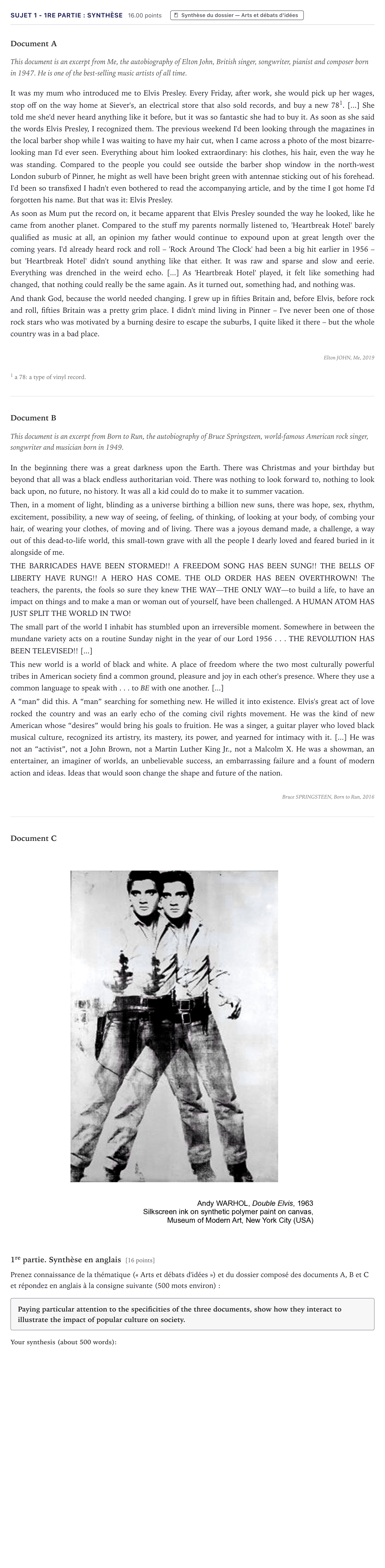
Réponse : ### Sample Synthesis (approx. 500 words) Introduction The post-World War II era was marked by profound socioeconomic transformations, yet daily life in both the United States and Britain often remained stifled by rigid social conventions and austerity. The three documents in this dossier—two autobiographical excerpts by prominent rock musicians, Elton John (*Me*, 2019) and Bruce Springsteen (*Born to Run*, 2016), and Andy Warhol’s silkscreen painting *Double Elvis* (1963)—converge on the pivotal figure of Elvis Presley to illustrate how popular culture emerged as an unprecedented catalyst for personal liberation, social upheaval, and artistic reinvention. 1. An Aesthetic and Generational Shock Both textual documents emphasize how popular culture delivered a sensory shock that disrupted the mundane conformity of the 1950s. For Elton John, growing up in suburban London ("Pinner"), the encounter with Elvis was alien and revolutionary: the singer looked "like he came from another planet" with his unconventional attire, hair, and posture. The raw sound of "Heartbreak Hotel" defied the musical expectations of the older generation, embodying a distinct youth culture that challenged parental authority. Similarly, Bruce Springsteen describes his pre-rock world as a "black endless authoritarian void." The sudden arrival of Elvis through national television in 1956 felt like a blinding "moment of light" that offered a new physicality, sexual freedom, and an avenue of escape from small-town paralysis. In both testimonies, popular culture functions as an explosive threshold dividing an obsolete past from an exhilarating future. 2. Crossing Social and Racial Boundaries Beyond individual revelation, popular culture served as an agent of social transformation. Springsteen explicitly links rock 'n' roll to the broader political landscape of the United States. He highlights Elvis's role as a bridge between "black and white" cultures: by embracing and popularizing African American musical traditions, Presley willed into existence a shared cultural ground that became "an early echo of the coming civil rights movement." Although not a conscious political activist, the performer democratized culture and enabled diverse communities to connect emotionally across entrenched racial divides through music and mass media. 3. The Mythification and Duplication of the Icon While Documents A and B capture the organic, visceral excitement of experiencing a new idol, Document C provides a critical visual commentary on the mechanisms of mass entertainment. Warhol’s *Double Elvis* depicts the star in a cinematic cowboy stance, drawing his revolver directly at the spectator. The repetition and ghostly fading produced by the silkscreen technique reflect how popular culture mass-produces myths and blurs the boundary between the authentic individual and his commodified persona. Elvis is no longer just a musician; he has become an ubiquitous American archetype, endlessly reproducible and consumed by society. Conclusion In conclusion, these documents demonstrate that popular culture is far more than mere entertainment. As Elton John and Bruce Springsteen testify, rock 'n' roll shattered generational complacencies and prefigured profound social emancipations. Concurrently, Warhol’s artwork reveals how popular icons evolve into enduring cultural myths, proving that popular culture reshapes both individual consciousness and collective identity.
L’explication pas à pas, faite avec l’IA, est réservée aux membres Premium. Premium
Résous-le ici : correction automatique, indices et corrigé détaillé.
‹ Sujet 2 - 1re partie · Métropole 2023 · Sujet 1 - 1re partie · Métropole remplacement 2022 ›