Sujet 1 - Partie 1 · Bac Anglais Métropole remplacement 2024
Thème : Synthèse du dossier — Arts et débats d'idées · Tiré du sujet Métropole France remplacement (2024)
Énoncé
Document A
Many Americans of Irish extraction turn their lineage into romantic tales of deep roots, bygone suffering, and picturesque desperation. Unfortunately for me, the story of the Joneses in Northern Ireland is awkward, unglamorous, and short. The family moved there from England in the mid-1950s, when my grandfather started working at a British naval base in Derry, a mid-sized city near the border with the Republic of Ireland. He died when my dad was a teenager [...]. My dad went to England for university; on break he met an American girl who was in art school in Wales. When she got into visa trouble, they moved to the U.S. and got married, which is where I showed up. [...]
Still, Derry remains the closest thing my father has to a hometown. As a child, I was terrified and entranced by his stories about the place, most of which involved masked men knocking on your door in the middle of the night and shooting you in front of your family, and all of which could not have seemed further away from my own sunny, Clinton-era youth. Now, the rest of the world seems to have caught my fascination. Somehow, someway, Northern Ireland is in the Zeitgeist 1 again. [...].
And then there's Derry Girls, the critically acclaimed Channel 4 comedy whose second season is currently streaming on Netflix in the U.S. A coming-of-age sitcom following four Catholic teens and their English buddy in 1990s Derry, the series is a fizzy antidote to the grimness that pervades most Northern Irish stories. [...]
Of the seven kids in my dad's family, six of them left Northern Ireland, scattering around the English-speaking parts of the globe. My cousin Rose is the daughter of the aunt who stayed, and in the '90s she too was a teenage girl [...].
Rose lives in London now, and after Derry Girls premiered, she was struck by the different ways it was perceived on either side of the Irish Sea. "Everyone from Northern Ireland liked the first series, but people in England thought it was weird," she said. "But the things they thought were surreal in England were not surreal in Northern Ireland." Like the way a daffy 2 aunt is bummed that a bomb means she won't be able to go tanning, or a blackboard where high-schoolers have to write down the differences between Catholics and Protestants. "People in England thought those things were totally silly and exaggerated for effect," she said. "But they weren't. Those things were true."
Nate JONES, "My Northern-Irish Family Reviews Derry Girls ", www.vulture.com, 2019.
1 Zeitgeist: the defining spirit of a particular period of time.
2 Daffy: silly.
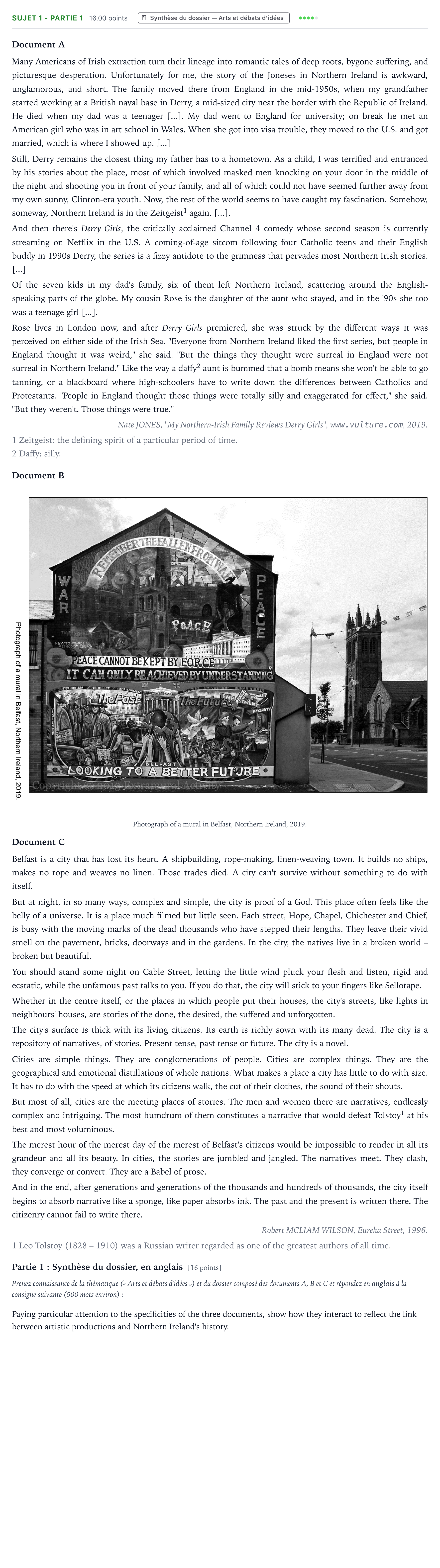
Document B
Photograph of a mural in Belfast, Northern Ireland, 2019.
Document C
Belfast is a city that has lost its heart. A shipbuilding, rope-making, linen-weaving town. It builds no ships, makes no rope and weaves no linen. Those trades died. A city can't survive without something to do with itself.
But at night, in so many ways, complex and simple, the city is proof of a God. This place often feels like the belly of a universe. It is a place much filmed but little seen. Each street, Hope, Chapel, Chichester and Chief, is busy with the moving marks of the dead thousands who have stepped their lengths. They leave their vivid smell on the pavement, bricks, doorways and in the gardens. In the city, the natives live in a broken world – broken but beautiful.
You should stand some night on Cable Street, letting the little wind pluck your flesh and listen, rigid and ecstatic, while the unfamous past talks to you. If you do that, the city will stick to your fingers like Sellotape.
Whether in the centre itself, or the places in which people put their houses, the city's streets, like lights in neighbours' houses, are stories of the done, the desired, the suffered and unforgotten.
The city's surface is thick with its living citizens. Its earth is richly sown with its many dead. The city is a repository of narratives, of stories. Present tense, past tense or future. The city is a novel.
Cities are simple things. They are conglomerations of people. Cities are complex things. They are the geographical and emotional distillations of whole nations. What makes a place a city has little to do with size. It has to do with the speed at which its citizens walk, the cut of their clothes, the sound of their shouts.
But most of all, cities are the meeting places of stories. The men and women there are narratives, endlessly complex and intriguing. The most humdrum of them constitutes a narrative that would defeat Tolstoy 1 at his best and most voluminous.
The merest hour of the merest day of the merest of Belfast's citizens would be impossible to render in all its grandeur and all its beauty. In cities, the stories are jumbled and jangled. The narratives meet. They clash, they converge or convert. They are a Babel of prose.
And in the end, after generations and generations of the thousands and hundreds of thousands, the city itself begins to absorb narrative like a sponge, like paper absorbs ink. The past and the present is written there. The citizenry cannot fail to write there.
Robert MCLIAM WILSON, Eureka Street, 1996.
1 Leo Tolstoy (1828 – 1910) was a Russian writer regarded as one of the greatest authors of all time.
Partie 1: Synthèse du dossier, en anglais [16 points]
Prenez connaissance de la thématique (« Arts et débats d'idées ») et du dossier composé des documents A, B et C et répondez en anglais à la consigne suivante (500 mots environ):
Paying particular attention to the specificities of the three documents, show how they interact to reflect the link between artistic productions and Northern Ireland's history.
Corrigé
Corrigé proposé par AprenAI (non officiel)
Paying particular attention to the specificities of the three documents, show how they interact to reflect the link between artistic productions and Northern Ireland's history.
Réponse : Sample Synthesis (~480 words): The history of Northern Ireland, profoundly marked by the sectarian violence of the Troubles from the late 1960s to the 1998 Good Friday Agreement, has generated a complex collective memory. This dossier brings together three distinct artistic and cultural expressions: an article by Nate Jones on the television sitcom *Derry Girls* (Document A), a contemporary street mural in Belfast (Document B), and an excerpt from Robert McLiam Wilson’s 1996 novel *Eureka Street* (Document C). Together, they explore how art captures historical trauma while offering paths toward resilience, remembrance, and reconciliation. First, all three documents illustrate how political violence became ingrained in everyday urban life. In Document A, Jones emphasizes that what British viewers found "surreal"—such as bomb scares disrupting mundane plans or school blackboards contrasting Catholics and Protestants—was the lived reality of 1990s Derry. Similarly, Document C portrays Belfast as a city physically and emotionally permeated by its conflict; Wilson describes it as "a broken world" where streets are filled with the "moving marks of the dead thousands." In Document B, the mural acknowledges this painful legacy in its lower-left section, "The Past," displaying emblems of terrorism, conflict, and military presence under the grim heading "WAR." However, these works demonstrate that art does not merely record violence; it reclaims human agency through varied media. In *Derry Girls* (Doc A), humor functions as a "fizzy antidote to the grimness." By prioritizing the trivial concerns of adolescence, the sitcom normalizes Northern Irish youth and challenges monolithic, tragedy-centered narratives. In contrast, the Belfast mural (Doc B) employs visual allegories and didactic political art. By inscribing slogans such as "Peace cannot be kept by force; it can only be achieved by understanding" alongside imagery of doves and youth, the mural actively educates citizens and envisions a transition from "The Past" to "The Future" and "Looking to a Better Future." Finally, Wilson’s literary prose (Doc C) conceptualizes the post-industrial city itself as an artistic medium: "The city is a novel," absorbing generations of narratives "like paper absorbs ink." Belfast’s identity transcends economic decline and political division through the convergence of myriad personal stories, suggesting that communal narrative-making creates empathy across divides. In conclusion, these documents reveal the reciprocal relationship between Northern Ireland's history and its cultural productions. While television comedy dismantles solemn stereotypes through authentic teenage irreverence, public murals promote civic dialogue and peacebuilding, and literature elevates individual memories into an enduring collective mosaic. Far from escaping history, art in Northern Ireland serves as an indispensable vehicle for processing trauma and imagining a reconciled future.
L’explication pas à pas, faite avec l’IA, est réservée aux membres Premium. Premium
Résous-le ici : correction automatique, indices et corrigé détaillé.
‹ Sujet 1 - Partie 1 · Métropole 2024 · Sujet 2 - 1re partie · Métropole 2023 ›