Sujet 2 - 1re partie · Bac Anglais Métropole 2023
Thème : Synthèse du dossier — Arts et débats d'idées · Tiré du sujet Métropole France (2023)
Énoncé
SUJET 2
Ce dossier porte sur la thématique « Arts et débats d'idées ».
1 re partie. Synthèse en anglais (16 points)
Document A
Holly is a devoted mother and a writer. She is waking up late on Christmas morning.
And then Holly thought, I must write this down before it slips away. It was that feeling she used to have when she was younger – the almost panicked desire to write about something she’d half glimpsed, to get it on the page before it dashed away again. Sometimes it had felt nearly nauseating, that desire to yank it out of herself and put it into written words before it hid away behind some organ deep inside her – some maroonish, liverish, gillish organ she’d have to pry behind, as if fingering it out a turkey carcass, ever to get at it again. That’s what writing a poem used to feel like to Holly, and why she’d quit writing poems.
My God, though, this thought was like a poem – a secret, a truth, just out of reach. Holly would need this time to pluck this out and examine in the light, but it was in her, whether she’d known or not until now. Like a poem, that wanted to be written. A truth insisting on recognition. […]
Holly needed to write down these things, this evidence! […]
How long it had been since she’d woken up needing to write? God, how Holly used to need to write. Now she needed to write again. What time was it? She was still in bed, or in bed again. Had she already risen, looked in on her daughter? Or had that been a dream? She’d come back to bed and slipped again into sleep? Perhaps. Now she didn’t need to open her eyes to know that it was morning, that it was snowing.
Was there a pen in this room? If she found a pen before Eric and Tatiana woke up, would she be able to actually sit down and write? That broken habit. That abandoned necessity.
Holly thought she could. She would be able to write. She could feel it – the bitter ache of it. There was some awful pressure on her lungs. There was, she felt, something stoppered up in her torso. She imagined vomiting it out of herself, like vomiting up a swan—something with a long, tangled throat nestled inside her own throat – choking on its feathers and all its bony quills. How relieved she would feel afterward, lying on the bedroom floor beside the swan she’d vomited out of herself into the world.
Laura KASISCHKE, Mind of Winter, 2015.
Document B
Here in this rural-suburban community in New Jersey where I was born fifty-three years ago, and where I have lived with my dear wife, Irina, for more than seventeen years, I am known as “Andrew J. Rush”—arguably the most famous of local residents, author of bestselling mystery-suspense novels with a touch of the macabre. (Not an excessive touch, not nasty-mean, or disturbing. Never obscene, nor even sexist. Women are treated graciously in my mysteries, apart from a few obligatory noir performances. Corpses are likely to be white adult males.) With my third bestseller in the 1990s it began to be said about me in the media— Andrew J. Rush is the gentleman’s Stephen King.
Of course, I was flattered. Sales of my novels, though in the millions after a quarter-century of effort, are yet in the double-digit millions and not the triple digit like Stephen King’s. And though my novels have been translated into as many as thirty languages—(quite a surprise to me who knows only one language)—I am sure that Stephen King’s books have been translated into even more, and more profitably. And only three of my novels have been adapted into (quickly forgotten) films, and only two into (less-than-premium cable) TV dramas—unlike King, whose adaptations are too many to count.
So far as money is concerned there is no comparing Andrew J. Rush and Stephen King. But when you have made, after taxes, somewhere in excess of thirty million dollars, you simply stopped thinking about money, as perhaps, a serial killer simply stops thinking about how many people he has killed, after a few dozen victims.
(Excuse me! I think that must have been a callous 1 remark, which I’m sure would provoke my dear Irina to kick my ankle in reprimand as she sometimes does when I misspeak in public. I did not mean to be callous at all but only just ‘witty’—in my clumsy way.)
Joyce Carol OATES, Jack of Spades, 2015.
1 callous: who feels no emotion.
Document C
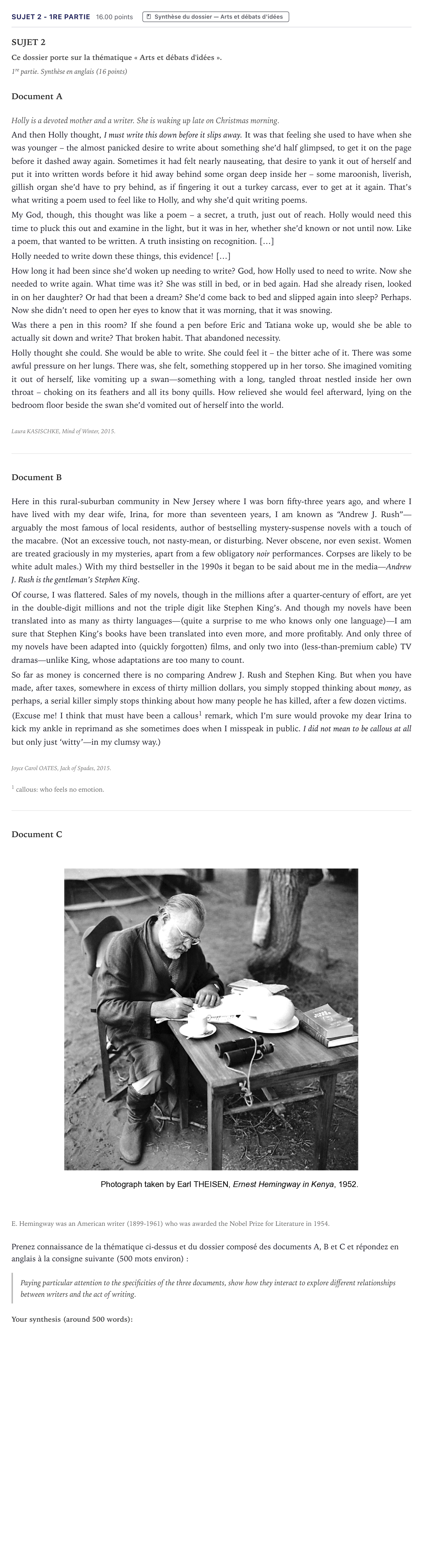
E. Hemingway was an American writer (1899-1961) who was awarded the Nobel Prize for Literature in 1954.
Prenez connaissance de la thématique ci-dessus et du dossier composé des documents A, B et C et répondez en anglais à la consigne suivante (500 mots environ):
Paying particular attention to the specificities of the three documents, show how they interact to explore different relationships between writers and the act of writing.
Corrigé
Corrigé proposé par AprenAI (non officiel)
Paying particular attention to the specificities of the three documents, show how they interact to explore different relationships between writers and the act of writing.
Réponse : The act of writing is not only a craft or a profession: it can also be a deeply psychological, physical and social experience. This dossier, linked to the theme "Arts and the Debate of Ideas", brings together an excerpt from Laura Kasischke's novel Mind of Winter (2015), an excerpt from Joyce Carol Oates's Jack of Spades (2015) and a 1952 photograph of Ernest Hemingway in Kenya by Earl Theisen. Together, these documents show that the relationship between writers and writing can range from visceral compulsion to commercial success and to absorbed, disciplined work. First, writing can be experienced as an uncontrollable, bodily need. In Document A, Holly, a mother who stopped writing poems, wakes up on Christmas morning with an urgent desire to write something down "before it slips away". Kasischke uses violent organic imagery ("nauseating", "some maroonish, liverish, gillish organ", "vomiting up a swan") to show that inspiration lies deep inside the body and must be painfully extracted. Writing is a "truth insisting on recognition", a "necessity" that she had abandoned. It is private and fragile: she wonders whether she will find a pen before her family wakes up. It is also liberating, since she imagines how "relieved" she would feel afterwards. In sharp contrast, Document B presents writing as a successful career and a marketable product. The first-person narrator, Andrew J. Rush, a bestselling mystery writer, never mentions inspiration or suffering. Instead, he measures his work through sales ("double-digit millions"), translations, adaptations and money ("in excess of thirty million dollars"). His fiction is carefully controlled: "a touch of the macabre", but "never obscene". He proudly accepts the label "the gentleman's Stephen King" while constantly comparing himself to his more famous rival. His tasteless comparison between a rich author and a serial killer, followed by an embarrassed apology, reveals a self-conscious, slightly ironic and perhaps disturbing persona. For Rush, writing is above all a source of public image, status and profit. Finally, Document C offers a visual image of writing as a concentrated, almost ritual activity rooted in lived experience. Hemingway sits at a simple wooden table outdoors, near a tent, in Kenya. He is bent over his papers, pen in hand, totally absorbed. The binoculars and the books on the table link writing to adventure, observation and reading. Unlike Holly, who struggles to find the time and the means to write, and unlike Rush, who talks about his career rather than his work, Hemingway is shown actually writing. The image also contributes to the myth of the adventurous writer, later crowned by the Nobel Prize. To conclude, the three documents interact to offer complementary views of literary creation. Kasischke presents writing as an intimate, painful but vital urge. Oates satirises the writer who has turned literature into a brand and a commodity. Theisen's photograph celebrates the writer as a disciplined craftsman whose work is nourished by experience. Together, they suggest that writing can be a personal necessity, a profession or a way of life, and that the writer's identity is shaped by his or her relationship to the act of writing itself.
L’explication pas à pas, faite avec l’IA, est réservée aux membres Premium. Premium
Résous-le ici : correction automatique, indices et corrigé détaillé.
‹ Sujet 1 - Partie 1 · Métropole remplacement 2024 · Sujet 1 - 1re partie : Synthèse · Métropole 2022 ›