Aufgabe HT 1 - 1 · Abitur NRW Sozialwissenschaften GK · Haupttermin · bilingual Englisch 2022
Thema: Wirtschaftspolitische Ziele, Konjunktur und Wohlstandsmessung · Aus der Prüfung GK · Haupttermin · bilingual Englisch (2022)
Aufgabenstellung
Christine Lagarde
Monetary policy during an atypical recovery [...]
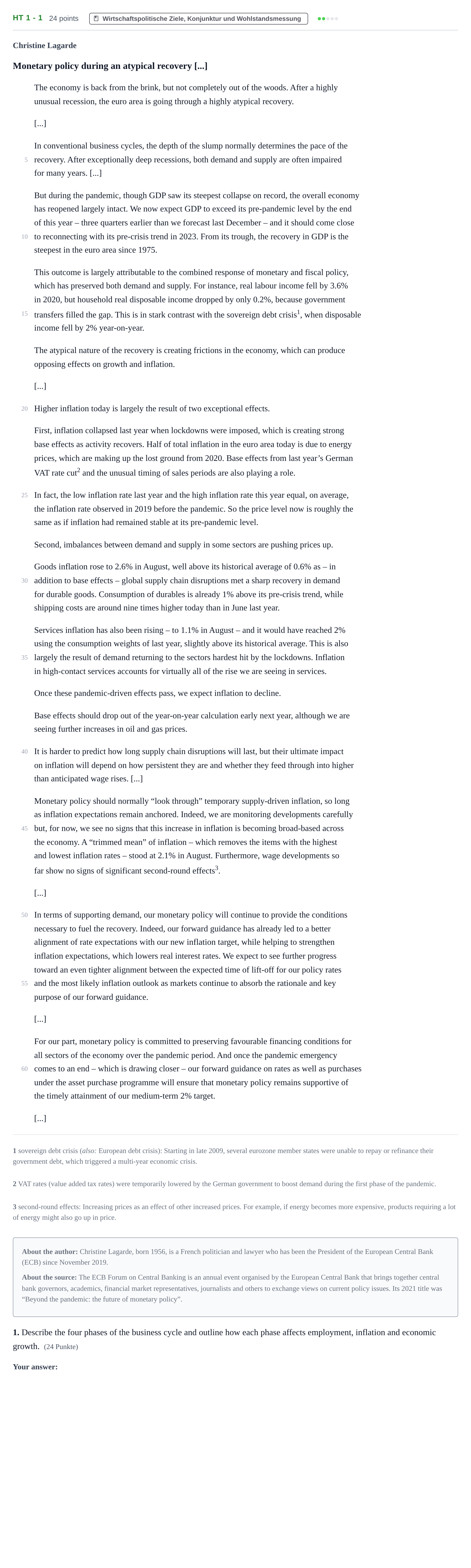
The economy is back from the brink, but not completely out of the woods. After a highly
unusual recession, the euro area is going through a highly atypical recovery.
[...]
In conventional business cycles, the depth of the slump normally determines the pace of the
5 recovery. After exceptionally deep recessions, both demand and supply are often impaired
for many years. [...]
But during the pandemic, though GDP saw its steepest collapse on record, the overall economy
has reopened largely intact. We now expect GDP to exceed its pre-pandemic level by the end
of this year – three quarters earlier than we forecast last December – and it should come close
10 to reconnecting with its pre-crisis trend in 2023. From its trough, the recovery in GDP is the
steepest in the euro area since 1975.
This outcome is largely attributable to the combined response of monetary and fiscal policy,
which has preserved both demand and supply. For instance, real labour income fell by 3.6%
in 2020, but household real disposable income dropped by only 0.2%, because government
15 transfers filled the gap. This is in stark contrast with the sovereign debt crisis 1, when disposable
income fell by 2% year-on-year.
The atypical nature of the recovery is creating frictions in the economy, which can produce
opposing effects on growth and inflation.
[...]
20 Higher inflation today is largely the result of two exceptional effects.
First, inflation collapsed last year when lockdowns were imposed, which is creating strong
base effects as activity recovers. Half of total inflation in the euro area today is due to energy
prices, which are making up the lost ground from 2020. Base effects from last year’s German
VAT rate cut 2 and the unusual timing of sales periods are also playing a role.
25 In fact, the low inflation rate last year and the high inflation rate this year equal, on average,
the inflation rate observed in 2019 before the pandemic. So the price level now is roughly the
same as if inflation had remained stable at its pre-pandemic level.
Second, imbalances between demand and supply in some sectors are pushing prices up.
Goods inflation rose to 2.6% in August, well above its historical average of 0.6% as – in
30 addition to base effects – global supply chain disruptions met a sharp recovery in demand
for durable goods. Consumption of durables is already 1% above its pre-crisis trend, while
shipping costs are around nine times higher today than in June last year.
Services inflation has also been rising – to 1.1% in August – and it would have reached 2%
using the consumption weights of last year, slightly above its historical average. This is also
35 largely the result of demand returning to the sectors hardest hit by the lockdowns. Inflation
in high-contact services accounts for virtually all of the rise we are seeing in services.
Once these pandemic-driven effects pass, we expect inflation to decline.
Base effects should drop out of the year-on-year calculation early next year, although we are
seeing further increases in oil and gas prices.
40 It is harder to predict how long supply chain disruptions will last, but their ultimate impact
on inflation will depend on how persistent they are and whether they feed through into higher
than anticipated wage rises. [...]
Monetary policy should normally “look through” temporary supply-driven inflation, so long
as inflation expectations remain anchored. Indeed, we are monitoring developments carefully
45 but, for now, we see no signs that this increase in inflation is becoming broad-based across
the economy. A “trimmed mean” of inflation – which removes the items with the highest
and lowest inflation rates – stood at 2.1% in August. Furthermore, wage developments so
far show no signs of significant second-round effects 3.
[...]
50 In terms of supporting demand, our monetary policy will continue to provide the conditions
necessary to fuel the recovery. Indeed, our forward guidance has already led to a better
alignment of rate expectations with our new inflation target, while helping to strengthen
inflation expectations, which lowers real interest rates. We expect to see further progress
toward an even tighter alignment between the expected time of lift-off for our policy rates
55 and the most likely inflation outlook as markets continue to absorb the rationale and key
purpose of our forward guidance.
[...]
For our part, monetary policy is committed to preserving favourable financing conditions for
all sectors of the economy over the pandemic period. And once the pandemic emergency
60 comes to an end – which is drawing closer – our forward guidance on rates as well as purchases
under the asset purchase programme will ensure that monetary policy remains supportive of
the timely attainment of our medium-term 2% target.
[...]
1 sovereign debt crisis ( also: European debt crisis): Starting in late 2009, several eurozone member states were unable to repay or refinance their government debt, which triggered a multi-year economic crisis.
2 VAT rates (value added tax rates) were temporarily lowered by the German government to boost demand during the first phase of the pandemic.
3 second-round effects: Increasing prices as an effect of other increased prices. For example, if energy becomes more expensive, products requiring a lot of energy might also go up in price.
About the author: Christine Lagarde, born 1956, is a French politician and lawyer who has been the President of the European Central Bank (ECB) since November 2019.
About the source: The ECB Forum on Central Banking is an annual event organised by the European Central Bank that brings together central bank governors, academics, financial market representatives, journalists and others to exchange views on current policy issues. Its 2021 title was “Beyond the pandemic: the future of monetary policy”.
1. Describe the four phases of the business cycle and outline how each phase affects employment, inflation and economic growth. (24 Punkte)
Lösung
Nach den offiziellen Korrekturhinweisen
1. Describe the four phases of the business cycle and outline how each phase affects employment, inflation and economic growth. (24 Punkte)
Lösung: The four phases of the business cycle and their characteristics regarding economic growth, inflation, and employment: 1. Expansion / Upswing (Aufschwung): - Economic growth: GDP and its growth rate increase due to more optimistic expectations, rising investment, and growing demand. - Inflation (Price level): Low or moderate rate of increase at first, as unused production capacities are being activated. - Employment: Employment rises, meaning unemployment falls (potentially with a slight time lag following increasing production). 2. Boom / Peak (Hochkonjunktur): - Economic growth: GDP continues to rise, but often at a slower pace due to increasing capacity utilization reaching its limits. - Inflation (Price level): Rises sharply as demand exceeds supply and capacities are fully utilized (bottlenecks occur). - Employment: Rises further, typically reaching full employment (production increases can no longer rely on unutilized capacity). 3. Recession / Downswing (Abschwung): - Economic growth: The GDP growth rate declines due to deteriorating business outlook, rising labor and production costs, and falling demand. - Inflation (Price level): Growth rate of the price level decreases as the excess demand ends and supply catches up or exceeds demand. - Employment: Employment falls, resulting in rising unemployment due to a lack of orders and cutbacks in production. 4. Trough / Depression / Crisis (Konjunkturtief): - Economic growth: The lowest point of GDP growth is reached; in severe recessions, negative growth (contraction) occurs due to persistent pessimism and weak demand. - Inflation (Price level): Constant or falling prices, carrying the risk of deflation as demand remains below supply and inventories are high. - Employment: Falls further, with unemployment reaching a peak as production and capacity utilization hit their minimum.
Die ausführliche Erklärung Schritt für Schritt (mit KI) gibt es mit Premium. Premium
Löse sie direkt hier: automatische Korrektur, Hinweise und Lösung Schritt für Schritt.
‹ Aufgabe HT 1 - Wirtschaftspolitische Ziele · GK · Haupttermin 2022 · Aufgabe HT 1 - Wirtschaftspolitische Ziele · GK · Haupttermin · Wirtschaft 2022 ›
Mehr Aufgaben zu Wirtschaftspolitische Ziele, Konjunktur und Wohlstandsmessung
- Aufgabe 1 (HT 1) - Teilaufgaben 1 und 2 · LK · Haupttermin 2023
- Aufgabe HT 1 - Aufgabe 1 · LK · Haupttermin · Wirtschaft 2023
- Aufgabe HT 1 - Aufgabe 2 · LK · Haupttermin · Wirtschaft 2023
- Aufgabe NT 3 - 1 · LK · Nachtermin · Wirtschaft 2023
- Aufgabe HT 1 - Wirtschaftspolitische Ziele · GK · Haupttermin 2022
- Aufgabe HT 1 - Wirtschaftspolitische Ziele · GK · Haupttermin · Wirtschaft 2022
- Aufgabe HT 2 - Wohlstandsmessung · GK · Haupttermin · Wirtschaft 2022
- Aufgabe NT 1 - Wirtschaftspolitische Ziele, Konjunktur un… · GK · Nachtermin 2022
- Aufgabe 1 - Wohlstandsmessung · GK · Nachtermin · Wirtschaft 2022
- Aufgabe 2 - Konjunktur und wirtschaftspolitische… · GK · Nachtermin · Wirtschaft 2022