Aufgabe HT 3 - Teilaufgabe 1.b · Abitur NRW Sozialwissenschaften GK · Haupttermin · bilingual Englisch 2023
Thema: Wirtschaftspolitische Konzeptionen, Staatsverschuldung und Fiskalpolitik · Aus der Prüfung GK · Haupttermin · bilingual Englisch (2023)
Aufgabenstellung
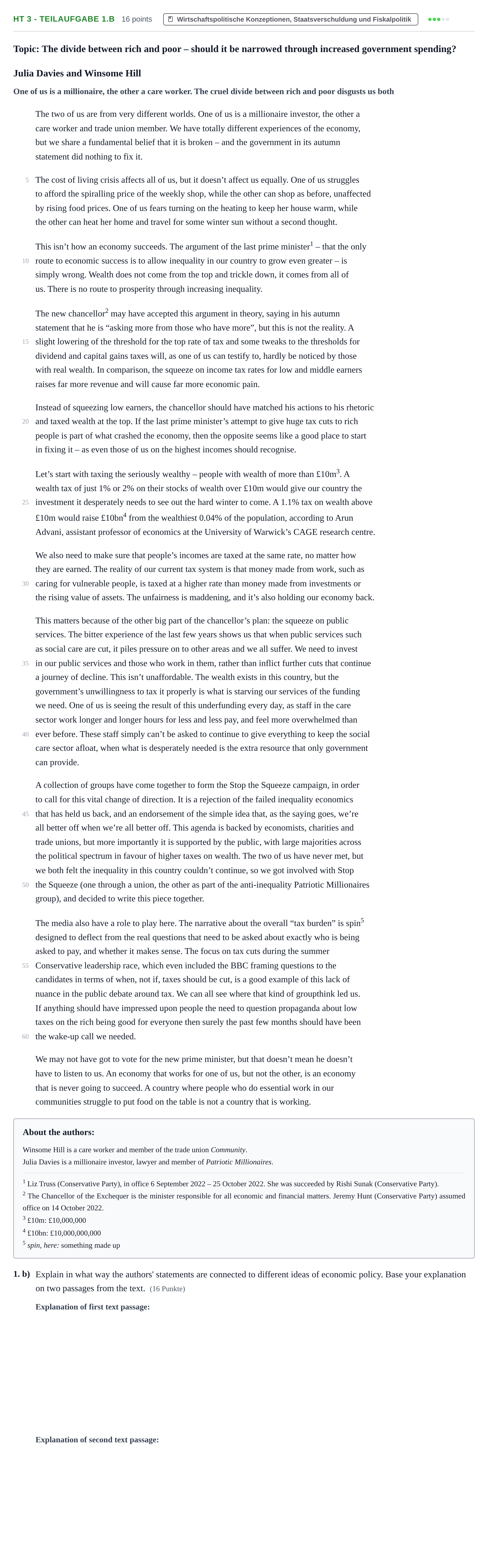
Topic: The divide between rich and poor – should it be narrowed through increased government spending?
Julia Davies and Winsome Hill
One of us is a millionaire, the other a care worker. The cruel divide between rich and poor disgusts us both
The two of us are from very different worlds. One of us is a millionaire investor, the other a
care worker and trade union member. We have totally different experiences of the economy,
but we share a fundamental belief that it is broken – and the government in its autumn
statement did nothing to fix it.
5 The cost of living crisis affects all of us, but it doesn’t affect us equally. One of us struggles
to afford the spiralling price of the weekly shop, while the other can shop as before, unaffected
by rising food prices. One of us fears turning on the heating to keep her house warm, while
the other can heat her home and travel for some winter sun without a second thought.
This isn’t how an economy succeeds. The argument of the last prime minister 1 – that the only
10 route to economic success is to allow inequality in our country to grow even greater – is
simply wrong. Wealth does not come from the top and trickle down, it comes from all of
us. There is no route to prosperity through increasing inequality.
The new chancellor 2 may have accepted this argument in theory, saying in his autumn
statement that he is “asking more from those who have more”, but this is not the reality. A
15 slight lowering of the threshold for the top rate of tax and some tweaks to the thresholds for
dividend and capital gains taxes will, as one of us can testify to, hardly be noticed by those
with real wealth. In comparison, the squeeze on income tax rates for low and middle earners
raises far more revenue and will cause far more economic pain.
Instead of squeezing low earners, the chancellor should have matched his actions to his rhetoric
20 and taxed wealth at the top. If the last prime minister’s attempt to give huge tax cuts to rich
people is part of what crashed the economy, then the opposite seems like a good place to start
in fixing it – as even those of us on the highest incomes should recognise.
Let’s start with taxing the seriously wealthy – people with wealth of more than £10m 3. A
wealth tax of just 1% or 2% on their stocks of wealth over £10m would give our country the
25 investment it desperately needs to see out the hard winter to come. A 1.1% tax on wealth above
£10m would raise £10bn 4 from the wealthiest 0.04% of the population, according to Arun
Advani, assistant professor of economics at the University of Warwick’s CAGE research centre.
We also need to make sure that people’s incomes are taxed at the same rate, no matter how
they are earned. The reality of our current tax system is that money made from work, such as
30 caring for vulnerable people, is taxed at a higher rate than money made from investments or
the rising value of assets. The unfairness is maddening, and it’s also holding our economy back.
This matters because of the other big part of the chancellor’s plan: the squeeze on public
services. The bitter experience of the last few years shows us that when public services such
as social care are cut, it piles pressure on to other areas and we all suffer. We need to invest
35 in our public services and those who work in them, rather than inflict further cuts that continue
a journey of decline. This isn’t unaffordable. The wealth exists in this country, but the
government’s unwillingness to tax it properly is what is starving our services of the funding
we need. One of us is seeing the result of this underfunding every day, as staff in the care
sector work longer and longer hours for less and less pay, and feel more overwhelmed than
40 ever before. These staff simply can’t be asked to continue to give everything to keep the social
care sector afloat, when what is desperately needed is the extra resource that only government
can provide.
A collection of groups have come together to form the Stop the Squeeze campaign, in order
to call for this vital change of direction. It is a rejection of the failed inequality economics
45 that has held us back, and an endorsement of the simple idea that, as the saying goes, we’re
all better off when we’re all better off. This agenda is backed by economists, charities and
trade unions, but more importantly it is supported by the public, with large majorities across
the political spectrum in favour of higher taxes on wealth. The two of us have never met, but
we both felt the inequality in this country couldn’t continue, so we got involved with Stop
50 the Squeeze (one through a union, the other as part of the anti-inequality Patriotic Millionaires
group), and decided to write this piece together.
The media also have a role to play here. The narrative about the overall “tax burden” is spin 5
designed to deflect from the real questions that need to be asked about exactly who is being
asked to pay, and whether it makes sense. The focus on tax cuts during the summer
55 Conservative leadership race, which even included the BBC framing questions to the
candidates in terms of when, not if, taxes should be cut, is a good example of this lack of
nuance in the public debate around tax. We can all see where that kind of groupthink led us.
If anything should have impressed upon people the need to question propaganda about low
taxes on the rich being good for everyone then surely the past few months should have been
60 the wake-up call we needed.
We may not have got to vote for the new prime minister, but that doesn’t mean he doesn’t
have to listen to us. An economy that works for one of us, but not the other, is an economy
that is never going to succeed. A country where people who do essential work in our
communities struggle to put food on the table is not a country that is working.
About the authors:
Winsome Hill is a care worker and member of the trade union Community.
Julia Davies is a millionaire investor, lawyer and member of Patriotic Millionaires.
1 Liz Truss (Conservative Party), in office 6 September 2022 – 25 October 2022. She was succeeded by Rishi Sunak (Conservative Party).
2 The Chancellor of the Exchequer is the minister responsible for all economic and financial matters. Jeremy Hunt (Conservative Party) assumed office on 14 October 2022.
3 £10m: £10,000,000
4 £10bn: £10,000,000,000
5 spin, here: something made up
1. b)
Explain in what way the authors' statements are connected to different ideas of economic policy. Base your explanation on two passages from the text. (16 Punkte)
Lösung
Nach den offiziellen Korrekturhinweisen
1. b) Explain in what way the authors' statements are connected to different ideas of economic policy. Base your explanation on two passages from the text (First text passage).
Lösung: Explanation linking a selected text passage to economic policy conceptions (demand-side economics or supply-side/trickle-down economics).
1. b) Explain in what way the authors' statements are connected to different ideas of economic policy. Base your explanation on two passages from the text (Second text passage).
Lösung: Explanation linking a second text passage to economic policy conceptions (demand-side economics or supply-side/trickle-down economics).
Die ausführliche Erklärung Schritt für Schritt (mit KI) gibt es mit Premium. Premium
Löse sie direkt hier: automatische Korrektur, Hinweise und Lösung Schritt für Schritt.
‹ Aufgabe HT 1 - Teilaufgaben 2 und 3 · GK · Haupttermin · bilingual Englisch 2023 · Aufgabe HT 1 - Wirtschaftspolitische Konzeptionen · GK · Haupttermin · Wirtschaft 2023 ›
Mehr Aufgaben zu Wirtschaftspolitische Konzeptionen, Staatsverschuldung und Fiskalpolitik
- Aufgabe SW GK HT 1 - Wirtschaftspolitik · GK · Haupttermin 2023
- Aufgabe HT 1 - Teilaufgaben 2 und 3 · GK · Haupttermin · bilingual Englisch 2023
- Aufgabe HT 1 - Wirtschaftspolitische Konzeptionen · GK · Haupttermin · Wirtschaft 2023
- Aufgabe 1 · GK · Nachtermin 2023
- Aufgabe 1 (HT 1) - Teilaufgabe 3 · LK · Haupttermin 2023
- Aufgabe NT 3 · LK · Nachtermin · Wirtschaft 2023
- Aufgabe HT 1 - Staatsverschuldung und Fiskalpolitik · GK · Haupttermin 2022
- Aufgabe HT 1 - 2 · GK · Haupttermin · bilingual Englisch 2022
- Aufgabe HT 1 - Staatsverschuldung und Fiskalpolitik · GK · Haupttermin · Wirtschaft 2022
- Aufgabe 2 - Wirtschaftspolitische Konzeptionen · GK · Nachtermin · Wirtschaft 2022