Aufgabe NT 2 - Aufgabe 4 · Abitur NRW Englisch LK · Nachtermin · Weiterbildungskolleg 2023
Thema: Sprachmittlung Deutsch → Englisch (Mediation) · Aus der Prüfung LK · Nachtermin · Weiterbildungskolleg (2023)
Aufgabenstellung
Klausurteil B: Sprachmittlung isoliert
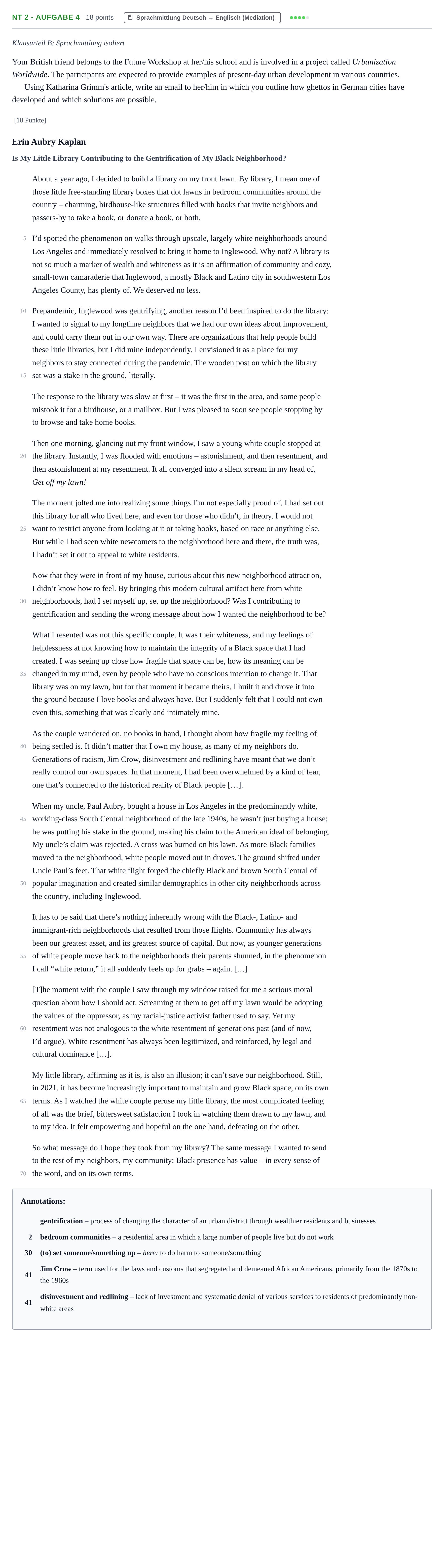
Your British friend belongs to the Future Workshop at her/his school and is involved in a project called Urbanization Worldwide. The participants are expected to provide examples of present-day urban development in various countries.
Using Katharina Grimm's article, write an email to her/him in which you outline how ghettos in German cities have developed and which solutions are possible.
[18 Punkte]
Erin Aubry Kaplan
Is My Little Library Contributing to the Gentrification of My Black Neighborhood?
About a year ago, I decided to build a library on my front lawn. By library, I mean one of
those little free-standing library boxes that dot lawns in bedroom communities around the
country – charming, birdhouse-like structures filled with books that invite neighbors and
passers-by to take a book, or donate a book, or both.
5 I’d spotted the phenomenon on walks through upscale, largely white neighborhoods around
Los Angeles and immediately resolved to bring it home to Inglewood. Why not? A library is
not so much a marker of wealth and whiteness as it is an affirmation of community and cozy,
small-town camaraderie that Inglewood, a mostly Black and Latino city in southwestern Los
Angeles County, has plenty of. We deserved no less.
10 Prepandemic, Inglewood was gentrifying, another reason I’d been inspired to do the library:
I wanted to signal to my longtime neighbors that we had our own ideas about improvement,
and could carry them out in our own way. There are organizations that help people build
these little libraries, but I did mine independently. I envisioned it as a place for my
neighbors to stay connected during the pandemic. The wooden post on which the library
15 sat was a stake in the ground, literally.
The response to the library was slow at first – it was the first in the area, and some people
mistook it for a birdhouse, or a mailbox. But I was pleased to soon see people stopping by
to browse and take home books.
Then one morning, glancing out my front window, I saw a young white couple stopped at
20 the library. Instantly, I was flooded with emotions – astonishment, and then resentment, and
then astonishment at my resentment. It all converged into a silent scream in my head of,
Get off my lawn!
The moment jolted me into realizing some things I’m not especially proud of. I had set out
this library for all who lived here, and even for those who didn’t, in theory. I would not
25 want to restrict anyone from looking at it or taking books, based on race or anything else.
But while I had seen white newcomers to the neighborhood here and there, the truth was,
I hadn’t set it out to appeal to white residents.
Now that they were in front of my house, curious about this new neighborhood attraction,
I didn’t know how to feel. By bringing this modern cultural artifact here from white
30 neighborhoods, had I set myself up, set up the neighborhood? Was I contributing to
gentrification and sending the wrong message about how I wanted the neighborhood to be?
What I resented was not this specific couple. It was their whiteness, and my feelings of
helplessness at not knowing how to maintain the integrity of a Black space that I had
created. I was seeing up close how fragile that space can be, how its meaning can be
35 changed in my mind, even by people who have no conscious intention to change it. That
library was on my lawn, but for that moment it became theirs. I built it and drove it into
the ground because I love books and always have. But I suddenly felt that I could not own
even this, something that was clearly and intimately mine.
As the couple wandered on, no books in hand, I thought about how fragile my feeling of
40 being settled is. It didn’t matter that I own my house, as many of my neighbors do.
Generations of racism, Jim Crow, disinvestment and redlining have meant that we don’t
really control our own spaces. In that moment, I had been overwhelmed by a kind of fear,
one that’s connected to the historical reality of Black people […].
When my uncle, Paul Aubry, bought a house in Los Angeles in the predominantly white,
45 working-class South Central neighborhood of the late 1940s, he wasn’t just buying a house;
he was putting his stake in the ground, making his claim to the American ideal of belonging.
My uncle’s claim was rejected. A cross was burned on his lawn. As more Black families
moved to the neighborhood, white people moved out in droves. The ground shifted under
Uncle Paul’s feet. That white flight forged the chiefly Black and brown South Central of
50 popular imagination and created similar demographics in other city neighborhoods across
the country, including Inglewood.
It has to be said that there’s nothing inherently wrong with the Black-, Latino- and
immigrant-rich neighborhoods that resulted from those flights. Community has always
been our greatest asset, and its greatest source of capital. But now, as younger generations
55 of white people move back to the neighborhoods their parents shunned, in the phenomenon
I call “white return,” it all suddenly feels up for grabs – again. […]
[T]he moment with the couple I saw through my window raised for me a serious moral
question about how I should act. Screaming at them to get off my lawn would be adopting
the values of the oppressor, as my racial-justice activist father used to say. Yet my
60 resentment was not analogous to the white resentment of generations past (and of now,
I’d argue). White resentment has always been legitimized, and reinforced, by legal and
cultural dominance […].
My little library, affirming as it is, is also an illusion; it can’t save our neighborhood. Still,
in 2021, it has become increasingly important to maintain and grow Black space, on its own
65 terms. As I watched the white couple peruse my little library, the most complicated feeling
of all was the brief, bittersweet satisfaction I took in watching them drawn to my lawn, and
to my idea. It felt empowering and hopeful on the one hand, defeating on the other.
So what message do I hope they took from my library? The same message I wanted to send
to the rest of my neighbors, my community: Black presence has value – in every sense of
70 the word, and on its own terms.
Annotations:
· gentrification – process of changing the character of an urban district through wealthier residents and businesses
2 · bedroom communities – a residential area in which a large number of people live but do not work
30 · (to) set someone/something up – here: to do harm to someone/something
41 · Jim Crow – term used for the laws and customs that segregated and demeaned African Americans, primarily from the 1870s to the 1960s
41 · disinvestment and redlining – lack of investment and systematic denial of various services to residents of predominantly non-white areas
Lösung
Nach den offiziellen Korrekturhinweisen
Using Katharina Grimm's article, write an email to her/him in which you outline how ghettos in German cities have developed and which solutions are possible.
Lösung: Eine situations- und adressatengerechte E-Mail, die die sozialräumliche Entwicklung in deutschen Großstädten darstellt (Zunahme räumlicher Ballung einkommensschwacher Gruppen; verstärkte Gettobildung v.a. im Osten Deutschlands, mit Ausnahmen wie Magdeburg und Dresden; Bildung sozialer Brennpunkte in Hochhausvierteln am Stadtrand nach der Wiedervereinigung; Entstehung teuren, attraktiven Wohnraums durch Sanierung in Altstadtvierteln; Bau von Sozialwohnungen in bereits einkommensschwachen Wohngegenden, was die Segregation verstärkt) sowie Lösungsvorschläge nennt (Schaffung von mehr Sozialwohnungen auch in beliebten, teuren Wohnlagen statt nur in armen Vierteln; gezielte Förderung von Bildungseinrichtungen in von Armut betroffenen Gebieten, v.a. für Kinder und Jugendliche).
Die ausführliche Erklärung Schritt für Schritt (mit KI) gibt es mit Premium. Premium
Löse sie direkt hier: automatische Korrektur, Hinweise und Lösung Schritt für Schritt.
‹ Aufgabe NT 1 - Aufgabe 4 · LK · Nachtermin · Weiterbildungskolleg 2023 · Aufgabe 1 · LK · Sielmann: Berliner Literaturprojekt 2023 ›
Mehr Aufgaben zu Sprachmittlung Deutsch → Englisch (Mediation)
- Aufgabe HT 2 - Task 4 · LK · Haupttermin · Weiterbildungskolleg 2023
- Aufgabe · LK · Ludwig: Der Spargel kommt per Laste 2023
- Aufgabe NT 1 - Aufgabe 4 · LK · Nachtermin 2023
- Aufgabe NT 2 - Aufgabe 4 · LK · Nachtermin 2023
- Aufgabe NT 1 - Aufgabe 4 · LK · Nachtermin · Weiterbildungskolleg 2023
- Aufgabe 1 · LK · Sielmann: Berliner Literaturprojekt 2023
- Aufgabe 1 · LK · von Leszczynski: Fahrradhelme, Lamp 2023
- Aufgabe 1 · GK · Grüling: Der Vorlesefriseur 2022
- Aufgabe 1 Aufgabe · GK · Gutensohn: „Fast niemand zieht mehr 2022
- Aufgabe 1 · GK · Hartmann-Wolff: Wie das Leben leich 2022