Aufgabe HT 1 - Aufgabe 4 · Abitur NRW Englisch LK · Haupttermin 2023
Thema: Sprachmittlung Deutsch → Englisch (Mediation) · Aus der Prüfung LK · Haupttermin (2023)
Aufgabenstellung
Klausurteil B: Sprachmittlung isoliert
A friend of yours from Britain is researching projects that foster multicultural partnerships in the arts and wants to know about similar initiatives in Germany.
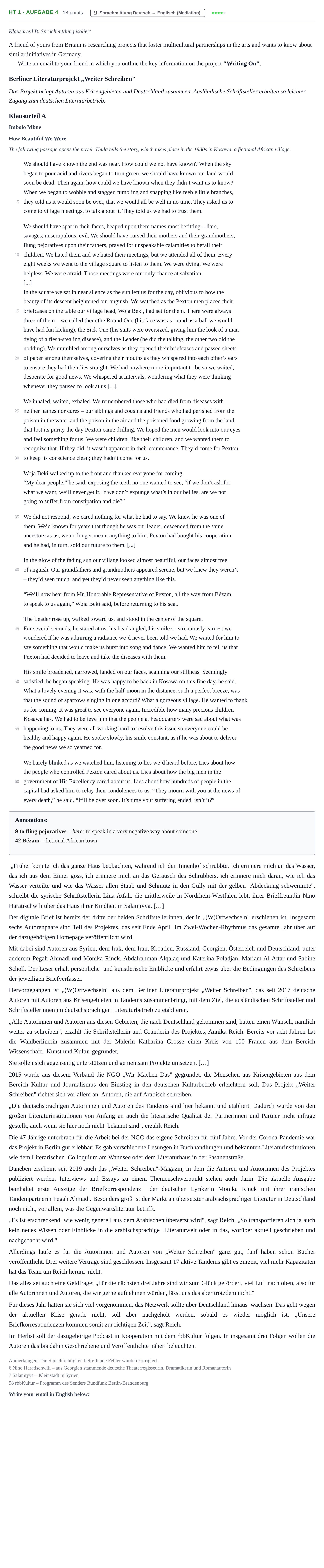
Write an email to your friend in which you outline the key information on the project "Writing On".
Berliner Literaturprojekt „Weiter Schreiben"
Das Projekt bringt Autoren aus Krisengebieten und Deutschland zusammen. Ausländische Schriftsteller erhalten so leichter Zugang zum deutschen Literaturbetrieb.
Klausurteil A
Imbolo Mbue
How Beautiful We Were
The following passage opens the novel. Thula tells the story, which takes place in the 1980s in Kosawa, a fictional African village.
We should have known the end was near. How could we not have known? When the sky
began to pour acid and rivers began to turn green, we should have known our land would
soon be dead. Then again, how could we have known when they didn’t want us to know?
When we began to wobble and stagger, tumbling and snapping like feeble little branches,
5 they told us it would soon be over, that we would all be well in no time. They asked us to
come to village meetings, to talk about it. They told us we had to trust them.
We should have spat in their faces, heaped upon them names most befitting – liars,
savages, unscrupulous, evil. We should have cursed their mothers and their grandmothers,
flung pejoratives upon their fathers, prayed for unspeakable calamities to befall their
10 children. We hated them and we hated their meetings, but we attended all of them. Every
eight weeks we went to the village square to listen to them. We were dying. We were
helpless. We were afraid. Those meetings were our only chance at salvation.
[...]
In the square we sat in near silence as the sun left us for the day, oblivious to how the
beauty of its descent heightened our anguish. We watched as the Pexton men placed their
15 briefcases on the table our village head, Woja Beki, had set for them. There were always
three of them – we called them the Round One (his face was as round as a ball we would
have had fun kicking), the Sick One (his suits were oversized, giving him the look of a man
dying of a flesh-stealing disease), and the Leader (he did the talking, the other two did the
nodding). We mumbled among ourselves as they opened their briefcases and passed sheets
20 of paper among themselves, covering their mouths as they whispered into each other’s ears
to ensure they had their lies straight. We had nowhere more important to be so we waited,
desperate for good news. We whispered at intervals, wondering what they were thinking
whenever they paused to look at us [...].
We inhaled, waited, exhaled. We remembered those who had died from diseases with
25 neither names nor cures – our siblings and cousins and friends who had perished from the
poison in the water and the poison in the air and the poisoned food growing from the land
that lost its purity the day Pexton came drilling. We hoped the men would look into our eyes
and feel something for us. We were children, like their children, and we wanted them to
recognize that. If they did, it wasn’t apparent in their countenance. They’d come for Pexton,
30 to keep its conscience clean; they hadn’t come for us.
Woja Beki walked up to the front and thanked everyone for coming.
“My dear people,” he said, exposing the teeth no one wanted to see, “if we don’t ask for
what we want, we’ll never get it. If we don’t expunge what’s in our bellies, are we not
going to suffer from constipation and die?”
35 We did not respond; we cared nothing for what he had to say. We knew he was one of
them. We’d known for years that though he was our leader, descended from the same
ancestors as us, we no longer meant anything to him. Pexton had bought his cooperation
and he had, in turn, sold our future to them. [...]
In the glow of the fading sun our village looked almost beautiful, our faces almost free
40 of anguish. Our grandfathers and grandmothers appeared serene, but we knew they weren’t
– they’d seen much, and yet they’d never seen anything like this.
“We’ll now hear from Mr. Honorable Representative of Pexton, all the way from Bézam
to speak to us again,” Woja Beki said, before returning to his seat.
The Leader rose up, walked toward us, and stood in the center of the square.
45 For several seconds, he stared at us, his head angled, his smile so strenuously earnest we
wondered if he was admiring a radiance we’d never been told we had. We waited for him to
say something that would make us burst into song and dance. We wanted him to tell us that
Pexton had decided to leave and take the diseases with them.
His smile broadened, narrowed, landed on our faces, scanning our stillness. Seemingly
50 satisfied, he began speaking. He was happy to be back in Kosawa on this fine day, he said.
What a lovely evening it was, with the half-moon in the distance, such a perfect breeze, was
that the sound of sparrows singing in one accord? What a gorgeous village. He wanted to thank
us for coming. It was great to see everyone again. Incredible how many precious children
Kosawa has. We had to believe him that the people at headquarters were sad about what was
55 happening to us. They were all working hard to resolve this issue so everyone could be
healthy and happy again. He spoke slowly, his smile constant, as if he was about to deliver
the good news we so yearned for.
We barely blinked as we watched him, listening to lies we’d heard before. Lies about how
the people who controlled Pexton cared about us. Lies about how the big men in the
60 government of His Excellency cared about us. Lies about how hundreds of people in the
capital had asked him to relay their condolences to us. “They mourn with you at the news of
every death,” he said. “It’ll be over soon. It’s time your suffering ended, isn’t it?”
Annotations:
9 to fling pejoratives – here: to speak in a very negative way about someone
42 Bézam – fictional African town
1 „Früher konnte ich das ganze Haus beobachten, während ich den Innenhof schrubbte. Ich erinnere mich an das Wasser, das ich aus dem Eimer goss, ich erinnere mich an das Geräusch des Schrubbers, ich erinnere mich daran, wie ich das Wasser verteilte und wie das Wasser allen Staub und Schmutz in den Gully mit der gelben 5 Abdeckung schwemmte", schreibt die syrische Schriftstellerin Lina Atfah, die mittlerweile in Nordrhein-Westfalen lebt, ihrer Brieffreundin Nino Haratischwili über das Haus ihrer Kindheit in Salamiyya. […]
Der digitale Brief ist bereits der dritte der beiden Schriftstellerinnen, der in „(W)Ortwechseln" erschienen ist. Insgesamt sechs Autorenpaare sind Teil des Projektes, das seit Ende April 10 im Zwei-Wochen-Rhythmus das gesamte Jahr über auf der dazugehörigen Homepage veröffentlicht wird.
Mit dabei sind Autoren aus Syrien, dem Irak, dem Iran, Kroatien, Russland, Georgien, Österreich und Deutschland, unter anderem Pegah Ahmadi und Monika Rinck, Abdalrahman Alqalaq und Katerina Poladjan, Mariam Al-Attar und Sabine Scholl. Der Leser erhält persönliche 15 und künstlerische Einblicke und erfährt etwas über die Bedingungen des Schreibens der jeweiligen Briefverfasser.
Hervorgegangen ist „(W)Ortwechseln" aus dem Berliner Literaturprojekt „Weiter Schreiben", das seit 2017 deutsche Autoren mit Autoren aus Krisengebieten in Tandems zusammenbringt, mit dem Ziel, die ausländischen Schriftsteller und Schriftstellerinnen im deutschsprachigen 20 Literaturbetrieb zu etablieren.
„Alle Autorinnen und Autoren aus diesen Gebieten, die nach Deutschland gekommen sind, hatten einen Wunsch, nämlich weiter zu schreiben", erzählt die Schriftstellerin und Gründerin des Projektes, Annika Reich. Bereits vor acht Jahren hat die Wahlberlinerin zusammen mit der Malerin Katharina Grosse einen Kreis von 100 Frauen aus dem Bereich Wissenschaft, 25 Kunst und Kultur gegründet.
Sie sollen sich gegenseitig unterstützen und gemeinsam Projekte umsetzen. […]
2015 wurde aus diesem Verband die NGO „Wir Machen Das" gegründet, die Menschen aus Krisengebieten aus dem Bereich Kultur und Journalismus den Einstieg in den deutschen Kulturbetrieb erleichtern soll. Das Projekt „Weiter Schreiben" richtet sich vor allem an 30 Autoren, die auf Arabisch schreiben.
„Die deutschsprachigen Autorinnen und Autoren des Tandems sind hier bekannt und etabliert. Dadurch wurde von den großen Literaturinstitutionen von Anfang an auch die literarische Qualität der Partnerinnen und Partner nicht infrage gestellt, auch wenn sie hier noch nicht 35 bekannt sind", erzählt Reich.
Die 47-Jährige unterbrach für die Arbeit bei der NGO das eigene Schreiben für fünf Jahre. Vor der Corona-Pandemie war das Projekt in Berlin gut erlebbar: Es gab verschiedene Lesungen in Buchhandlungen und bekannten Literaturinstitutionen wie dem Literarischen 40 Colloquium am Wannsee oder dem Literaturhaus in der Fasanenstraße.
Daneben erscheint seit 2019 auch das „Weiter Schreiben"-Magazin, in dem die Autoren und Autorinnen des Projektes publiziert werden. Interviews und Essays zu einem Themenschwerpunkt stehen auch darin. Die aktuelle Ausgabe beinhaltet erste Auszüge der Briefkorrespondenz 45 der deutschen Lyrikerin Monika Rinck mit ihrer iranischen Tandempartnerin Pegah Ahmadi. Besonders groß ist der Markt an übersetzter arabischsprachiger Literatur in Deutschland noch nicht, vor allem, was die Gegenwartsliteratur betrifft.
„Es ist erschreckend, wie wenig generell aus dem Arabischen übersetzt wird", sagt Reich. „So transportieren sich ja auch kein neues Wissen oder Einblicke in die arabischsprachige 50 Literaturwelt oder in das, worüber aktuell geschrieben und nachgedacht wird."
Allerdings laufe es für die Autorinnen und Autoren von „Weiter Schreiben" ganz gut, fünf haben schon Bücher veröffentlicht. Drei weitere Verträge sind geschlossen. Insgesamt 17 aktive Tandems gibt es zurzeit, viel mehr Kapazitäten hat das Team um Reich herum 50 nicht.
Das alles sei auch eine Geldfrage: „Für die nächsten drei Jahre sind wir zum Glück gefördert, viel Luft nach oben, also für alle Autorinnen und Autoren, die wir gerne aufnehmen würden, lässt uns das aber trotzdem nicht."
Für dieses Jahr hatten sie sich viel vorgenommen, das Netzwerk sollte über Deutschland hinaus 55 wachsen. Das geht wegen der aktuellen Krise gerade nicht, soll aber nachgeholt werden, sobald es wieder möglich ist. „Unsere Briefkorrespondenzen kommen somit zur richtigen Zeit", sagt Reich.
Im Herbst soll der dazugehörige Podcast in Kooperation mit dem rbbKultur folgen. In insgesamt drei Folgen wollen die Autoren das bis dahin Geschriebene und Veröffentlichte näher 60 beleuchten.
Anmerkungen: Die Sprachrichtigkeit betreffende Fehler wurden korrigiert.
6 Nino Haratischwili – aus Georgien stammende deutsche Theaterregisseurin, Dramatikerin und Romanautorin
7 Salamiyya – Kleinstadt in Syrien
58 rbbKultur – Programm des Senders Rundfunk Berlin-Brandenburg
Lösung
Nach den offiziellen Korrekturhinweisen
Write an email to your friend in which you outline the key information on the project "Writing On".
Lösung: An email to the British friend mediating the main aspects of the project "Writing On" ("Weiter Schreiben"), covering: context and initiation (founded in 2017 by Annika Reich / NGO "Wir Machen Das" to help authors from crisis regions access the German literary scene), tandem structure (pairing established German-speaking writers with immigrant/refugee writers, predominantly Arabic-speaking), key initiatives (digital letters in "(W)Ortwechseln", readings, the project magazine, upcoming podcast with rbbKultur), and current achievements/challenges (book contracts, funding limitations, plans for international expansion).
Write an email to your friend in which you outline the key information on the project "Writing On".
Lösung: Eine adressatengerechte E-Mail, die zusammenfassend wiedergibt: das Projekt "Weiter Schreiben" (seit einigen Jahren bestehendes literarisches Partnerprojekt in Berlin zwischen deutschen und ausländischen Schriftstellerinnen und Schriftstellern aus Krisengebieten); die Aktivitäten (Lesungen in Buchhandlungen und literarischen Einrichtungen, Publikation digitaler Briefe in "(W)Ortwechseln", Veröffentlichung unterschiedlicher Schreibprodukte in einem Magazin); die Ziele (Schaffen eines Forums für Schriftstellerinnen und Schriftsteller aus Krisenregionen; Erleichterung des Zugangs zum deutschen Literaturbetrieb für ausländische Autorinnen und Autoren durch Tandembildung mit bekannten deutschen Schriftstellerinnen und Schriftstellern; Vermitteln eines Einblicks in die persönlichen Lebens- und Arbeitsumstände sowie das kreative Schaffen der Teilnehmenden; Erhöhung des Bekanntheits- und Verbreitungsgrades zeitgenössischer arabischer Literatur auf dem deutschen Literaturmarkt; Ausweitung des Projektes auf andere Länder und andere mediale Kanäle).
Die ausführliche Erklärung Schritt für Schritt (mit KI) gibt es mit Premium. Premium
Löse sie direkt hier: automatische Korrektur, Hinweise und Lösung Schritt für Schritt.
‹ Aufgabe 1 · LK · Freudenberg: Von Sittenwächtern zu 2023 · Aufgabe HT 2 - Aufgabe 4 · LK · Haupttermin 2023 ›
Mehr Aufgaben zu Sprachmittlung Deutsch → Englisch (Mediation)
- Aufgabe 1 · GK · Hunger: Jugend. Macht. Politik 2023
- Aufgabe NT 1 - Task 4 · GK · Nachtermin · Weiterbildungskolleg 2023
- Aufgabe NT 2 - Task 4 · GK · Nachtermin · Weiterbildungskolleg 2023
- Aufgabe · GK · Stiftung Jugend forscht e. V.: Hist 2023
- Aufgabe 1 · LK · Freudenberg: Von Sittenwächtern zu 2023
- Aufgabe HT 2 - Aufgabe 4 · LK · Haupttermin 2023
- Aufgabe HT 1 - Task 4 · LK · Haupttermin · Weiterbildungskolleg 2023
- Aufgabe HT 2 - Task 4 · LK · Haupttermin · Weiterbildungskolleg 2023
- Aufgabe · LK · Ludwig: Der Spargel kommt per Laste 2023
- Aufgabe NT 1 - Aufgabe 4 · LK · Nachtermin 2023