Aufgabe Vorschlag A - Aufgaben 1 und 2 · Abitur Hessen Politik und Wirtschaft GK · bilingual Englisch 2022
Thema: Konjunktur und wirtschaftspolitische Konzeptionen · Aus der Prüfung GK · bilingual Englisch (2022)
Aufgabenstellung
Material
Christian Reiermann: Stimulus measures have helped German economy buck 1 the Corona Crisis (2020)
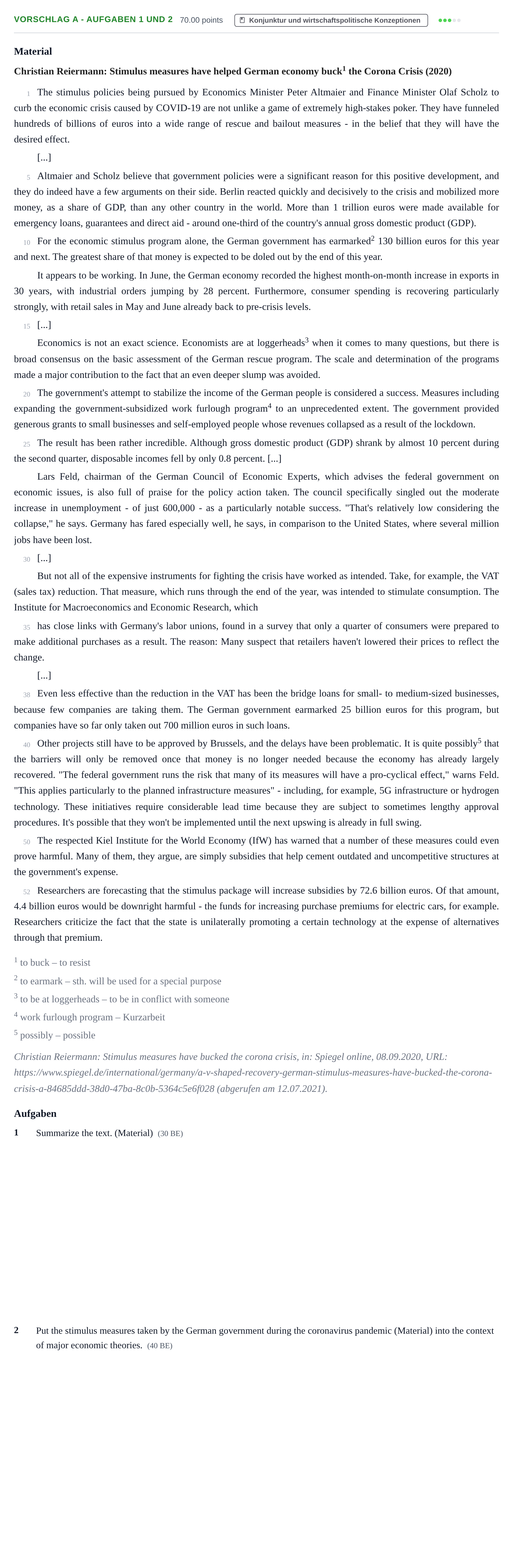
1 The stimulus policies being pursued by Economics Minister Peter Altmaier and Finance Minister Olaf Scholz to curb the economic crisis caused by COVID-19 are not unlike a game of extremely high-stakes poker. They have funneled hundreds of billions of euros into a wide range of rescue and bailout measures - in the belief that they will have the desired effect.
[...]
5 Altmaier and Scholz believe that government policies were a significant reason for this positive development, and they do indeed have a few arguments on their side. Berlin reacted quickly and decisively to the crisis and mobilized more money, as a share of GDP, than any other country in the world. More than 1 trillion euros were made available for emergency loans, guarantees and direct aid - around one-third of the country's annual gross domestic product (GDP).
10 For the economic stimulus program alone, the German government has earmarked 2 130 billion euros for this year and next. The greatest share of that money is expected to be doled out by the end of this year.
It appears to be working. In June, the German economy recorded the highest month-on-month increase in exports in 30 years, with industrial orders jumping by 28 percent. Furthermore, consumer spending is recovering particularly strongly, with retail sales in May and June already back to pre-crisis levels.
15 [...]
Economics is not an exact science. Economists are at loggerheads 3 when it comes to many questions, but there is broad consensus on the basic assessment of the German rescue program. The scale and determination of the programs made a major contribution to the fact that an even deeper slump was avoided.
20 The government's attempt to stabilize the income of the German people is considered a success. Measures including expanding the government-subsidized work furlough program 4 to an unprecedented extent. The government provided generous grants to small businesses and self-employed people whose revenues collapsed as a result of the lockdown.
25 The result has been rather incredible. Although gross domestic product (GDP) shrank by almost 10 percent during the second quarter, disposable incomes fell by only 0.8 percent. [...]
Lars Feld, chairman of the German Council of Economic Experts, which advises the federal government on economic issues, is also full of praise for the policy action taken. The council specifically singled out the moderate increase in unemployment - of just 600,000 - as a particularly notable success. "That's relatively low considering the collapse," he says. Germany has fared especially well, he says, in comparison to the United States, where several million jobs have been lost.
30 [...]
But not all of the expensive instruments for fighting the crisis have worked as intended. Take, for example, the VAT (sales tax) reduction. That measure, which runs through the end of the year, was intended to stimulate consumption. The Institute for Macroeconomics and Economic Research, which
35 has close links with Germany's labor unions, found in a survey that only a quarter of consumers were prepared to make additional purchases as a result. The reason: Many suspect that retailers haven't lowered their prices to reflect the change.
[...]
38 Even less effective than the reduction in the VAT has been the bridge loans for small- to medium-sized businesses, because few companies are taking them. The German government earmarked 25 billion euros for this program, but companies have so far only taken out 700 million euros in such loans.
40 Other projects still have to be approved by Brussels, and the delays have been problematic. It is quite possibly 5 that the barriers will only be removed once that money is no longer needed because the economy has already largely recovered. "The federal government runs the risk that many of its measures will have a pro-cyclical effect," warns Feld. "This applies particularly to the planned infrastructure measures" - including, for example, 5G infrastructure or hydrogen technology. These initiatives require considerable lead time because they are subject to sometimes lengthy approval procedures. It's possible that they won't be implemented until the next upswing is already in full swing.
50 The respected Kiel Institute for the World Economy (IfW) has warned that a number of these measures could even prove harmful. Many of them, they argue, are simply subsidies that help cement outdated and uncompetitive structures at the government's expense.
52 Researchers are forecasting that the stimulus package will increase subsidies by 72.6 billion euros. Of that amount, 4.4 billion euros would be downright harmful - the funds for increasing purchase premiums for electric cars, for example. Researchers criticize the fact that the state is unilaterally promoting a certain technology at the expense of alternatives through that premium.
1 to buck – to resist
2 to earmark – sth. will be used for a special purpose
3 to be at loggerheads – to be in conflict with someone
4 work furlough program – Kurzarbeit
5 possibly – possible
Christian Reiermann: Stimulus measures have bucked the corona crisis, in: Spiegel online, 08.09.2020, URL: https://www.spiegel.de/international/germany/a-v-shaped-recovery-german-stimulus-measures-have-bucked-the-corona-crisis-a-84685ddd-38d0-47ba-8c0b-5364c5e6f028 (abgerufen am 12.07.2021).
Aufgaben
1
Summarize the text. (Material)
(30 BE)
2
Put the stimulus measures taken by the German government during the coronavirus pandemic (Material) into the context of major economic theories.
(40 BE)
Lösung
Nach den offiziellen Korrekturhinweisen
1 Summarize the text. (Material) (30 BE)
Lösung: In einer Einleitung sollen Autor, Titel, Textsorte, Erscheinungsjahr, das Thema und ggf. der Adressat genannt werden: Der Autor Christian Reiermann beurteilt in seinem Kommentar „Stimulus measures have helped German economy buck the Corona Crisis“, der am 08.09.2020 auf Spiegel.de veröffentlicht wurde, die intendierten und eingetretenen Ergebnisse des Konjunkturpakets zur Abmilderung der Auswirkungen der Corona-Pandemie. - Wirtschaftsminister Altmaier und Finanzminister Scholz seien der Meinung, dass die Wirtschaftspolitik für die positive Entwicklung verantwortlich sei. - Für das Konjunkturpaket seien 130 Mrd. Euro bereitgestellt worden, was u. a. zu einem Anstieg der Konsumausgaben geführt habe. - Volkswirtschaftslehre sei keine exakte Wissenschaft, jedoch bestehe ein breiter Konsens, dass das Konjunkturprogramm einen großen Beitrag zur Vermeidung einer Krise beigetragen habe. - Der Ansatz, die Einkommen der deutschen Bevölkerung durch Kurzarbeit und Kreditangebote zu sichern, sei geglückt. - Die Resultate seien beeindruckend, da bei einem gesunkenen BIP von fast 10% das verfügbare Einkommen nur um 0,8% gefallen sei. - Die Senkung der Mehrwertsteuer habe lediglich bei einem Viertel der Verbraucher zu einem höheren Konsum geführt und sei vielfach überhaupt nicht an die Kunden weitergegeben worden. - Noch weniger erfolgreich seien Kredite für kleine und mittlere Unternehmen (KMUs) gewesen, welche kaum genutzt würden. - Weitere Projekte müssten erst in Brüssel genehmigt werden und könnten wirksam werden, wenn die Wirtschaft sich bereits wieder erholt habe. - Dadurch würden diese Maßnahmen pro-zyklisch wirken. - Das IfW warne zudem, dass wettbewerbsunfähige Strukturen durch Subventionen auf Kosten der Regierung aufrechterhalten würden.
2 Put the stimulus measures taken by the German government during the coronavirus pandemic (Material) into the context of major economic theories. (40 BE)
Lösung: Die nachfrageorientierte Wirtschaftspolitik (Keynesianismus) besagt, dass: - der Staat antizyklisch in den Wirtschaftskreislauf eingreifen soll, - Staatsausgaben (deficit spending) im Infrastrukturbereich erforderlich sein können, um kurzfristig Arbeitsplätze zu schaffen und Einkommen zu sichern, - dies wiederum die Konsumgüternachfrage steigert, was Investitionen der Unternehmen bewirken soll. U. a. folgende Elemente des Konjunkturprogramms sind nachfrageorientiert: - temporäre Mehrwertsteuerreduzierung, - Infrastrukturprogramme (z. B. 5G, Wasserstofftechnologien), - Kurzarbeitergeld, - temporäre Soforthilfe für Unternehmen, - Bürgschaften für Großunternehmen. Die angebotsorientierte Wirtschaftspolitik (Monetarismus/Neoklassik) besagt, dass: - das Angebot essentiell ist für wirtschaftlichen Wohlstand, - sich jedes Angebot seine Nachfrage selbst schafft (Saysches Theorem), - günstige Rahmenbedingungen für Unternehmen geschaffen werden müssen, - Steuern gesenkt, Reglementierungen abgeschafft und staatliche Eingriffe minimiert/privatisiert werden sollen. U. a. folgende Elemente sind (auch) angebotsorientiert: - temporäre Soforthilfe für Unternehmen (Liquiditätssicherung zur Produktionserhaltung), - Bürgschaften für Großunternehmen.
Die ausführliche Erklärung Schritt für Schritt (mit KI) gibt es mit Premium. Premium
Löse sie direkt hier: automatische Korrektur, Hinweise und Lösung Schritt für Schritt.
‹ Aufgabe Vorschlag C - Wirtschaftspolitische Konzeptionen… · GK 2022 · Aufgabe Vorschlag B - Aufgabe 3 · GK · bilingual Französisch 2022 ›
Mehr Aufgaben zu Konjunktur und wirtschaftspolitische Konzeptionen
- Aufgabe Vorschlag B - Konzeptionen und Konjunkturpolitik · GK 2022
- Aufgabe Vorschlag C - Wirtschaftspolitische Konzeptionen… · GK 2022
- Aufgabe Vorschlag B - Aufgabe 3 · GK · bilingual Französisch 2022
- Aufgabe Vorschlag C - Aufgabe 3 · GK · bilingual Französisch 2022
- Aufgabe Vorschlag B - Konjunktur und wirtschaftspolitisch… · LK 2022
- Aufgabe Vorschlag B - Aufgabe 1 · GK 2021
- Aufgabe Vorschlag B - Aufgabe 2 · GK 2021
- Aufgabe Vorschlag B - Aufgabe 4 · GK 2021
- Aufgabe Vorschlag B - Konjunktur und wirtschaftspolitisch… · GK · bilingual Englisch 2021
- Aufgabe Vorschlag B - Konjunktur und wirtschaftspolitisch… · LK 2021