Aufgabe Vorschlag B - Konjunktur und wirtschaftspolitisch… · Abitur Hessen Politik und Wirtschaft GK · bilingual Englisch 2021
Thema: Konjunktur und wirtschaftspolitische Konzeptionen · Aus der Prüfung GK · bilingual Englisch (2021)
Aufgabenstellung
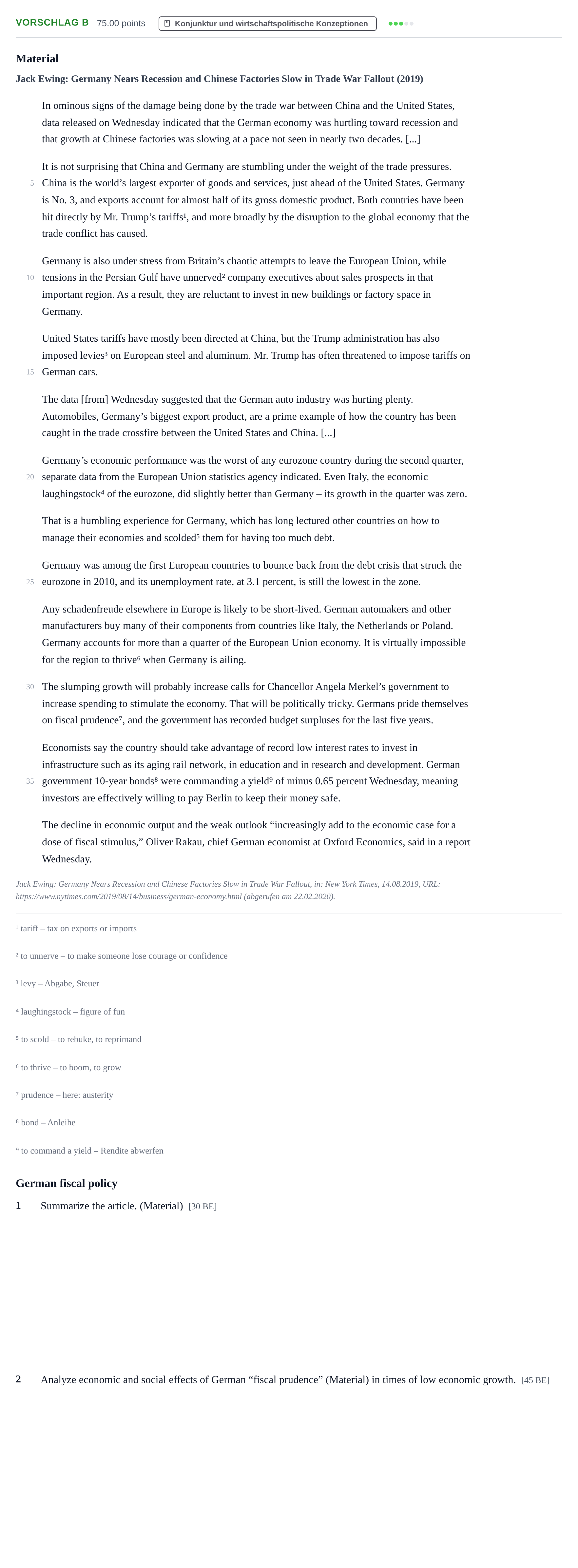
Material
Jack Ewing: Germany Nears Recession and Chinese Factories Slow in Trade War Fallout (2019)
In ominous signs of the damage being done by the trade war between China and the United States,
data released on Wednesday indicated that the German economy was hurtling toward recession and
that growth at Chinese factories was slowing at a pace not seen in nearly two decades. [...]
It is not surprising that China and Germany are stumbling under the weight of the trade pressures.
5 China is the world’s largest exporter of goods and services, just ahead of the United States. Germany
is No. 3, and exports account for almost half of its gross domestic product. Both countries have been
hit directly by Mr. Trump’s tariffs¹, and more broadly by the disruption to the global economy that the
trade conflict has caused.
Germany is also under stress from Britain’s chaotic attempts to leave the European Union, while
10 tensions in the Persian Gulf have unnerved² company executives about sales prospects in that
important region. As a result, they are reluctant to invest in new buildings or factory space in
Germany.
United States tariffs have mostly been directed at China, but the Trump administration has also
imposed levies³ on European steel and aluminum. Mr. Trump has often threatened to impose tariffs on
15 German cars.
The data [from] Wednesday suggested that the German auto industry was hurting plenty.
Automobiles, Germany’s biggest export product, are a prime example of how the country has been
caught in the trade crossfire between the United States and China. [...]
Germany’s economic performance was the worst of any eurozone country during the second quarter,
20 separate data from the European Union statistics agency indicated. Even Italy, the economic
laughingstock⁴ of the eurozone, did slightly better than Germany – its growth in the quarter was zero.
That is a humbling experience for Germany, which has long lectured other countries on how to
manage their economies and scolded⁵ them for having too much debt.
Germany was among the first European countries to bounce back from the debt crisis that struck the
25 eurozone in 2010, and its unemployment rate, at 3.1 percent, is still the lowest in the zone.
Any schadenfreude elsewhere in Europe is likely to be short-lived. German automakers and other
manufacturers buy many of their components from countries like Italy, the Netherlands or Poland.
Germany accounts for more than a quarter of the European Union economy. It is virtually impossible
for the region to thrive⁶ when Germany is ailing.
30 The slumping growth will probably increase calls for Chancellor Angela Merkel’s government to
increase spending to stimulate the economy. That will be politically tricky. Germans pride themselves
on fiscal prudence⁷, and the government has recorded budget surpluses for the last five years.
Economists say the country should take advantage of record low interest rates to invest in
infrastructure such as its aging rail network, in education and in research and development. German
35 government 10-year bonds⁸ were commanding a yield⁹ of minus 0.65 percent Wednesday, meaning
investors are effectively willing to pay Berlin to keep their money safe.
The decline in economic output and the weak outlook “increasingly add to the economic case for a
dose of fiscal stimulus,” Oliver Rakau, chief German economist at Oxford Economics, said in a report
Wednesday.
Jack Ewing: Germany Nears Recession and Chinese Factories Slow in Trade War Fallout, in: New York Times, 14.08.2019, URL: https://www.nytimes.com/2019/08/14/business/german-economy.html (abgerufen am 22.02.2020).
¹ tariff – tax on exports or imports
² to unnerve – to make someone lose courage or confidence
³ levy – Abgabe, Steuer
⁴ laughingstock – figure of fun
⁵ to scold – to rebuke, to reprimand
⁶ to thrive – to boom, to grow
⁷ prudence – here: austerity
⁸ bond – Anleihe
⁹ to command a yield – Rendite abwerfen
German fiscal policy
1
Summarize the article. (Material)
[30 BE]
2
Analyze economic and social effects of German “fiscal prudence” (Material) in times of low economic growth.
[45 BE]
Lösung
Nach den offiziellen Korrekturhinweisen
1 Summarize the article. (Material)
Lösung: In einer Einleitung sollten Autor, Titel, Textsorte, Erscheinungsjahr und das Thema genannt werden (Jack Ewing, 'Germany Nears Recession and Chinese Factories Slow in Trade War Fallout', New York Times, 14. August 2019). Wesentliche Aspekte des Inhalts: - Die protektionistische Handelspolitik Donald Trumps trübt die Weltwirtschaft ein; Deutschland stehe am Rande einer Rezession und Chinas Wachstumszahlen sinken; beide Volkswirtschaften sind stark exportabhängig. - Die USA haben Zölle auf chinesische Produkte sowie auf europäischen Stahl und Aluminium erhoben; Drohung mit Zöllen auf deutsche Autos als wichtigste Exportware. - Weitere Faktoren dämpfen das Wachstum: bevorstehender Brexit und Spannungen am Persischen Golf. - Deutschlands Wachstumszahlen sind erstmals seit 2010 die niedrigsten der Eurozone; Gefahr einer Ausbreitung der Schwäche auf die EU wegen enger Verflechtung (Zuliefererketten, z. B. Autoteile). - Forderungen nach Abkehr von der 'schwarzen Null': Ökonomen fordern Nutzung der Niedrigzinsen auf Staatsanleihen für kreditfinanzierte Zukunftsinvestitionen (Infrastruktur, Bildung, Forschung).
2 Analyze economic and social effects of German “fiscal prudence” (Material) in times of low economic growth.
Lösung: Wesentliche Aspekte der Analyse: - Festhalten an der Schuldenbremse (Art. 109, 115 GG) und den Maastricht-Kriterien (Verschuldung unter 60 % des BIP, Neuverschuldung unter 3 %). - Verzicht auf keynesianisches Deficit-Spending trotz Abschwung; Vermeidung von inflationären Tendenzen. - Ausbleiben des Multiplikatoreffekts, da staatliche Zukunftsinvestitionen (Infrastruktur, Bildung, Digitalisierung) und Arbeitsbeschaffungsmaßnahmen unterbleiben. - Keine Erhöhung von Sozialleistungen. - Soziale und ökonomische Folgen durch Nachfragestagnation: * Abbau von Arbeitsplätzen * Verschlechterung der finanziellen Situation von Geringverdienern * Anstieg von Beschäftigten mit Zweitjobs * Zunehmende gruppenbezogene Menschenfeindlichkeit und Zulauf für Extremparteien * Wachsende Kluft zwischen Arm und Reich * Zunahme psychischer Erkrankungen und gesellschaftlicher Frustration
Die ausführliche Erklärung Schritt für Schritt (mit KI) gibt es mit Premium. Premium
Löse sie direkt hier: automatische Korrektur, Hinweise und Lösung Schritt für Schritt.
‹ Aufgabe Vorschlag B - Aufgabe 4 · GK 2021 · Aufgabe Vorschlag B - Konjunktur und wirtschaftspolitisch… · LK 2021 ›
Mehr Aufgaben zu Konjunktur und wirtschaftspolitische Konzeptionen
- Aufgabe Vorschlag C - Aufgabe 3 · GK · bilingual Französisch 2022
- Aufgabe Vorschlag B - Konjunktur und wirtschaftspolitisch… · LK 2022
- Aufgabe Vorschlag B - Aufgabe 1 · GK 2021
- Aufgabe Vorschlag B - Aufgabe 2 · GK 2021
- Aufgabe Vorschlag B - Aufgabe 4 · GK 2021
- Aufgabe Vorschlag B - Konjunktur und wirtschaftspolitisch… · LK 2021
- Aufgabe Vorschlag C - Konjunktur und wirtschaftspolitisch… · LK 2021
- Aufgabe Vorschlag D - Konjunktur und wirtschaftspolitisch… · LK 2021