Aufgabe Vorschlag C - NS-Außenpolitik und Weg in den Zwei… · Abitur Hessen Geschichte GK · bilingual Englisch 2022
Thema: NS-Außenpolitik und Weg in den Zweiten Weltkrieg · Aus der Prüfung GK · bilingual Englisch (2022)
Aufgabenstellung
Europe before the Second World War
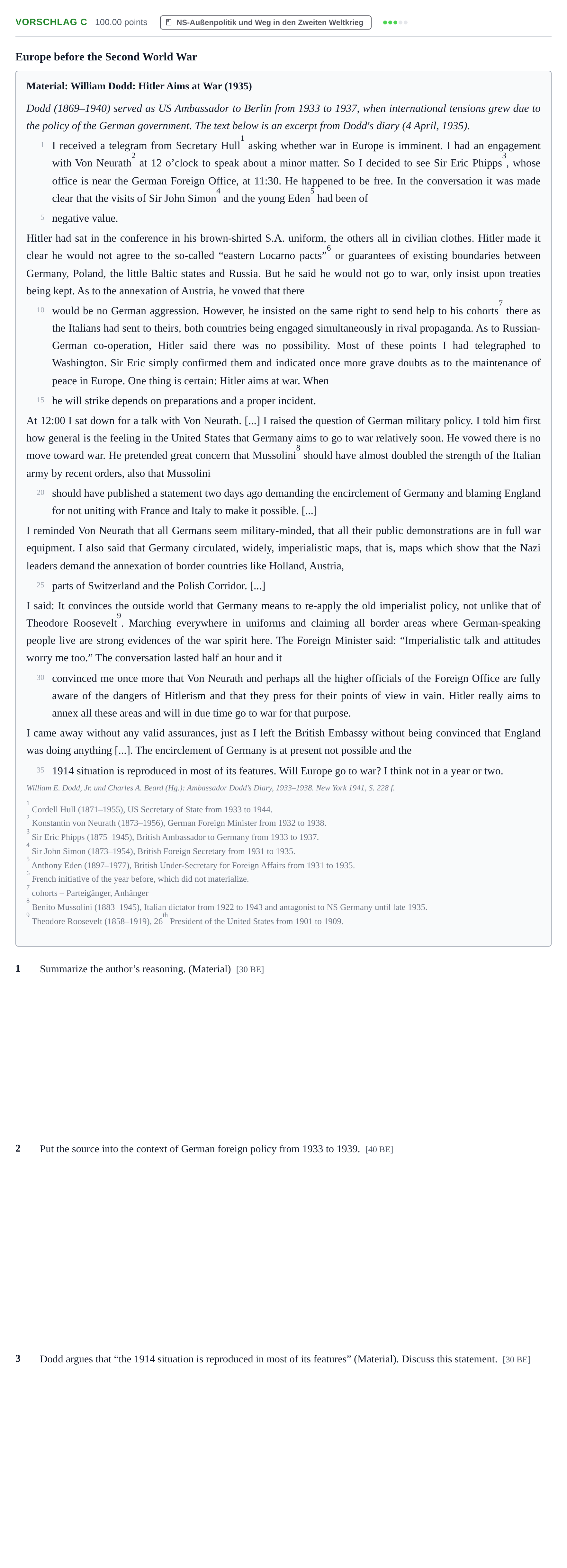
Material: William Dodd: Hitler Aims at War (1935)
Dodd (1869–1940) served as US Ambassador to Berlin from 1933 to 1937, when international tensions grew due to the policy of the German government. The text below is an excerpt from Dodd's diary (4 April, 1935).
1 I received a telegram from Secretary Hull 1 asking whether war in Europe is imminent. I had an engagement with Von Neurath 2 at 12 o’clock to speak about a minor matter. So I decided to see Sir Eric Phipps 3, whose office is near the German Foreign Office, at 11:30. He happened to be free. In the conversation it was made clear that the visits of Sir John Simon 4 and the young Eden 5 had been of
5 negative value.
Hitler had sat in the conference in his brown-shirted S.A. uniform, the others all in civilian clothes. Hitler made it clear he would not agree to the so-called “eastern Locarno pacts” 6 or guarantees of existing boundaries between Germany, Poland, the little Baltic states and Russia. But he said he would not go to war, only insist upon treaties being kept. As to the annexation of Austria, he vowed that there
10 would be no German aggression. However, he insisted on the same right to send help to his cohorts 7 there as the Italians had sent to theirs, both countries being engaged simultaneously in rival propaganda. As to Russian-German co-operation, Hitler said there was no possibility. Most of these points I had telegraphed to Washington. Sir Eric simply confirmed them and indicated once more grave doubts as to the maintenance of peace in Europe. One thing is certain: Hitler aims at war. When
15 he will strike depends on preparations and a proper incident.
At 12:00 I sat down for a talk with Von Neurath. [...] I raised the question of German military policy. I told him first how general is the feeling in the United States that Germany aims to go to war relatively soon. He vowed there is no move toward war. He pretended great concern that Mussolini 8 should have almost doubled the strength of the Italian army by recent orders, also that Mussolini
20 should have published a statement two days ago demanding the encirclement of Germany and blaming England for not uniting with France and Italy to make it possible. [...]
I reminded Von Neurath that all Germans seem military-minded, that all their public demonstrations are in full war equipment. I also said that Germany circulated, widely, imperialistic maps, that is, maps which show that the Nazi leaders demand the annexation of border countries like Holland, Austria,
25 parts of Switzerland and the Polish Corridor. [...]
I said: It convinces the outside world that Germany means to re-apply the old imperialist policy, not unlike that of Theodore Roosevelt 9. Marching everywhere in uniforms and claiming all border areas where German-speaking people live are strong evidences of the war spirit here. The Foreign Minister said: “Imperialistic talk and attitudes worry me too.” The conversation lasted half an hour and it
30 convinced me once more that Von Neurath and perhaps all the higher officials of the Foreign Office are fully aware of the dangers of Hitlerism and that they press for their points of view in vain. Hitler really aims to annex all these areas and will in due time go to war for that purpose.
I came away without any valid assurances, just as I left the British Embassy without being convinced that England was doing anything [...]. The encirclement of Germany is at present not possible and the
35 1914 situation is reproduced in most of its features. Will Europe go to war? I think not in a year or two.
William E. Dodd, Jr. und Charles A. Beard (Hg.): Ambassador Dodd’s Diary, 1933–1938. New York 1941, S. 228 f.
1 Cordell Hull (1871–1955), US Secretary of State from 1933 to 1944.
2 Konstantin von Neurath (1873–1956), German Foreign Minister from 1932 to 1938.
3 Sir Eric Phipps (1875–1945), British Ambassador to Germany from 1933 to 1937.
4 Sir John Simon (1873–1954), British Foreign Secretary from 1931 to 1935.
5 Anthony Eden (1897–1977), British Under-Secretary for Foreign Affairs from 1931 to 1935.
6 French initiative of the year before, which did not materialize.
7 cohorts – Parteigänger, Anhänger
8 Benito Mussolini (1883–1945), Italian dictator from 1922 to 1943 and antagonist to NS Germany until late 1935.
9 Theodore Roosevelt (1858–1919), 26 th President of the United States from 1901 to 1909.
1
Summarize the author’s reasoning. (Material)
[30 BE]
2
Put the source into the context of German foreign policy from 1933 to 1939.
[40 BE]
3
Dodd argues that “the 1914 situation is reproduced in most of its features” (Material). Discuss this statement.
[30 BE]
Lösung
Nach den offiziellen Korrekturhinweisen
1 Summarize the author's reasoning. (Material)
Lösung: In einer Einleitung werden Textsorte (Tagebucheintrag), Autor (William Dodd, US-Botschafter in Berlin), Datum (4. April 1935) und das Thema (Kriegsgefahr durch Deutschland) benannt. Zusammenfassung der Hauptpunkte: - Gespräch mit dem britischen Botschafter Phipps: Die Verhandlungen Simons und Edens mit Hitler verliefen enttäuschend. Hitler lehnte den Ostlocarno-Pakt und Grenzgarantien ab, betonte aber verbal Friedenswillen und Vertragstreue; Einflussnahme auf Österreich hielt er aufrecht, schloss Kooperation mit der UdSSR aus. Phipps bezweifelt den Erhalt des Friedens: Hitlers Ziel sei Krieg. - Gespräch mit Außenminister von Neurath: Dodd spricht die US-Sorge vor einem nahen Krieg, die Militarisierung des Alltags und imperialistische Landkarten an. Von Neurath bestreitet Kriegsabsichten und verweist auf Mussolinis Aufrüstung, zeigt jedoch Verständnis für Dodds Besorgnis. Dodd schließt, dass das diplomatische Korps gegen Hitlers Kurs machtlos ist. - Fazit: Hitler strebe Krieg und Annexionen an, ein Kriegsausbruch sei jedoch in den nächsten ein bis zwei Jahren noch nicht zu erwarten; eine Einkreisung Deutschlands sei derzeit nicht möglich.
2 Put the source into the context of German foreign policy from 1933 to 1939.
Lösung: Einordnung in den Verlauf der NS-Außenpolitik im Spannungsfeld von Friedensbeteuerungen, Provokationen und Revisionismus bzw. Expansion: - 1933: Austritt aus dem Völkerbund und Abbruch der Genfer Abrüstungskonferenz. - 1934: Deutsch-polnischer Nichtangriffspakt zur Verschleierung von Aggressionsabsichten und Schwächung des französischen Bündnissystems. - März 1935: Wiedereinführung der allgemeinen Wehrpflicht und offene Aufrüstung (Bruch des Versailler Vertrags). Unmittelbar in diese Phase der Verunsicherung fällt die Quelle. - Juni 1935: Deutsch-britisches Flottenabkommen (Durchbrechung der Isolation). - März 1936: Remilitarisierung des Rheinlands und Kündigung von Locarno. - März 1938: „Anschluss“ Österreichs an das Deutsche Reich (in der Quelle bereits thematisiert). - September 1938: Münchner Abkommen (Abtretung des Sudetenlandes; Höhepunkt der britisch-französischen Appeasement-Politik). - März 1939: Zerschlagung der Rest-Tschechei („Protektorat Böhmen und Mähren“). - August 1939: Hitler-Stalin-Pakt (Nichtangriffspakt mit geheimem Zusatzprotokoll zur Aufteilung Polens). - 1. September 1939: Deutscher Überfall auf Polen und Beginn des Zweiten Weltkriegs.
3 Dodd argues that “the 1914 situation is reproduced in most of its features” (Material). Discuss this statement.
Lösung: Diskussion der These Dodds: Ähnlichkeiten: - Wie im Wilhelminismus vor 1914 (z. B. Marokkokrisen 1905/06 und 1911) trat Deutschland unberechenbar und konfrontativ auf und wurde international als Gefährdung des Friedens wahrgenommen. - Großbritannien und Frankreich fungierten erneut als primäre Gegenspieler Deutschlands. - Vorhandensein eines hohen Eskalationspotenzials durch unvorhersehbare Krisen. Unterschiede: - Bündniskonstellation: 1914 standen sich feste Blöcke gegenüber (Zweibund Deutschland/Österreich-Ungarn vs. Triple Entente). 1935 existierte die Habsburgermonarchie nicht mehr, die Sowjetunion war isoliert und Mussolini stand NS-Deutschland bis Ende 1935 noch ablehnend gegenüber; eine Einkreisung Deutschlands gab es 1935 nicht. - Motive und Zielsetzungen: Vor 1914 ging es um imperialistische Weltmachtkonkurrenz der europäischen Mächte bei allgemeinem Wettrüsten; in den 1930er Jahren ging die Aggression primär von der rassistisch-ideologischen Lebensraum- und Vernichtungsideologie des NS-Regimes aus. Fazit: Auf der Ebene der diplomatischen Spannungen und des aggressiven Auftretens bestanden Parallelen, die strukturellen Rahmenbedingungen, ideologischen Kriegsursachen und Bündnissysteme unterschieden sich jedoch grundlegend.
Die ausführliche Erklärung Schritt für Schritt (mit KI) gibt es mit Premium. Premium
Löse sie direkt hier: automatische Korrektur, Hinweise und Lösung Schritt für Schritt.
‹ Aufgabe Vorschlag C - Aufgabe 4 (1933–1939) · GK 2022 · Aufgabe Vorschlag B · GK · bilingual Französisch 2022 ›