Aufgabe Vorschlag C - Aufgabe 2.1 · Abitur Hessen Geschichte GK · bilingual Englisch 2021
Thema: Imperialismus und Weg in den Ersten Weltkrieg · Aus der Prüfung GK · bilingual Englisch (2021)
Aufgabenstellung
Material
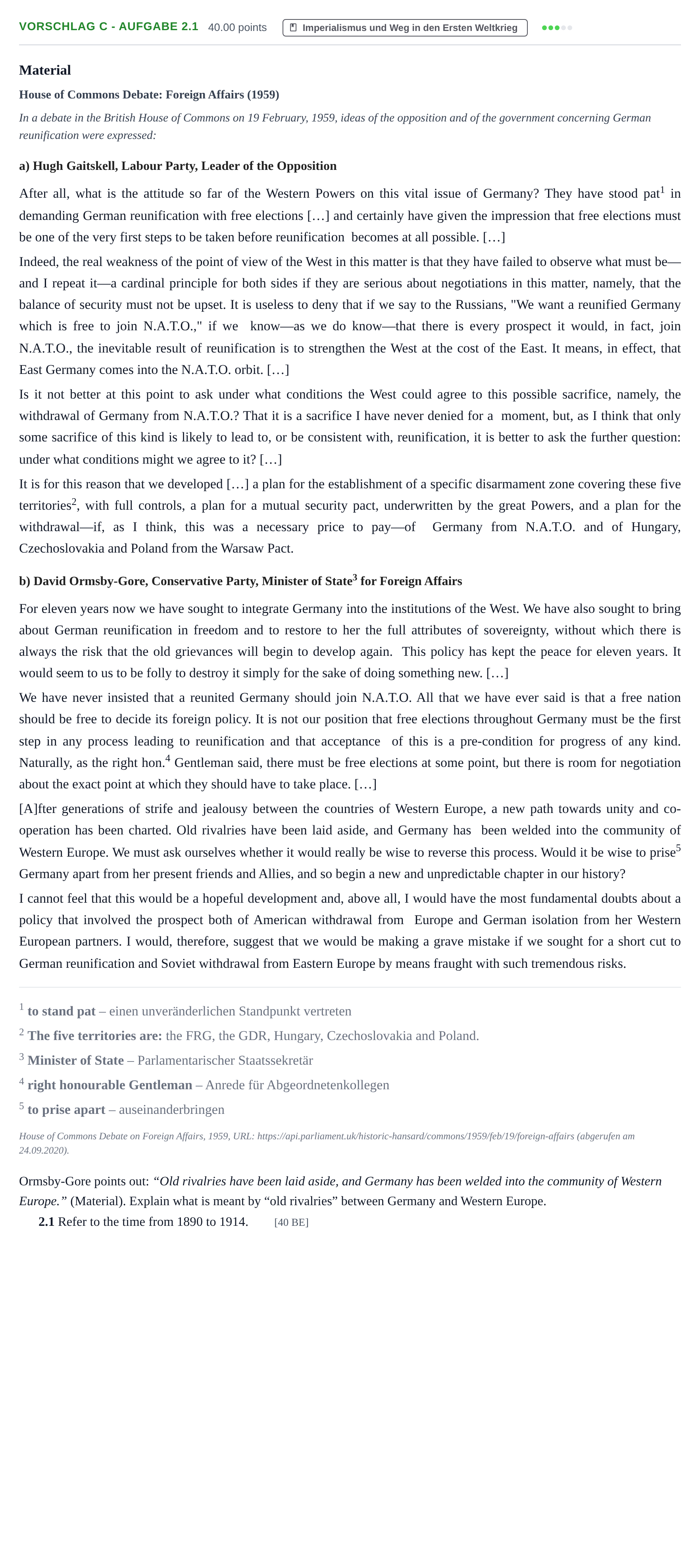
House of Commons Debate: Foreign Affairs (1959)
In a debate in the British House of Commons on 19 February, 1959, ideas of the opposition and of the government concerning German reunification were expressed:
a) Hugh Gaitskell, Labour Party, Leader of the Opposition
After all, what is the attitude so far of the Western Powers on this vital issue of Germany? They have stood pat 1 in demanding German reunification with free elections […] and certainly have given the impression that free elections must be one of the very first steps to be taken before reunification [5] becomes at all possible. […]
Indeed, the real weakness of the point of view of the West in this matter is that they have failed to observe what must be—and I repeat it—a cardinal principle for both sides if they are serious about negotiations in this matter, namely, that the balance of security must not be upset. It is useless to deny that if we say to the Russians, "We want a reunified Germany which is free to join N.A.T.O.," if we [10] know—as we do know—that there is every prospect it would, in fact, join N.A.T.O., the inevitable result of reunification is to strengthen the West at the cost of the East. It means, in effect, that East Germany comes into the N.A.T.O. orbit. […]
Is it not better at this point to ask under what conditions the West could agree to this possible sacrifice, namely, the withdrawal of Germany from N.A.T.O.? That it is a sacrifice I have never denied for a [15] moment, but, as I think that only some sacrifice of this kind is likely to lead to, or be consistent with, reunification, it is better to ask the further question: under what conditions might we agree to it? […]
It is for this reason that we developed […] a plan for the establishment of a specific disarmament zone covering these five territories 2, with full controls, a plan for a mutual security pact, underwritten by the great Powers, and a plan for the withdrawal—if, as I think, this was a necessary price to pay—of [20] Germany from N.A.T.O. and of Hungary, Czechoslovakia and Poland from the Warsaw Pact.
b) David Ormsby-Gore, Conservative Party, Minister of State 3 for Foreign Affairs
For eleven years now we have sought to integrate Germany into the institutions of the West. We have also sought to bring about German reunification in freedom and to restore to her the full attributes of sovereignty, without which there is always the risk that the old grievances will begin to develop again. [25] This policy has kept the peace for eleven years. It would seem to us to be folly to destroy it simply for the sake of doing something new. […]
We have never insisted that a reunited Germany should join N.A.T.O. All that we have ever said is that a free nation should be free to decide its foreign policy. It is not our position that free elections throughout Germany must be the first step in any process leading to reunification and that acceptance [30] of this is a pre-condition for progress of any kind. Naturally, as the right hon. 4 Gentleman said, there must be free elections at some point, but there is room for negotiation about the exact point at which they should have to take place. […]
[A]fter generations of strife and jealousy between the countries of Western Europe, a new path towards unity and co-operation has been charted. Old rivalries have been laid aside, and Germany has [35] been welded into the community of Western Europe. We must ask ourselves whether it would really be wise to reverse this process. Would it be wise to prise 5 Germany apart from her present friends and Allies, and so begin a new and unpredictable chapter in our history?
I cannot feel that this would be a hopeful development and, above all, I would have the most fundamental doubts about a policy that involved the prospect both of American withdrawal from [40] Europe and German isolation from her Western European partners. I would, therefore, suggest that we would be making a grave mistake if we sought for a short cut to German reunification and Soviet withdrawal from Eastern Europe by means fraught with such tremendous risks.
1 to stand pat – einen unveränderlichen Standpunkt vertreten
2 The five territories are: the FRG, the GDR, Hungary, Czechoslovakia and Poland.
3 Minister of State – Parlamentarischer Staatssekretär
4 right honourable Gentleman – Anrede für Abgeordnetenkollegen
5 to prise apart – auseinanderbringen
House of Commons Debate on Foreign Affairs, 1959, URL: https://api.parliament.uk/historic-hansard/commons/1959/feb/19/foreign-affairs (abgerufen am 24.09.2020).
Ormsby-Gore points out: “Old rivalries have been laid aside, and Germany has been welded into the community of Western Europe.” (Material). Explain what is meant by “old rivalries” between Germany and Western Europe.
2.1 Refer to the time from 1890 to 1914. [40 BE]
Lösung
Nach den offiziellen Korrekturhinweisen
2.1 Refer to the time from 1890 to 1914. Explain what is meant by “old rivalries” between Germany and Western Europe.
Lösung: The 'old rivalries' between 1890 and 1914 refer to the escalating diplomatic, imperial, and military conflicts between the German Empire and Western European powers (Britain and France): - Abandonment of Bismarck's complex balance of alliances under Wilhelm II (e.g. non-renewal of the Reinsurance Treaty with Russia in 1890, leading to the Franco-Russian alliance). - Wilhelmine 'Weltpolitik' and the German naval expansion (Tirpitz Plan) around 1900, which directly challenged British naval supremacy and spurred an Anglo-German arms race. - Imperial confrontations such as the First (1905/06) and Second (1911) Moroccan Crises, exacerbating Franco-German enmity and solidifying the British-French Entente Cordiale (1904). - The division of Europe into two opposing armed blocs (Triple Alliance vs. Triple Entente), which culminated in the July Crisis of 1914 and the outbreak of World War I.
Die ausführliche Erklärung Schritt für Schritt (mit KI) gibt es mit Premium. Premium
Löse sie direkt hier: automatische Korrektur, Hinweise und Lösung Schritt für Schritt.
‹ Aufgabe Vorschlag A - Aufgabe 2 · GK · bilingual Englisch 2021 · Aufgabe Vorschlag B - Aufgaben 1 et 3 · GK · bilingual Französisch 2021 ›
Mehr Aufgaben zu Imperialismus und Weg in den Ersten Weltkrieg
- Aufgabe Vorschlag A - Imperialismus und Weg in den Ersten… · GK · bilingual Englisch 2022
- Aufgabe Vorschlag C - Aufgabe 3: Imperialismus vor 1914 · LK 2022
- Aufgabe Vorschlag D - Aufgaben 1 und 2 · GK 2021
- Aufgabe Vorschlag A - Aufgabe 1 · GK · bilingual Englisch 2021
- Aufgabe Vorschlag A - Aufgabe 2 · GK · bilingual Englisch 2021
- Aufgabe Vorschlag B - Aufgaben 1 et 3 · GK · bilingual Französisch 2021