Ejercicio B2 · Inglés PAU Valencia Extraordinaria 2022
Tema: Verdadero o falso con justificación textual (True/False) · Del examen Extraordinaria (2022)
Enunciado
TEXT B / TEXTO B
PLASTIC DISASTER
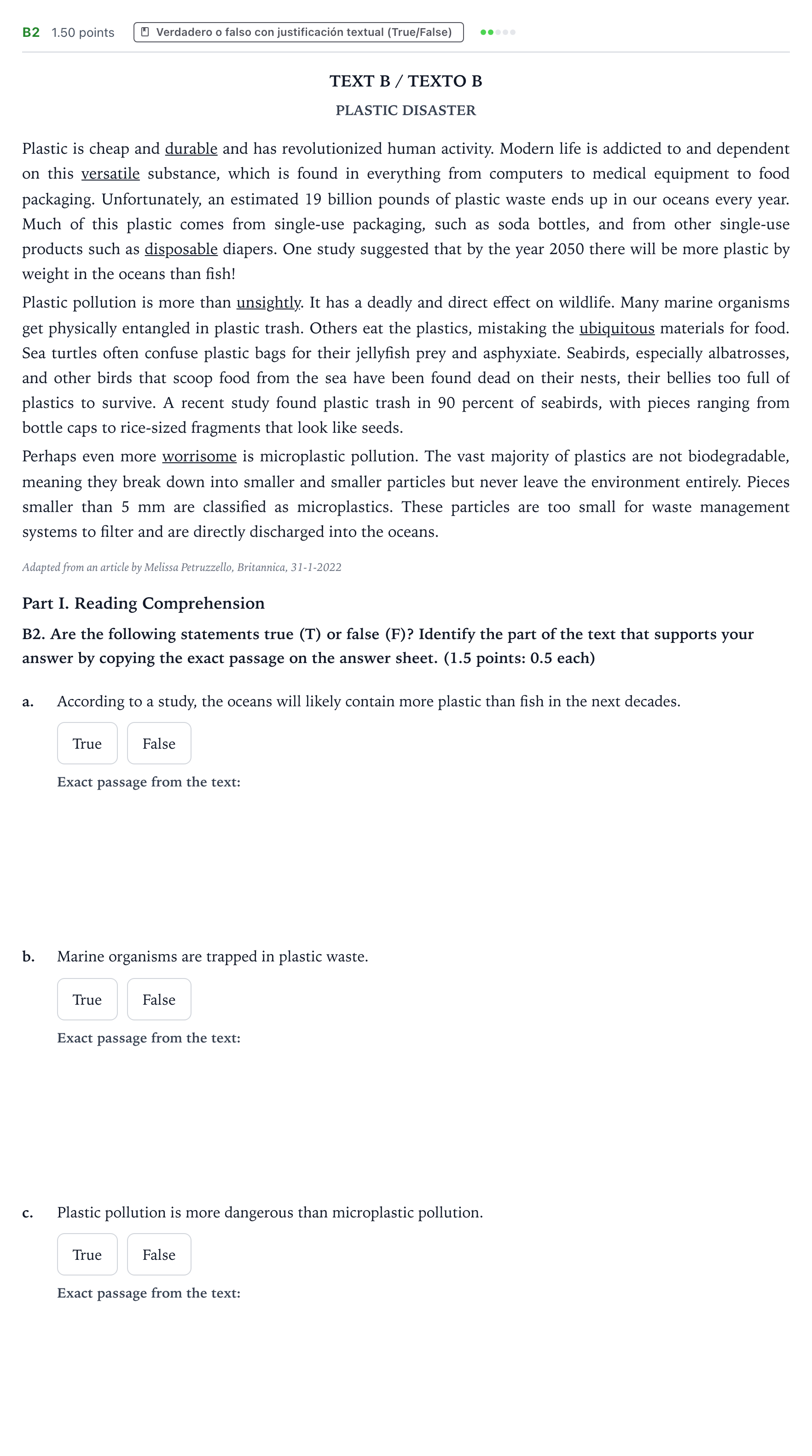
Plastic is cheap and durable and has revolutionized human activity. Modern life is addicted to and dependent on this versatile substance, which is found in everything from computers to medical equipment to food packaging. Unfortunately, an estimated 19 billion pounds of plastic waste ends up in our oceans every year. Much of this plastic comes from single-use packaging, such as soda bottles, and from other single-use products such as disposable diapers. One study suggested that by the year 2050 there will be more plastic by weight in the oceans than fish!
Plastic pollution is more than unsightly. It has a deadly and direct effect on wildlife. Many marine organisms get physically entangled in plastic trash. Others eat the plastics, mistaking the ubiquitous materials for food. Sea turtles often confuse plastic bags for their jellyfish prey and asphyxiate. Seabirds, especially albatrosses, and other birds that scoop food from the sea have been found dead on their nests, their bellies too full of plastics to survive. A recent study found plastic trash in 90 percent of seabirds, with pieces ranging from bottle caps to rice-sized fragments that look like seeds.
Perhaps even more worrisome is microplastic pollution. The vast majority of plastics are not biodegradable, meaning they break down into smaller and smaller particles but never leave the environment entirely. Pieces smaller than 5 mm are classified as microplastics. These particles are too small for waste management systems to filter and are directly discharged into the oceans.
Adapted from an article by Melissa Petruzzello, Britannica, 31-1-2022
Part I. Reading Comprehension
B2. Are the following statements true (T) or false (F)? Identify the part of the text that supports your answer by copying the exact passage on the answer sheet. (1.5 points: 0.5 each)
a.
According to a study, the oceans will likely contain more plastic than fish in the next decades.
True
False
b.
Marine organisms are trapped in plastic waste.
True
False
c.
Plastic pollution is more dangerous than microplastic pollution.
True
False
Solución
Según los criterios oficiales de corrección
a. According to a study, the oceans will likely contain more plastic than fish in the next decades.
Solución: One study suggested that by the year 2050 there will be more plastic by weight in the oceans than fish!
b. Marine organisms are trapped in plastic waste.
Solución: Many marine organisms get physically entangled in plastic trash.
c. Plastic pollution is more dangerous than microplastic pollution.
Solución: Perhaps even more worrisome is microplastic pollution.
True/False choices for statements a, b, and c
Solución: a: True; b: True; c: False
La explicación paso a paso, hecha con IA, es Premium. Premium
Resuélvelo aquí mismo: corrección automática, pistas y solución paso a paso.
‹ Ejercicio A2 · Extraordinaria 2022 · Ejercicio A2 · Ordinaria 2022 ›
Más ejercicios de Verdadero o falso con justificación textual (True/False)
- Ejercicio A2 - True/False · Extraordinaria 2023
- Ejercicio B2 - True/False · Extraordinaria 2023
- Ejercicio A2 · Ordinaria 2023
- Ejercicio B2 · Ordinaria 2023
- Ejercicio A2 · Extraordinaria 2022
- Ejercicio A2 · Ordinaria 2022
- Ejercicio B2 · Ordinaria 2022
- Ejercicio A2 · Extraordinaria 2021
- Ejercicio B2 · Extraordinaria 2021
- Ejercicio A2 · Ordinaria 2021