Ejercicio A2 · Inglés PAU Valencia Extraordinaria 2021
Tema: Verdadero o falso con justificación textual (True/False) · Del examen Extraordinaria (2021)
Enunciado
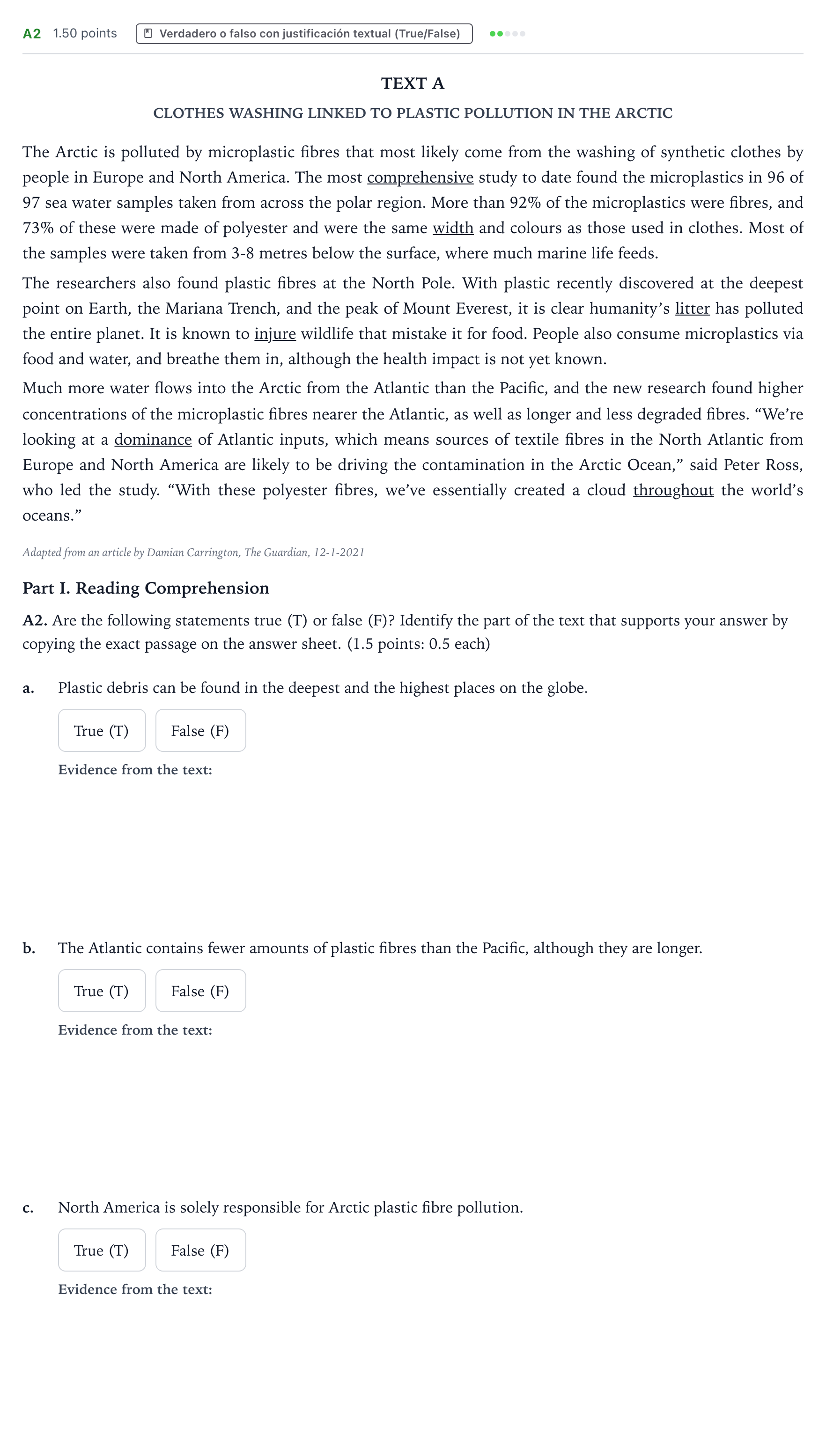
TEXT A
CLOTHES WASHING LINKED TO PLASTIC POLLUTION IN THE ARCTIC
The Arctic is polluted by microplastic fibres that most likely come from the washing of synthetic clothes by people in Europe and North America. The most comprehensive study to date found the microplastics in 96 of 97 sea water samples taken from across the polar region. More than 92% of the microplastics were fibres, and 73% of these were made of polyester and were the same width and colours as those used in clothes. Most of the samples were taken from 3-8 metres below the surface, where much marine life feeds.
The researchers also found plastic fibres at the North Pole. With plastic recently discovered at the deepest point on Earth, the Mariana Trench, and the peak of Mount Everest, it is clear humanity’s litter has polluted the entire planet. It is known to injure wildlife that mistake it for food. People also consume microplastics via food and water, and breathe them in, although the health impact is not yet known.
Much more water flows into the Arctic from the Atlantic than the Pacific, and the new research found higher concentrations of the microplastic fibres nearer the Atlantic, as well as longer and less degraded fibres. “We’re looking at a dominance of Atlantic inputs, which means sources of textile fibres in the North Atlantic from Europe and North America are likely to be driving the contamination in the Arctic Ocean,” said Peter Ross, who led the study. “With these polyester fibres, we’ve essentially created a cloud throughout the world’s oceans.”
Adapted from an article by Damian Carrington, The Guardian, 12-1-2021
Part I. Reading Comprehension
A2. Are the following statements true (T) or false (F)? Identify the part of the text that supports your answer by copying the exact passage on the answer sheet. (1.5 points: 0.5 each)
a.
Plastic debris can be found in the deepest and the highest places on the globe.
True (T)
False (F)
b.
The Atlantic contains fewer amounts of plastic fibres than the Pacific, although they are longer.
True (T)
False (F)
c.
North America is solely responsible for Arctic plastic fibre pollution.
True (T)
False (F)
Solución
Según los criterios oficiales de corrección
A2. Statements True / False choice
Solución: a: True; b: False; c: False
a. Plastic debris can be found in the deepest and the highest places on the globe.
Solución: With plastic recently discovered at the deepest point on Earth, the Mariana Trench, and the peak of Mount Everest, it is clear humanity’s litter has polluted the entire planet.
b. The Atlantic contains fewer amounts of plastic fibres than the Pacific, although they are longer.
Solución: Much more water flows into the Arctic from the Atlantic than the Pacific, and the new research found higher concentrations of the microplastic fibres nearer the Atlantic, as well as longer and less degraded fibres.
c. North America is solely responsible for Arctic plastic fibre pollution.
Solución: “We’re looking at a dominance of Atlantic inputs, which means sources of textile fibres in the North Atlantic from Europe and North America are likely to be driving the contamination in the Arctic Ocean...”
La explicación paso a paso, hecha con IA, es Premium. Premium
Resuélvelo aquí mismo: corrección automática, pistas y solución paso a paso.
‹ Ejercicio B2 · Ordinaria 2022 · Ejercicio B2 · Extraordinaria 2021 ›