Ejercicio I.- a) · Inglés PAU País Vasco Ordinaria 2026
Tema: Preguntas abiertas con tus propias palabras (Answer the questions) · Del examen Ordinaria (2026)
Enunciado
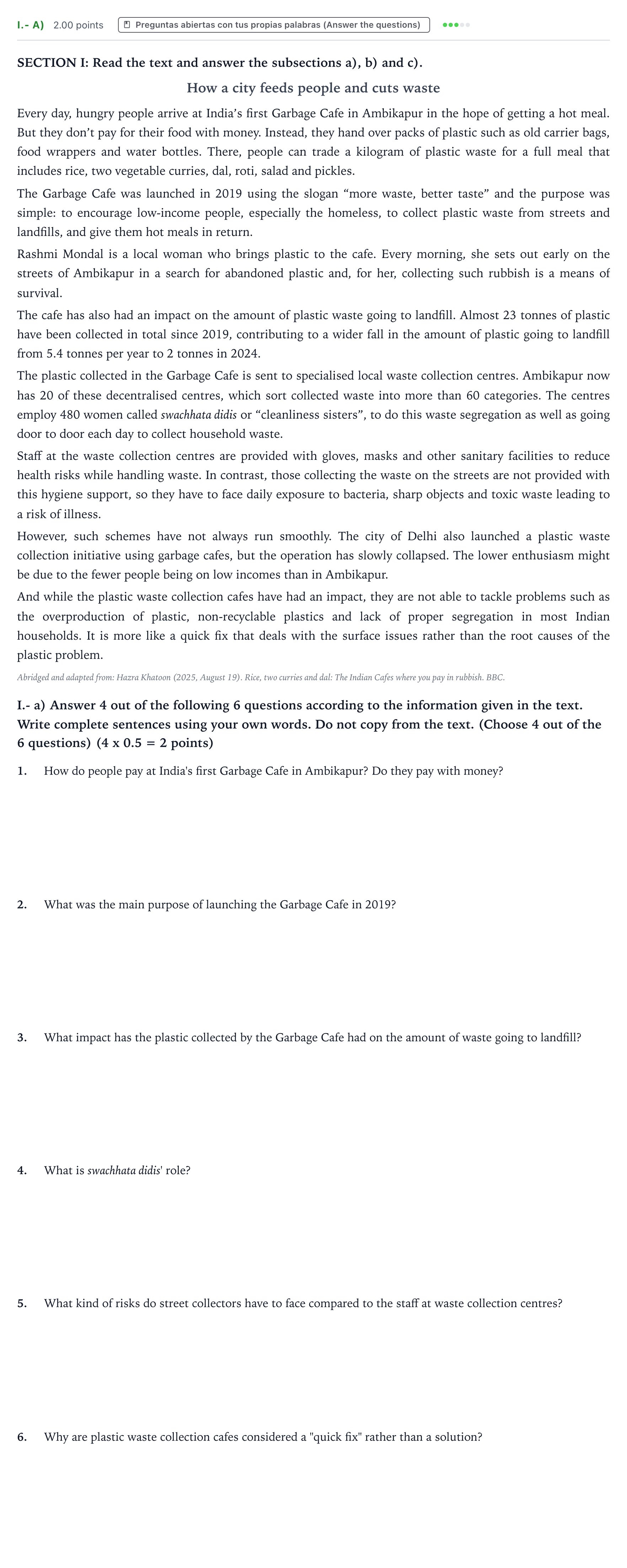
SECTION I: Read the text and answer the subsections a), b) and c).
How a city feeds people and cuts waste
Every day, hungry people arrive at India’s first Garbage Cafe in Ambikapur in the hope of getting a hot meal. But they don’t pay for their food with money. Instead, they hand over packs of plastic such as old carrier bags, food wrappers and water bottles. There, people can trade a kilogram of plastic waste for a full meal that includes rice, two vegetable curries, dal, roti, salad and pickles.
The Garbage Cafe was launched in 2019 using the slogan “more waste, better taste” and the purpose was simple: to encourage low-income people, especially the homeless, to collect plastic waste from streets and landfills, and give them hot meals in return.
Rashmi Mondal is a local woman who brings plastic to the cafe. Every morning, she sets out early on the streets of Ambikapur in a search for abandoned plastic and, for her, collecting such rubbish is a means of survival.
The cafe has also had an impact on the amount of plastic waste going to landfill. Almost 23 tonnes of plastic have been collected in total since 2019, contributing to a wider fall in the amount of plastic going to landfill from 5.4 tonnes per year to 2 tonnes in 2024.
The plastic collected in the Garbage Cafe is sent to specialised local waste collection centres. Ambikapur now has 20 of these decentralised centres, which sort collected waste into more than 60 categories. The centres employ 480 women called swachhata didis or “cleanliness sisters”, to do this waste segregation as well as going door to door each day to collect household waste.
Staff at the waste collection centres are provided with gloves, masks and other sanitary facilities to reduce health risks while handling waste. In contrast, those collecting the waste on the streets are not provided with this hygiene support, so they have to face daily exposure to bacteria, sharp objects and toxic waste leading to a risk of illness.
However, such schemes have not always run smoothly. The city of Delhi also launched a plastic waste collection initiative using garbage cafes, but the operation has slowly collapsed. The lower enthusiasm might be due to the fewer people being on low incomes than in Ambikapur.
And while the plastic waste collection cafes have had an impact, they are not able to tackle problems such as the overproduction of plastic, non-recyclable plastics and lack of proper segregation in most Indian households. It is more like a quick fix that deals with the surface issues rather than the root causes of the plastic problem.
Abridged and adapted from: Hazra Khatoon (2025, August 19). Rice, two curries and dal: The Indian Cafes where you pay in rubbish. BBC.
I.- a) Answer 4 out of the following 6 questions according to the information given in the text. Write complete sentences using your own words. Do not copy from the text. (Choose 4 out of the 6 questions) (4 x 0.5 = 2 points)
1.
How do people pay at India's first Garbage Cafe in Ambikapur? Do they pay with money?
2.
What was the main purpose of launching the Garbage Cafe in 2019?
3.
What impact has the plastic collected by the Garbage Cafe had on the amount of waste going to landfill?
4.
What is swachhata didis ' role?
5.
What kind of risks do street collectors have to face compared to the staff at waste collection centres?
6.
Why are plastic waste collection cafes considered a "quick fix" rather than a solution?
Solución
Según los criterios oficiales de corrección
1. How do people pay at India's first Garbage Cafe in Ambikapur? Do they pay with money?
Solución: No, people don't use money. Instead, they give plastic waste like bags, bottles or wrappers in exchange for a meal.
2. What was the main purpose of launching the Garbage Cafe in 2019?
Solución: It was launched to motivate poor and homeless people to collect plastic from the streets while providing them with food.
3. What impact has the plastic collected by the Garbage Cafe had on the amount of waste going to landfill?
Solución: It has significantly reduced the amount of plastic going to landfills, cutting it from over five tonnes a year to about two tonnes by 2024.
4. What is swachhata didis' role?
Solución: Swachhata didis are employed in waste collection centres, sorting plastic into many categories and visiting homes daily to collect household waste.
5. What kind of risks do street collectors have to face compared to the staff at waste collection centres?
Solución: Street collectors do not have/are not given protective material, so they are exposed to germs, sharp objects and toxic materials, which can make them sick.
6. Why are plastic waste collection cafes considered a "quick fix" rather than a solution?
Solución: They are considered a "quick fix" because they do not deal with deeper issues/problems like plastic overproduction, plastic that cannot be recycled and how people sort waste at home.
La explicación paso a paso, hecha con IA, es Premium. Premium
Resuélvelo aquí mismo: corrección automática, pistas y solución paso a paso.
‹ Ejercicio I.- a) · Extraordinaria 2026 · Ejercicio SECTION I - a) · Extraordinaria 2025 ›
Más ejercicios de Preguntas abiertas con tus propias palabras (Answer the questions)
- Ejercicio I.- a) · Extraordinaria 2026
- Ejercicio SECTION I - a) · Extraordinaria 2025
- Ejercicio SECTION I - a) · Ordinaria 2025
- Ejercicio Option A - I · Extraordinaria 2024
- Ejercicio Option B - I · Extraordinaria 2024
- Ejercicio OPTION A - I · Ordinaria 2024
- Ejercicio OPTION B - I · Ordinaria 2024
- Ejercicio Option A - I · Extraordinaria 2022
- Ejercicio Option B - I · Extraordinaria 2022
- Ejercicio Option A - I · Ordinaria 2022