Ejercicio Option A - I · Inglés PAU País Vasco Extraordinaria 2024
Tema: Preguntas abiertas con tus propias palabras (Answer the questions) · Del examen Extraordinaria (2024)
Enunciado
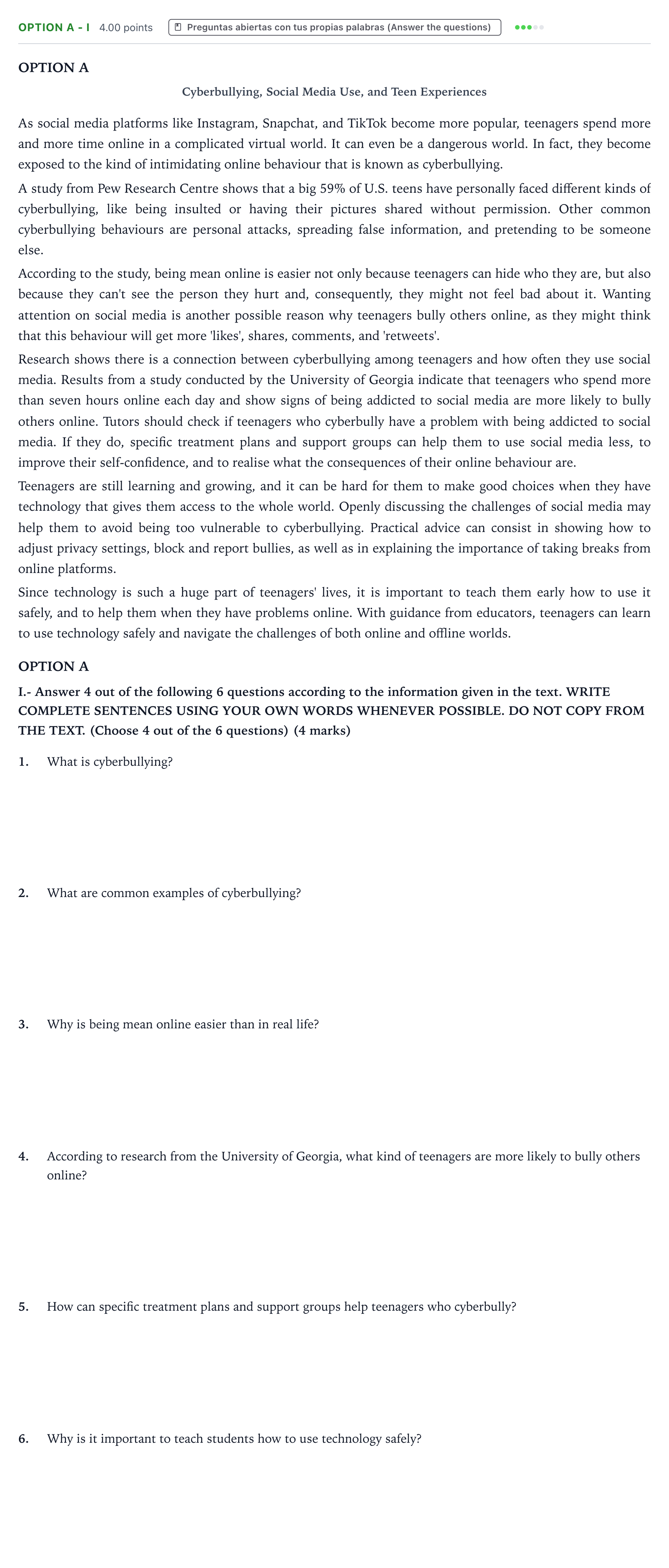
OPTION A
Cyberbullying, Social Media Use, and Teen Experiences
As social media platforms like Instagram, Snapchat, and TikTok become more popular, teenagers spend more and more time online in a complicated virtual world. It can even be a dangerous world. In fact, they become exposed to the kind of intimidating online behaviour that is known as cyberbullying.
A study from Pew Research Centre shows that a big 59% of U.S. teens have personally faced different kinds of cyberbullying, like being insulted or having their pictures shared without permission. Other common cyberbullying behaviours are personal attacks, spreading false information, and pretending to be someone else.
According to the study, being mean online is easier not only because teenagers can hide who they are, but also because they can't see the person they hurt and, consequently, they might not feel bad about it. Wanting attention on social media is another possible reason why teenagers bully others online, as they might think that this behaviour will get more 'likes', shares, comments, and 'retweets'.
Research shows there is a connection between cyberbullying among teenagers and how often they use social media. Results from a study conducted by the University of Georgia indicate that teenagers who spend more than seven hours online each day and show signs of being addicted to social media are more likely to bully others online. Tutors should check if teenagers who cyberbully have a problem with being addicted to social media. If they do, specific treatment plans and support groups can help them to use social media less, to improve their self-confidence, and to realise what the consequences of their online behaviour are.
Teenagers are still learning and growing, and it can be hard for them to make good choices when they have technology that gives them access to the whole world. Openly discussing the challenges of social media may help them to avoid being too vulnerable to cyberbullying. Practical advice can consist in showing how to adjust privacy settings, block and report bullies, as well as in explaining the importance of taking breaks from online platforms.
Since technology is such a huge part of teenagers' lives, it is important to teach them early how to use it safely, and to help them when they have problems online. With guidance from educators, teenagers can learn to use technology safely and navigate the challenges of both online and offline worlds.
OPTION A
I.- Answer 4 out of the following 6 questions according to the information given in the text. WRITE COMPLETE SENTENCES USING YOUR OWN WORDS WHENEVER POSSIBLE. DO NOT COPY FROM THE TEXT. (Choose 4 out of the 6 questions) (4 marks)
1.
What is cyberbullying?
2.
What are common examples of cyberbullying?
3.
Why is being mean online easier than in real life?
4.
According to research from the University of Georgia, what kind of teenagers are more likely to bully others online?
5.
How can specific treatment plans and support groups help teenagers who cyberbully?
6.
Why is it important to teach students how to use technology safely?
Solución
Según los criterios oficiales de corrección
1. What is cyberbullying?
Solución: Cyberbullying is behaving aggressively / intimidating people online / making people afraid of you online.
2. What are common examples of cyberbullying?
Solución: Common examples of cyberbullying are insulting people, sharing other people's photos/pictures without their permission / even when you don't have their permission, attacking people, sharing information that is not true, lying about one's/your identity.
3. Why is being mean online easier than in real life?
Solución: Being mean online is easier because teenagers don't have to show their true identity / can pretend to be someone else, and they don't have to look at the person they are bullying / making suffer, and, therefore, they don't have to feel sorry [for their behaviour].
4. According to research from the University of Georgia, what kind of teenagers are more likely to bully others online?
Solución: According to research from the University of Georgia, teenagers who are online / use online platforms / the Internet more than 7 hours a day and seem addicted to social media are more likely to bully others online.
5. How can specific treatment plans and support groups help teenagers who cyberbully?
Solución: Specific treatment plans and support groups can help teenagers who cyberbully to spend less time on social media, to have more confidence in themselves, and to understand the consequences of their actions online.
6. Why is it important to teach students how to use technology safely?
Solución: It is important to teach students how to use technology safely because teenagers use technology a lot in their life / spend a lot of time using it.
La explicación paso a paso, hecha con IA, es Premium. Premium
Resuélvelo aquí mismo: corrección automática, pistas y solución paso a paso.
‹ Ejercicio SECTION I - a) · Ordinaria 2025 · Ejercicio Option B - I · Extraordinaria 2024 ›
Más ejercicios de Preguntas abiertas con tus propias palabras (Answer the questions)
- Ejercicio I.- a) · Extraordinaria 2026
- Ejercicio I.- a) · Ordinaria 2026
- Ejercicio SECTION I - a) · Extraordinaria 2025
- Ejercicio SECTION I - a) · Ordinaria 2025
- Ejercicio Option B - I · Extraordinaria 2024
- Ejercicio OPTION A - I · Ordinaria 2024
- Ejercicio OPTION B - I · Ordinaria 2024
- Ejercicio Option A - I · Extraordinaria 2022
- Ejercicio Option B - I · Extraordinaria 2022
- Ejercicio Option A - I · Ordinaria 2022