Ejercicio B · Inglés PAU Madrid Ordinaria Martes 2021
Tema: Comprensión Lectora · Del examen Ordinaria Martes (2021)
Enunciado
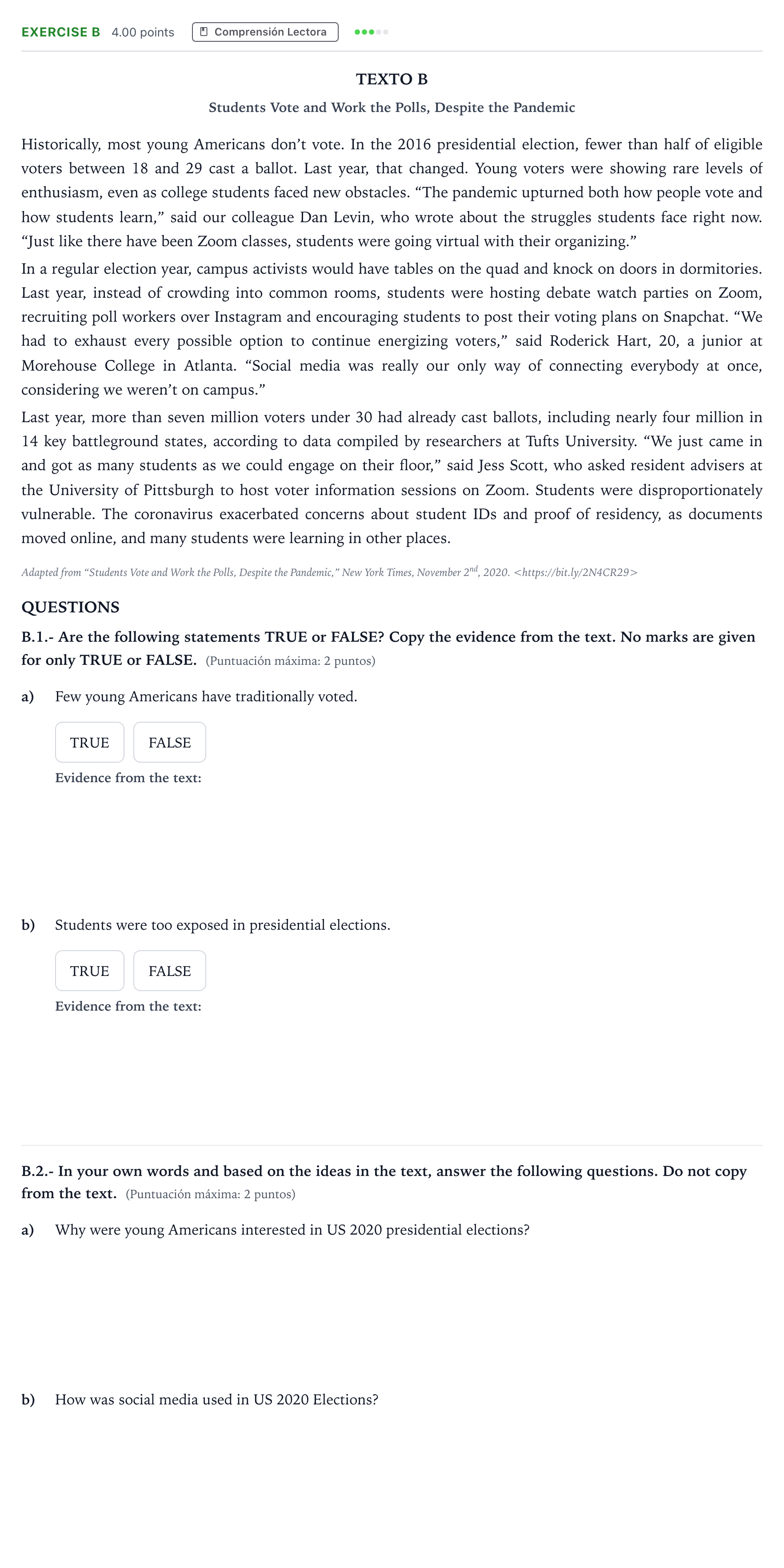
TEXTO B
Students Vote and Work the Polls, Despite the Pandemic
Historically, most young Americans don’t vote. In the 2016 presidential election, fewer than half of eligible voters between 18 and 29 cast a ballot. Last year, that changed. Young voters were showing rare levels of enthusiasm, even as college students faced new obstacles. “The pandemic upturned both how people vote and how students learn,” said our colleague Dan Levin, who wrote about the struggles students face right now. “Just like there have been Zoom classes, students were going virtual with their organizing.”
In a regular election year, campus activists would have tables on the quad and knock on doors in dormitories. Last year, instead of crowding into common rooms, students were hosting debate watch parties on Zoom, recruiting poll workers over Instagram and encouraging students to post their voting plans on Snapchat. “We had to exhaust every possible option to continue energizing voters,” said Roderick Hart, 20, a junior at Morehouse College in Atlanta. “Social media was really our only way of connecting everybody at once, considering we weren’t on campus.”
Last year, more than seven million voters under 30 had already cast ballots, including nearly four million in 14 key battleground states, according to data compiled by researchers at Tufts University. “We just came in and got as many students as we could engage on their floor,” said Jess Scott, who asked resident advisers at the University of Pittsburgh to host voter information sessions on Zoom. Students were disproportionately vulnerable. The coronavirus exacerbated concerns about student IDs and proof of residency, as documents moved online, and many students were learning in other places.
Adapted from “Students Vote and Work the Polls, Despite the Pandemic,” New York Times, November 2 nd, 2020. <https://bit.ly/2N4CR29>
QUESTIONS
B.1.- Are the following statements TRUE or FALSE? Copy the evidence from the text. No marks are given for only TRUE or FALSE. (Puntuación máxima: 2 puntos)
a)
Few young Americans have traditionally voted.
TRUE
FALSE
b)
Students were too exposed in presidential elections.
TRUE
FALSE
B.2.- In your own words and based on the ideas in the text, answer the following questions. Do not copy from the text. (Puntuación máxima: 2 puntos)
a)
Why were young Americans interested in US 2020 presidential elections?
b)
How was social media used in US 2020 Elections?
Solución
Según los criterios oficiales de corrección
B.1.a) Few young Americans have traditionally voted. (TRUE/FALSE)
Solución: TRUE
B.1.a) Evidence from the text
Solución: "Historically, most young Americans don’t vote."
B.1.b) Students were too exposed in presidential elections. (TRUE/FALSE)
Solución: TRUE
B.1.b) Evidence from the text
Solución: "Students were disproportionately vulnerable."
B.2.a) Why were young Americans interested in US 2020 presidential elections?
Solución: Young Americans wanted to surpass youth voting records despite the Covid-19 Pandemic. Some campus activists were interested in politics and engaged in online debates to encourage young people to vote.
B.2.b) How was social media used in US 2020 Elections?
Solución: Different social media (Snapchat, Zoom and Instagram) were used to appeal to young voters with the aim to encourage their participation in the elections.
La explicación paso a paso, hecha con IA, es Premium. Premium
Resuélvelo aquí mismo: corrección automática, pistas y solución paso a paso.
‹ Ejercicio A · Ordinaria Martes 2021 · Ejercicio A · Extraordinaria 2020 ›
Más ejercicios de Comprensión Lectora
- Ejercicio A · Ordinaria (2ª lengua) Coincidencias 2021
- Ejercicio B · Ordinaria (2ª lengua) Coincidencias 2021
- Ejercicio A · Ordinaria Lunes 2021
- Ejercicio B · Ordinaria Lunes 2021
- Ejercicio A · Ordinaria Martes 2021
- Ejercicio A · Extraordinaria 2020
- Ejercicio B · Extraordinaria 2020
- Ejercicio A · Extraordinaria (2ª lengua) 2020
- Ejercicio B · Extraordinaria (2ª lengua) 2020
- Ejercicio A · Extraordinaria Coincidencias 2020