Ejercicio A · Inglés PAU Madrid Ordinaria Lunes 2021
Tema: Comprensión Lectora · Del examen Ordinaria Lunes (2021)
Enunciado
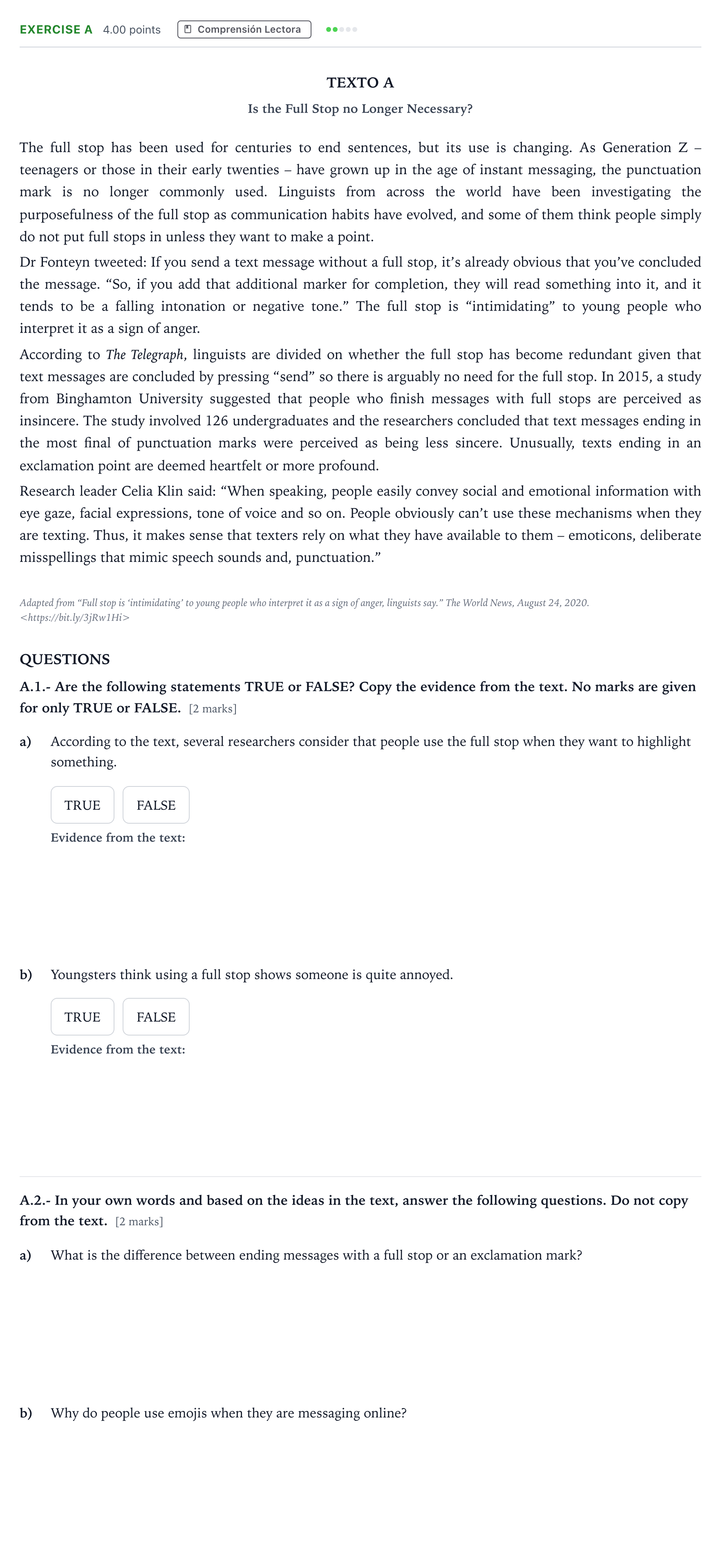
TEXTO A
Is the Full Stop no Longer Necessary?
The full stop has been used for centuries to end sentences, but its use is changing. As Generation Z – teenagers or those in their early twenties – have grown up in the age of instant messaging, the punctuation mark is no longer commonly used. Linguists from across the world have been investigating the purposefulness of the full stop as communication habits have evolved, and some of them think people simply do not put full stops in unless they want to make a point.
Dr Fonteyn tweeted: If you send a text message without a full stop, it’s already obvious that you’ve concluded the message. “So, if you add that additional marker for completion, they will read something into it, and it tends to be a falling intonation or negative tone.” The full stop is “intimidating” to young people who interpret it as a sign of anger.
According to The Telegraph, linguists are divided on whether the full stop has become redundant given that text messages are concluded by pressing “send” so there is arguably no need for the full stop. In 2015, a study from Binghamton University suggested that people who finish messages with full stops are perceived as insincere. The study involved 126 undergraduates and the researchers concluded that text messages ending in the most final of punctuation marks were perceived as being less sincere. Unusually, texts ending in an exclamation point are deemed heartfelt or more profound.
Research leader Celia Klin said: “When speaking, people easily convey social and emotional information with eye gaze, facial expressions, tone of voice and so on. People obviously can’t use these mechanisms when they are texting. Thus, it makes sense that texters rely on what they have available to them – emoticons, deliberate misspellings that mimic speech sounds and, punctuation.”
Adapted from “Full stop is ‘intimidating’ to young people who interpret it as a sign of anger, linguists say.” The World News, August 24, 2020. <https://bit.ly/3jRw1Hi>
QUESTIONS
A.1.- Are the following statements TRUE or FALSE? Copy the evidence from the text. No marks are given for only TRUE or FALSE.
[2 marks]
a)
According to the text, several researchers consider that people use the full stop when they want to highlight something.
TRUE
FALSE
b)
Youngsters think using a full stop shows someone is quite annoyed.
TRUE
FALSE
A.2.- In your own words and based on the ideas in the text, answer the following questions. Do not copy from the text.
[2 marks]
a)
What is the difference between ending messages with a full stop or an exclamation mark?
b)
Why do people use emojis when they are messaging online?
Solución
Según los criterios oficiales de corrección
A.1.a) According to the text, several researchers consider that people use the full stop when they want to highlight something.
Solución: TRUE
A.1.a) Evidence from the text
Solución: "Linguists from across the world have been investigating the purposefulness of the full stop as communication habits have evolved, and some of them think people simply do not put full stops in unless they want to make a point."
A.1.b) Youngsters think using a full stop shows someone is quite annoyed.
Solución: TRUE
A.1.b) Evidence from the text
Solución: "The full stop is "intimidating" to young people who interpret it as a sign of anger."
A.2.a) What is the difference between ending messages with a full stop or an exclamation mark?
Solución: The difference is that ending messages with a full stop is considered dishonest / is identified as a sign of dishonesty or lack of sincerity and ending messages with an exclamation mark is supposed to be more genuine and sincere.
A.2.b) Why do people use emojis when they are messaging online?
Solución: People use emojis because online messaging forces people to develop new ways of conveying emotion and meaning without the use of body language or tone of voice.
La explicación paso a paso, hecha con IA, es Premium. Premium
Resuélvelo aquí mismo: corrección automática, pistas y solución paso a paso.
‹ Ejercicio B · Ordinaria (2ª lengua) Coincidencias 2021 · Ejercicio B · Ordinaria Lunes 2021 ›
Más ejercicios de Comprensión Lectora
- Ejercicio B · Modelo 2021
- Ejercicio A.1 - A.2 · Ordinaria (2ª lengua) 2021
- Ejercicio B.1 - B.2 · Ordinaria (2ª lengua) 2021
- Ejercicio A · Ordinaria (2ª lengua) Coincidencias 2021
- Ejercicio B · Ordinaria (2ª lengua) Coincidencias 2021
- Ejercicio B · Ordinaria Lunes 2021
- Ejercicio A · Ordinaria Martes 2021
- Ejercicio B · Ordinaria Martes 2021
- Ejercicio A · Extraordinaria 2020
- Ejercicio B · Extraordinaria 2020