Ejercicio A · Inglés PAU Madrid Extraordinaria 2020
Tema: Comprensión Lectora · Del examen Extraordinaria (2020)
Enunciado
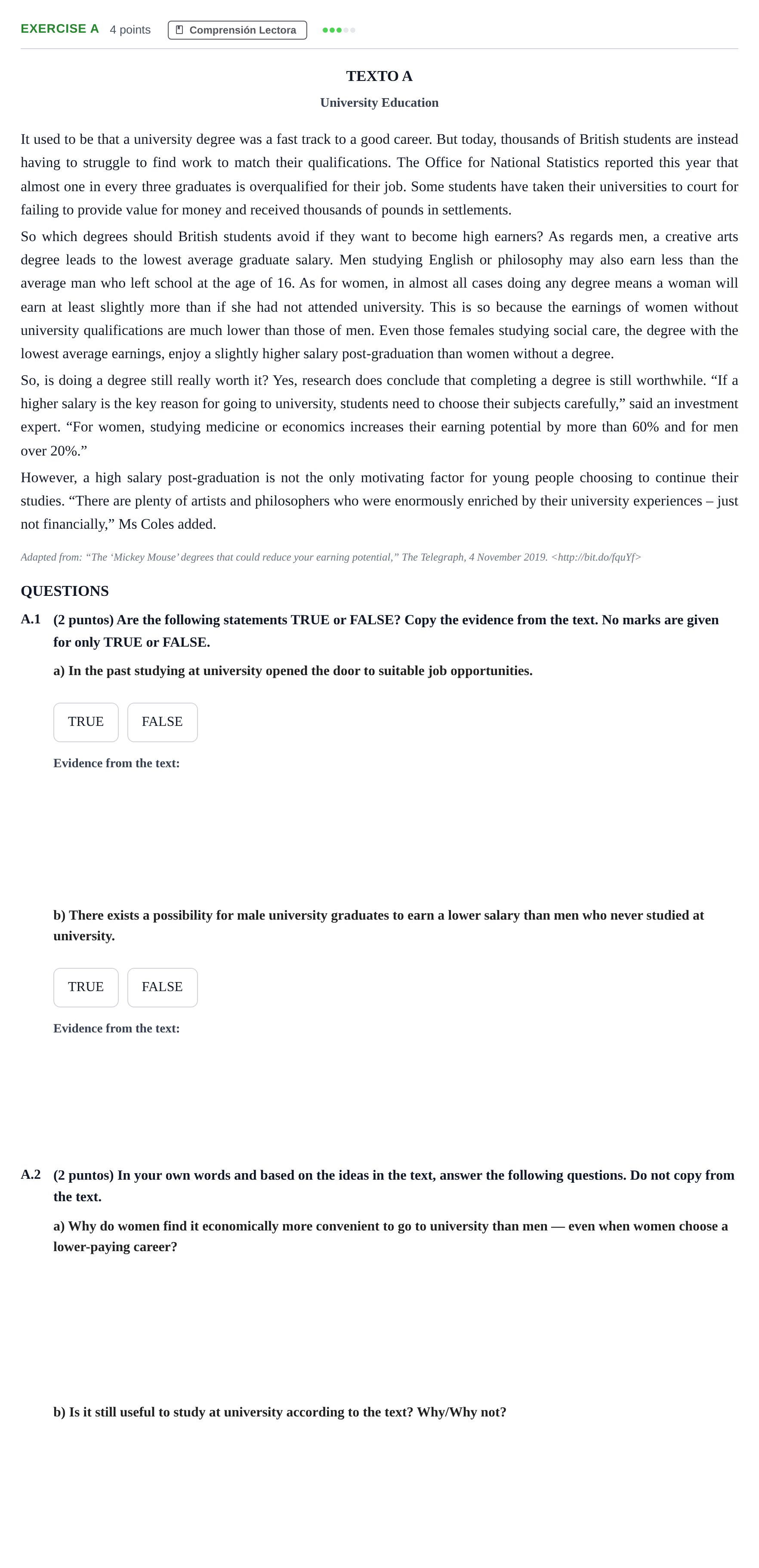
TEXTO A
University Education
It used to be that a university degree was a fast track to a good career. But today, thousands of British students are instead having to struggle to find work to match their qualifications. The Office for National Statistics reported this year that almost one in every three graduates is overqualified for their job. Some students have taken their universities to court for failing to provide value for money and received thousands of pounds in settlements.
So which degrees should British students avoid if they want to become high earners? As regards men, a creative arts degree leads to the lowest average graduate salary. Men studying English or philosophy may also earn less than the average man who left school at the age of 16. As for women, in almost all cases doing any degree means a woman will earn at least slightly more than if she had not attended university. This is so because the earnings of women without university qualifications are much lower than those of men. Even those females studying social care, the degree with the lowest average earnings, enjoy a slightly higher salary post-graduation than women without a degree.
So, is doing a degree still really worth it? Yes, research does conclude that completing a degree is still worthwhile. “If a higher salary is the key reason for going to university, students need to choose their subjects carefully,” said an investment expert. “For women, studying medicine or economics increases their earning potential by more than 60% and for men over 20%.”
However, a high salary post-graduation is not the only motivating factor for young people choosing to continue their studies. “There are plenty of artists and philosophers who were enormously enriched by their university experiences – just not financially,” Ms Coles added.
Adapted from: “The ‘Mickey Mouse’ degrees that could reduce your earning potential,” The Telegraph, 4 November 2019. <http://bit.do/fquYf>
QUESTIONS
A.1
(2 puntos) Are the following statements TRUE or FALSE? Copy the evidence from the text. No marks are given for only TRUE or FALSE.
a) In the past studying at university opened the door to suitable job opportunities.
TRUE
FALSE
b) There exists a possibility for male university graduates to earn a lower salary than men who never studied at university.
TRUE
FALSE
A.2
(2 puntos) In your own words and based on the ideas in the text, answer the following questions. Do not copy from the text.
a) Why do women find it economically more convenient to go to university than men — even when women choose a lower-paying career?
b) Is it still useful to study at university according to the text? Why/Why not?
Solución
Según los criterios oficiales de corrección
A.1 (2 puntos) Are the following statements TRUE or FALSE? Copy the evidence from the text.
Solución: a) TRUE b) TRUE
A.1 a) In the past studying at university opened the door to suitable job opportunities.
Solución: "It used to be that a university degree was a fast track to a good career."
A.1 b) There exists a possibility for male university graduates to earn a lower salary than men who never studied at university.
Solución: "Men studying English or philosophy may also earn less than the average man who left school at the age of 16."
A.2 a) Why do women find it economically more convenient to go to university than men — even when women choose a lower-paying career?
Solución: Women who do not have a university degree earn less than men who have no qualifications. So even a degree which will allow women to earn a low salary is worthwhile, as it will result in higher earnings than no degree at all.
A.2 b) Is it still useful to study at university according to the text? Why/Why not?
Solución: Yes, you can earn more money if you choose to study certain degrees. On the other hand, you can choose to study other subjects which will not make you a higher earner but will help you develop personally.
La explicación paso a paso, hecha con IA, es Premium. Premium
Resuélvelo aquí mismo: corrección automática, pistas y solución paso a paso.
‹ Ejercicio B · Ordinaria Martes 2021 · Ejercicio B · Extraordinaria 2020 ›
Más ejercicios de Comprensión Lectora
- Ejercicio B · Ordinaria (2ª lengua) Coincidencias 2021
- Ejercicio A · Ordinaria Lunes 2021
- Ejercicio B · Ordinaria Lunes 2021
- Ejercicio A · Ordinaria Martes 2021
- Ejercicio B · Ordinaria Martes 2021
- Ejercicio B · Extraordinaria 2020
- Ejercicio A · Extraordinaria (2ª lengua) 2020
- Ejercicio B · Extraordinaria (2ª lengua) 2020
- Ejercicio A · Extraordinaria Coincidencias 2020
- Ejercicio B · Extraordinaria Coincidencias 2020