Ejercicio B · Inglés PAU Madrid Extraordinaria 2021
Tema: Comprensión Lectora · Del examen Extraordinaria (2021)
Enunciado
TEXTO B
Gap Years for Every Student
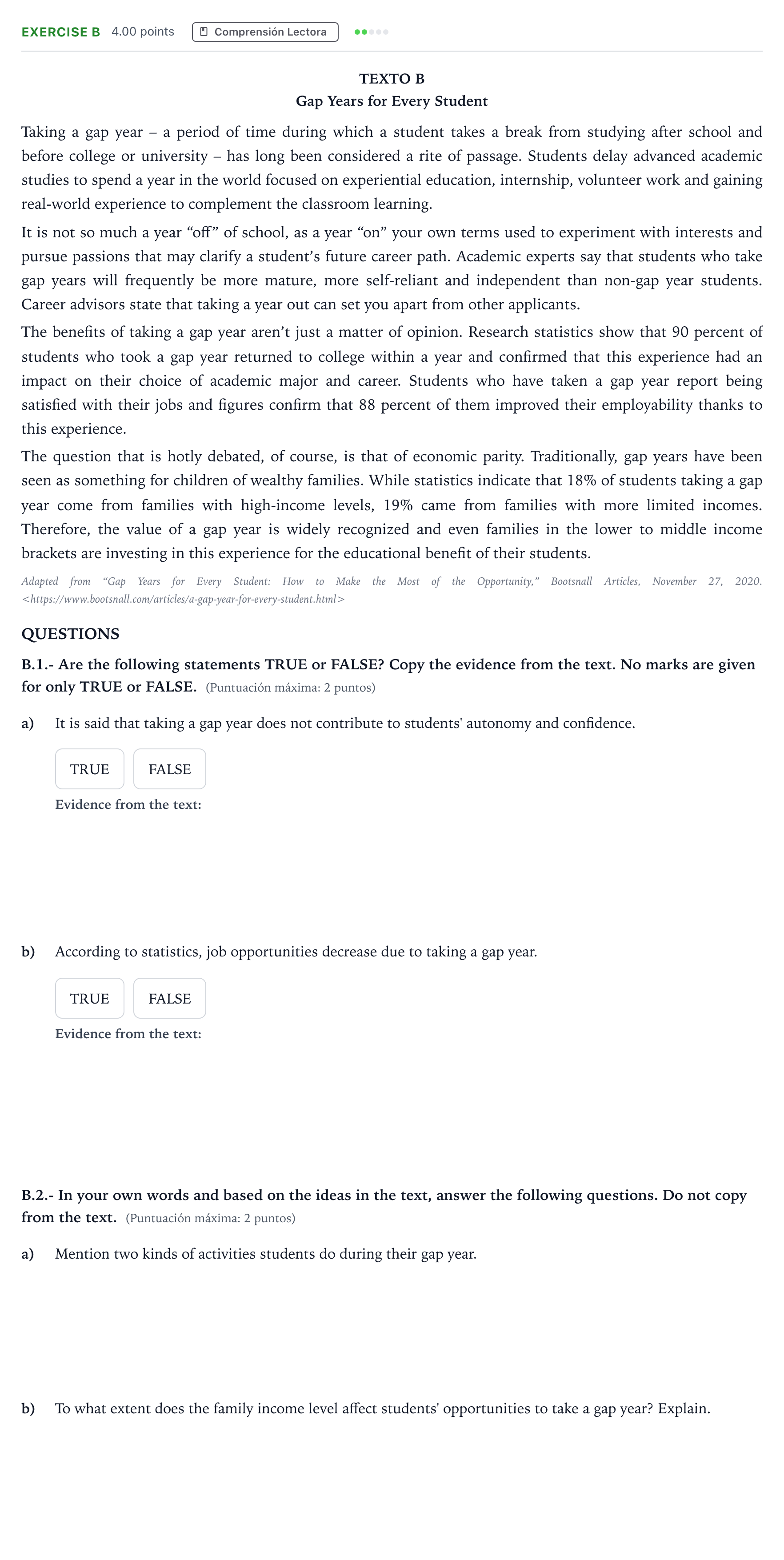
Taking a gap year – a period of time during which a student takes a break from studying after school and before college or university – has long been considered a rite of passage. Students delay advanced academic studies to spend a year in the world focused on experiential education, internship, volunteer work and gaining real-world experience to complement the classroom learning.
It is not so much a year “off” of school, as a year “on” your own terms used to experiment with interests and pursue passions that may clarify a student’s future career path. Academic experts say that students who take gap years will frequently be more mature, more self-reliant and independent than non-gap year students. Career advisors state that taking a year out can set you apart from other applicants.
The benefits of taking a gap year aren’t just a matter of opinion. Research statistics show that 90 percent of students who took a gap year returned to college within a year and confirmed that this experience had an impact on their choice of academic major and career. Students who have taken a gap year report being satisfied with their jobs and figures confirm that 88 percent of them improved their employability thanks to this experience.
The question that is hotly debated, of course, is that of economic parity. Traditionally, gap years have been seen as something for children of wealthy families. While statistics indicate that 18% of students taking a gap year come from families with high-income levels, 19% came from families with more limited incomes. Therefore, the value of a gap year is widely recognized and even families in the lower to middle income brackets are investing in this experience for the educational benefit of their students.
Adapted from “Gap Years for Every Student: How to Make the Most of the Opportunity,” Bootsnall Articles, November 27, 2020. <https://www.bootsnall.com/articles/a-gap-year-for-every-student.html>
QUESTIONS
B.1.- Are the following statements TRUE or FALSE? Copy the evidence from the text. No marks are given for only TRUE or FALSE. (Puntuación máxima: 2 puntos)
a)
It is said that taking a gap year does not contribute to students' autonomy and confidence.
TRUE
FALSE
b)
According to statistics, job opportunities decrease due to taking a gap year.
TRUE
FALSE
B.2.- In your own words and based on the ideas in the text, answer the following questions. Do not copy from the text. (Puntuación máxima: 2 puntos)
a)
Mention two kinds of activities students do during their gap year.
b)
To what extent does the family income level affect students' opportunities to take a gap year? Explain.
Solución
Según los criterios oficiales de corrección
B.1. a) It is said that taking a gap year does not contribute to students' autonomy and confidence.
Solución: FALSE
B.1. a) Evidence from the text
Solución: "Academic experts say that students who take gap years will frequently be more mature, more self-reliant and independent than non-gap year students."
B.1. b) According to statistics, job opportunities decrease due to taking a gap year.
Solución: FALSE
B.1. b) Evidence from the text
Solución: "Students who have taken a gap year report being satisfied with their jobs and figures confirm that 88 percent of them improved their employability thanks to this experience."
B.2. a) Mention two kinds of activities students do during their gap year.
Solución: Students spend time travelling around the world to get more real-life experiences. They work in a company, cooperate as volunteers and learn about life.
B.2. b) To what extent does the family income level affect students' opportunities to take a gap year? Explain.
Solución: The money a family has does not significantly influence this decision; students take a gap year both from high-income and from low-income families; families pay for their children gap year regardless of their economic level because they believe the experience is worthy.
La explicación paso a paso, hecha con IA, es Premium. Premium
Resuélvelo aquí mismo: corrección automática, pistas y solución paso a paso.
‹ Ejercicio A · Extraordinaria 2021 · Ejercicio A · Extraordinaria (2ª lengua) 2021 ›
Más ejercicios de Comprensión Lectora
- Ejercicio A.1 - A.2 · Ordinaria Lunes 2022
- Ejercicio B.1 - B.2 · Ordinaria Lunes 2022
- Ejercicio A · Ordinaria Martes 2022
- Ejercicio B · Ordinaria Martes 2022
- Ejercicio A · Extraordinaria 2021
- Ejercicio A · Extraordinaria (2ª lengua) 2021
- Ejercicio B · Extraordinaria (2ª lengua) 2021
- Ejercicio A · Modelo 2021
- Ejercicio B · Modelo 2021
- Ejercicio A.1 - A.2 · Ordinaria (2ª lengua) 2021