Ejercicio B · Inglés PAU Madrid Ordinaria Martes 2020
Tema: Comprensión Lectora · Del examen Ordinaria Martes (2020)
Enunciado
TEXTO B
The Carbon Footprint of your Inbox
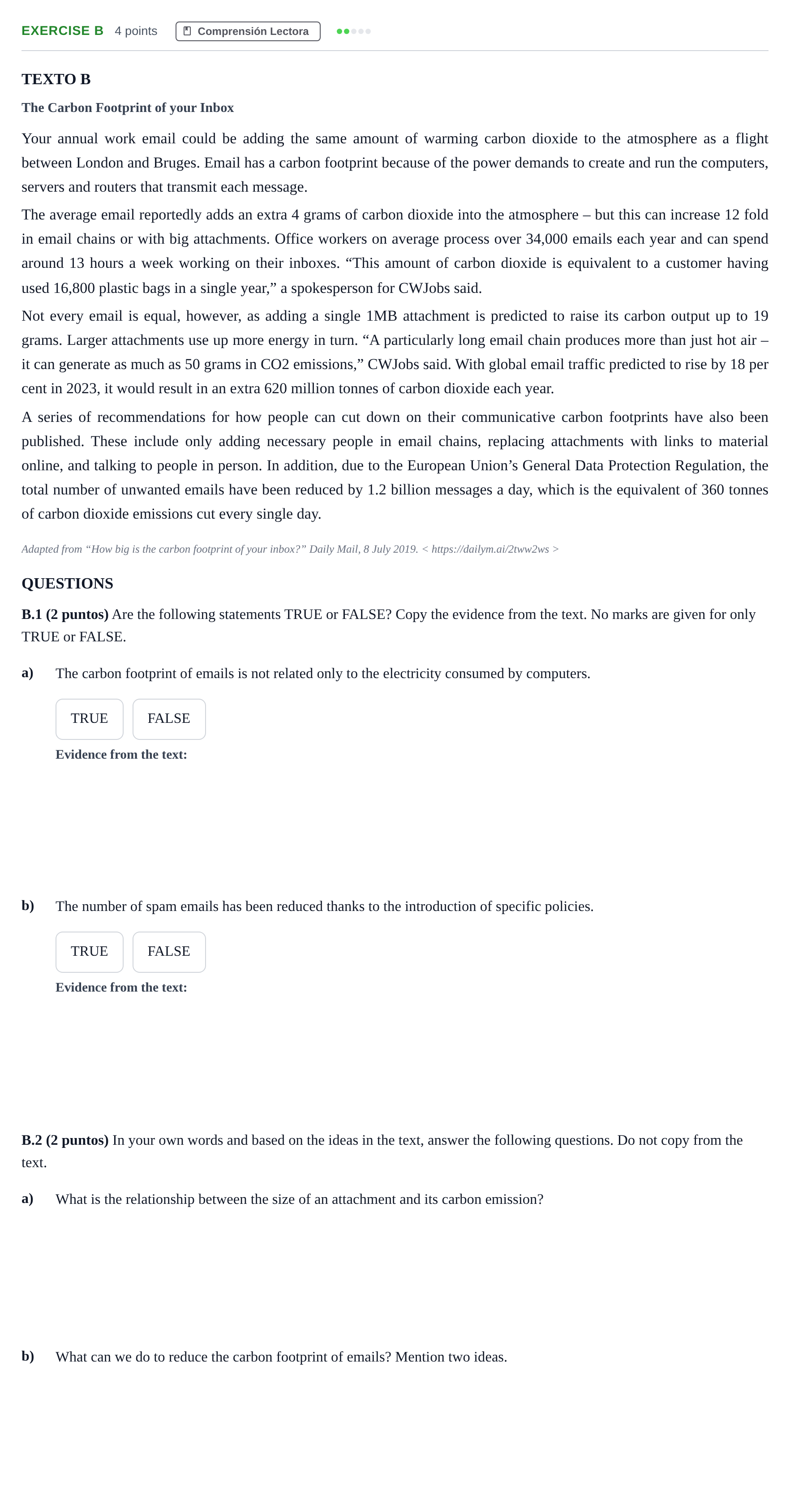
Your annual work email could be adding the same amount of warming carbon dioxide to the atmosphere as a flight between London and Bruges. Email has a carbon footprint because of the power demands to create and run the computers, servers and routers that transmit each message.
The average email reportedly adds an extra 4 grams of carbon dioxide into the atmosphere – but this can increase 12 fold in email chains or with big attachments. Office workers on average process over 34,000 emails each year and can spend around 13 hours a week working on their inboxes. “This amount of carbon dioxide is equivalent to a customer having used 16,800 plastic bags in a single year,” a spokesperson for CWJobs said.
Not every email is equal, however, as adding a single 1MB attachment is predicted to raise its carbon output up to 19 grams. Larger attachments use up more energy in turn. “A particularly long email chain produces more than just hot air – it can generate as much as 50 grams in CO2 emissions,” CWJobs said. With global email traffic predicted to rise by 18 per cent in 2023, it would result in an extra 620 million tonnes of carbon dioxide each year.
A series of recommendations for how people can cut down on their communicative carbon footprints have also been published. These include only adding necessary people in email chains, replacing attachments with links to material online, and talking to people in person. In addition, due to the European Union’s General Data Protection Regulation, the total number of unwanted emails have been reduced by 1.2 billion messages a day, which is the equivalent of 360 tonnes of carbon dioxide emissions cut every single day.
Adapted from “How big is the carbon footprint of your inbox?” Daily Mail, 8 July 2019. < https://dailym.ai/2tww2ws >
QUESTIONS
B.1 (2 puntos) Are the following statements TRUE or FALSE? Copy the evidence from the text. No marks are given for only TRUE or FALSE.
a)
The carbon footprint of emails is not related only to the electricity consumed by computers.
TRUE
FALSE
b)
The number of spam emails has been reduced thanks to the introduction of specific policies.
TRUE
FALSE
B.2 (2 puntos) In your own words and based on the ideas in the text, answer the following questions. Do not copy from the text.
a)
What is the relationship between the size of an attachment and its carbon emission?
b)
What can we do to reduce the carbon footprint of emails? Mention two ideas.
Solución
Según los criterios oficiales de corrección
B.1 True/False options
Solución: a) TRUE; b) TRUE
B.1 a) The carbon footprint of emails is not related only to the electricity consumed by computers.
Solución: TRUE: "Email has a carbon footprint because of the power demands to create and run the computers, servers and routers that transmit each message."
B.1 b) The number of spam emails has been reduced thanks to the introduction of specific policies.
Solución: TRUE: "In addition, due to the European Union’s General Data Protection Regulation, the total number of unwanted emails have been reduced by 1.2 billion messages a day, which is the equivalent of 360 tonnes of carbon dioxide emissions cut every single day."
B.2 a) What is the relationship between the size of an attachment and its carbon emission?
Solución: The larger the attachment, the more power is needed. This leads to greater carbon emissions.
B.2 b) What can we do to reduce the carbon footprint of emails? Mention two ideas.
Solución: Avoid attachments and use website links instead; think about the number of people we really need to email; make face-to-face communication a priority.
La explicación paso a paso, hecha con IA, es Premium. Premium
Resuélvelo aquí mismo: corrección automática, pistas y solución paso a paso.
‹ Ejercicio A · Ordinaria Martes 2020 · Opción A · Extraordinaria 2019 ›
Más ejercicios de Comprensión Lectora
- Ejercicio A · Ordinaria (2ª lengua) Coincidencias 2020
- Ejercicio B · Ordinaria (2ª lengua) Coincidencias 2020
- Ejercicio A · Ordinaria Lunes 2020
- Ejercicio B · Ordinaria Lunes 2020
- Ejercicio A · Ordinaria Martes 2020
- Opción A · Extraordinaria 2019
- Opción B · Extraordinaria 2019
- Opción A · Extraordinaria (2ª lengua) 2019
- Opción B · Extraordinaria (2ª lengua) 2019
- Opción A - Preguntas 1 y 2 · Modelo 2019