Opción A - Preguntas 1 y 2 · Inglés PAU Madrid Modelo 2019
Tema: Comprensión Lectora · Del examen Modelo (2019)
Enunciado
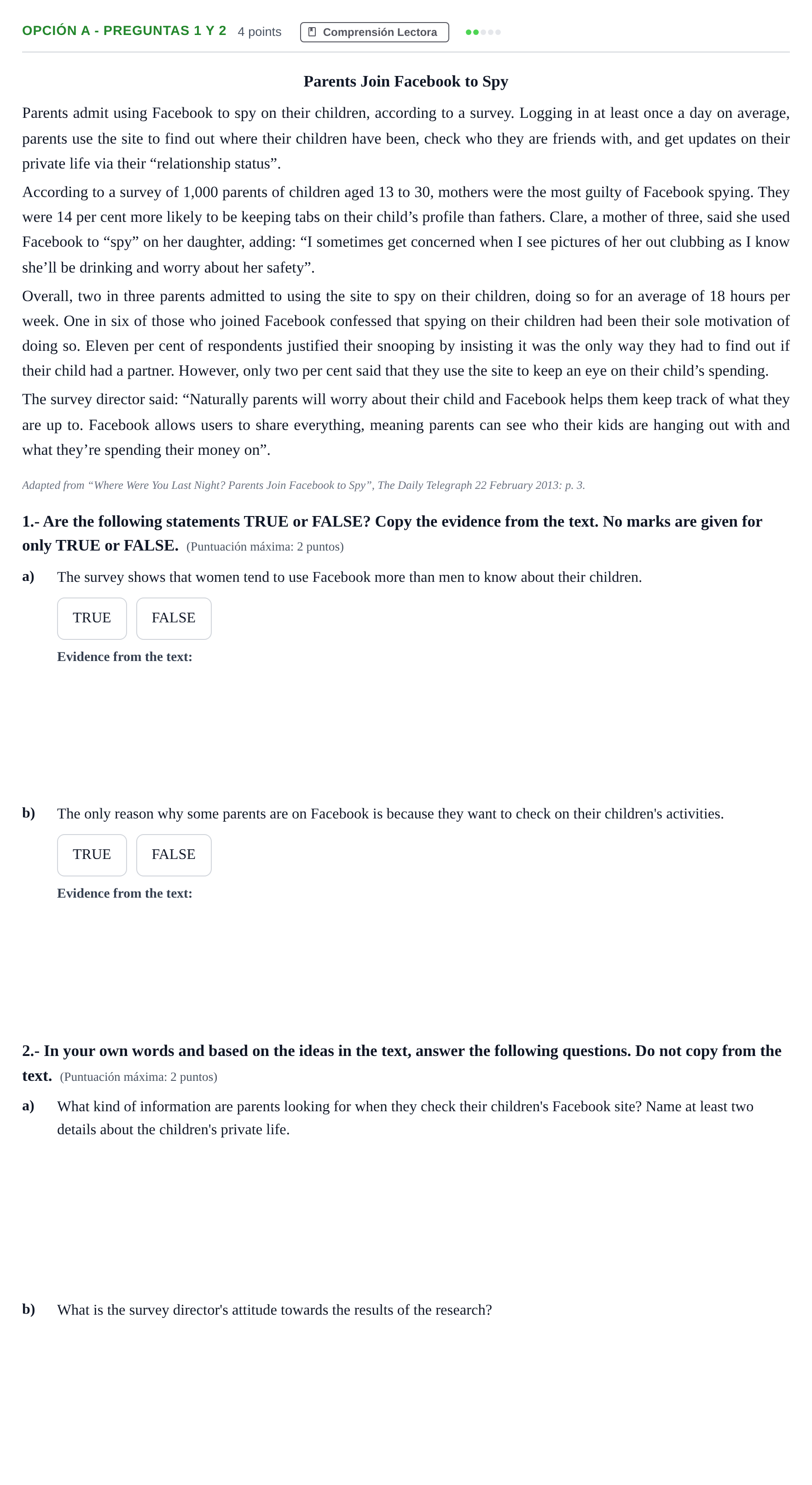
Parents Join Facebook to Spy
Parents admit using Facebook to spy on their children, according to a survey. Logging in at least once a day on average, parents use the site to find out where their children have been, check who they are friends with, and get updates on their private life via their “relationship status”.
According to a survey of 1,000 parents of children aged 13 to 30, mothers were the most guilty of Facebook spying. They were 14 per cent more likely to be keeping tabs on their child’s profile than fathers. Clare, a mother of three, said she used Facebook to “spy” on her daughter, adding: “I sometimes get concerned when I see pictures of her out clubbing as I know she’ll be drinking and worry about her safety”.
Overall, two in three parents admitted to using the site to spy on their children, doing so for an average of 18 hours per week. One in six of those who joined Facebook confessed that spying on their children had been their sole motivation of doing so. Eleven per cent of respondents justified their snooping by insisting it was the only way they had to find out if their child had a partner. However, only two per cent said that they use the site to keep an eye on their child’s spending.
The survey director said: “Naturally parents will worry about their child and Facebook helps them keep track of what they are up to. Facebook allows users to share everything, meaning parents can see who their kids are hanging out with and what they’re spending their money on”.
Adapted from “Where Were You Last Night? Parents Join Facebook to Spy”, The Daily Telegraph 22 February 2013: p. 3.
1.- Are the following statements TRUE or FALSE? Copy the evidence from the text. No marks are given for only TRUE or FALSE. (Puntuación máxima: 2 puntos)
a)
The survey shows that women tend to use Facebook more than men to know about their children.
TRUE
FALSE
b)
The only reason why some parents are on Facebook is because they want to check on their children's activities.
TRUE
FALSE
2.- In your own words and based on the ideas in the text, answer the following questions. Do not copy from the text. (Puntuación máxima: 2 puntos)
a)
What kind of information are parents looking for when they check their children's Facebook site? Name at least two details about the children's private life.
b)
What is the survey director's attitude towards the results of the research?
Solución
Según los criterios oficiales de corrección
1. Are the following statements TRUE or FALSE?
Solución: a) TRUE b) TRUE
1. a) The survey shows that women tend to use Facebook more than men to know about their children. Evidence:
Solución: "They were 14 per cent more likely to be keeping tabs on their child’s profile than fathers."
1. b) The only reason why some parents are on Facebook is because they want to check on their children's activities. Evidence:
Solución: "One in six of those who joined Facebook confessed that spying on their children had been their sole motivation of doing so."
2. a) What kind of information are parents looking for when they check their children's Facebook site? Name at least two details about the children's private life.
Solución: Parents want to find out where their children go to and who their friends are / whether they drink a lot / whether they have a boyfriend or a girlfriend / Some parents also want to know how their children spend their money.
2. b) What is the survey director's attitude towards the results of the research?
Solución: The survey director understands parents' behaviour, since Facebook is a very useful tool to keep an eye on their children.
La explicación paso a paso, hecha con IA, es Premium. Premium
Resuélvelo aquí mismo: corrección automática, pistas y solución paso a paso.
‹ Opción B · Extraordinaria (2ª lengua) 2019 · Opción B - Preguntas 1 y 2 · Modelo 2019 ›
Más ejercicios de Comprensión Lectora
- Ejercicio B · Ordinaria Martes 2020
- Opción A · Extraordinaria 2019
- Opción B · Extraordinaria 2019
- Opción A · Extraordinaria (2ª lengua) 2019
- Opción B · Extraordinaria (2ª lengua) 2019
- Opción B - Preguntas 1 y 2 · Modelo 2019
- Opción A - Pregunta 1 · Ordinaria 2019
- Opción A - Pregunta 2 · Ordinaria 2019
- Opción B - Pregunta 1 · Ordinaria 2019
- Opción B - Pregunta 2 · Ordinaria 2019