Opción A · Inglés PAU Madrid Extraordinaria 2019
Tema: Comprensión Lectora · Del examen Extraordinaria (2019)
Enunciado
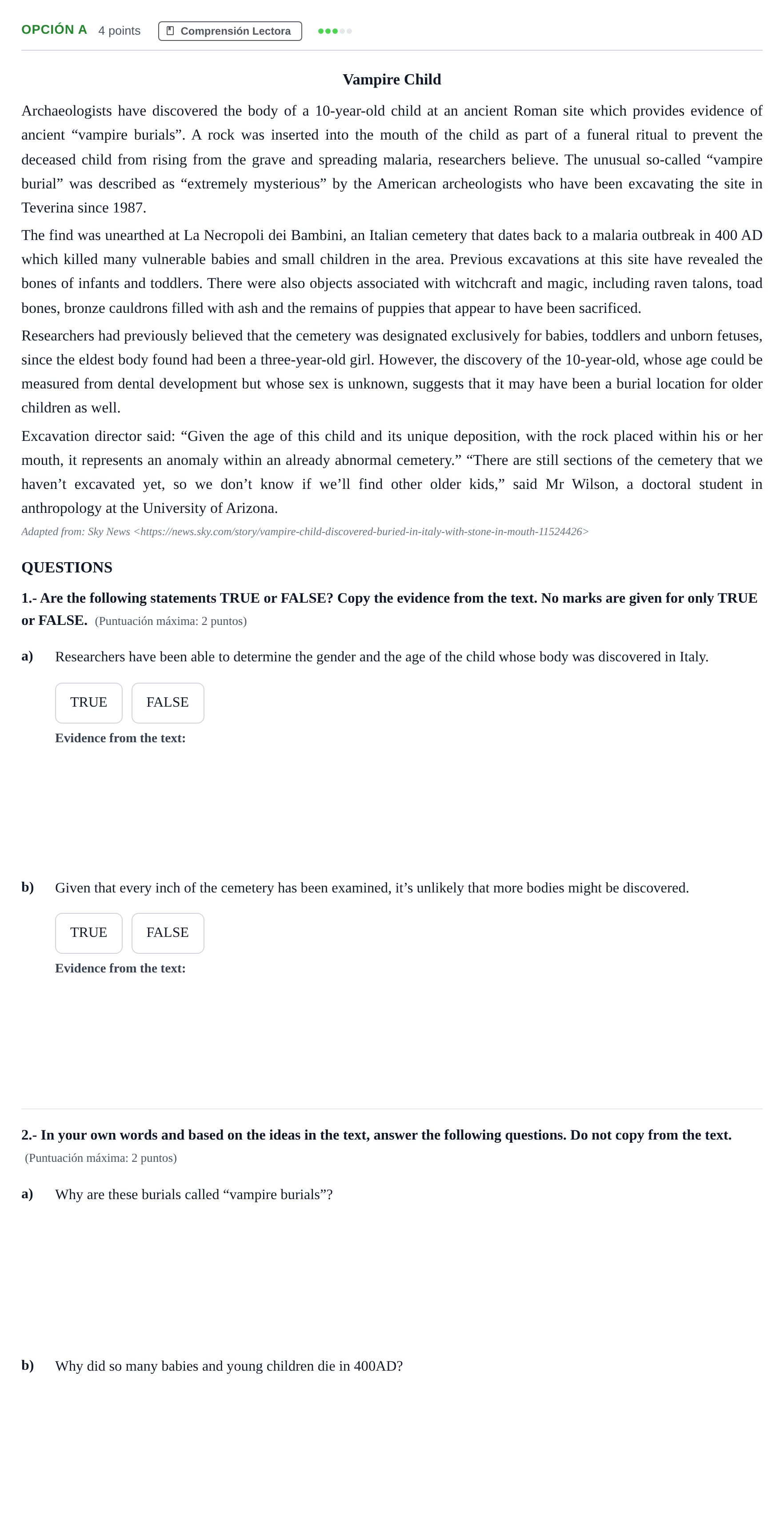
Vampire Child
Archaeologists have discovered the body of a 10-year-old child at an ancient Roman site which provides evidence of ancient “vampire burials”. A rock was inserted into the mouth of the child as part of a funeral ritual to prevent the deceased child from rising from the grave and spreading malaria, researchers believe. The unusual so-called “vampire burial” was described as “extremely mysterious” by the American archeologists who have been excavating the site in Teverina since 1987.
The find was unearthed at La Necropoli dei Bambini, an Italian cemetery that dates back to a malaria outbreak in 400 AD which killed many vulnerable babies and small children in the area. Previous excavations at this site have revealed the bones of infants and toddlers. There were also objects associated with witchcraft and magic, including raven talons, toad bones, bronze cauldrons filled with ash and the remains of puppies that appear to have been sacrificed.
Researchers had previously believed that the cemetery was designated exclusively for babies, toddlers and unborn fetuses, since the eldest body found had been a three-year-old girl. However, the discovery of the 10-year-old, whose age could be measured from dental development but whose sex is unknown, suggests that it may have been a burial location for older children as well.
Excavation director said: “Given the age of this child and its unique deposition, with the rock placed within his or her mouth, it represents an anomaly within an already abnormal cemetery.” “There are still sections of the cemetery that we haven’t excavated yet, so we don’t know if we’ll find other older kids,” said Mr Wilson, a doctoral student in anthropology at the University of Arizona.
Adapted from: Sky News <https://news.sky.com/story/vampire-child-discovered-buried-in-italy-with-stone-in-mouth-11524426>
QUESTIONS
1.- Are the following statements TRUE or FALSE? Copy the evidence from the text. No marks are given for only TRUE or FALSE.
(Puntuación máxima: 2 puntos)
a)
Researchers have been able to determine the gender and the age of the child whose body was discovered in Italy.
TRUE
FALSE
b)
Given that every inch of the cemetery has been examined, it’s unlikely that more bodies might be discovered.
TRUE
FALSE
2.- In your own words and based on the ideas in the text, answer the following questions. Do not copy from the text.
(Puntuación máxima: 2 puntos)
a)
Why are these burials called “vampire burials”?
b)
Why did so many babies and young children die in 400AD?
Solución
Según los criterios oficiales de corrección
1.- Are the following statements TRUE or FALSE? Copy the evidence from the text.
Solución: a) FALSE b) FALSE
1. a) Evidence for: Researchers have been able to determine the gender and the age of the child whose body was discovered in Italy.
Solución: FALSE: "...whose age could be measured from dental development but whose sex is unknown..." (lines 13-14)
1. b) Evidence for: Given that every inch of the cemetery has been examined, it's unlikely that more bodies might be discovered.
Solución: FALSE: "...There are still sections of the cemetery that we haven't excavated yet, so we don't know if we'll find other older kids..." (lines 18-20)
2. a) Why are these burials called “vampire burials”?
Solución: Because people used to insert a stone into the corpse's mouth so that the dead child could not wake up and transmit malaria to the living.
2. b) Why did so many babies and young children die in 400AD?
Solución: Because there was a severe outbreak of malaria in the area, and young children and babies were particularly vulnerable to the illness.
La explicación paso a paso, hecha con IA, es Premium. Premium
Resuélvelo aquí mismo: corrección automática, pistas y solución paso a paso.
‹ Ejercicio B · Ordinaria Martes 2020 · Opción B · Extraordinaria 2019 ›
Más ejercicios de Comprensión Lectora
- Ejercicio B · Ordinaria (2ª lengua) Coincidencias 2020
- Ejercicio A · Ordinaria Lunes 2020
- Ejercicio B · Ordinaria Lunes 2020
- Ejercicio A · Ordinaria Martes 2020
- Ejercicio B · Ordinaria Martes 2020
- Opción B · Extraordinaria 2019
- Opción A · Extraordinaria (2ª lengua) 2019
- Opción B · Extraordinaria (2ª lengua) 2019
- Opción A - Preguntas 1 y 2 · Modelo 2019
- Opción B - Preguntas 1 y 2 · Modelo 2019