Part 1 - Option 2 - Question 2 · Inglés PAU Cantabria Extraordinaria 2026
Tema: Preguntas abiertas con tus propias palabras (Answer the questions) · Del examen Extraordinaria (2026)
Enunciado
Option 2.
Overtourism
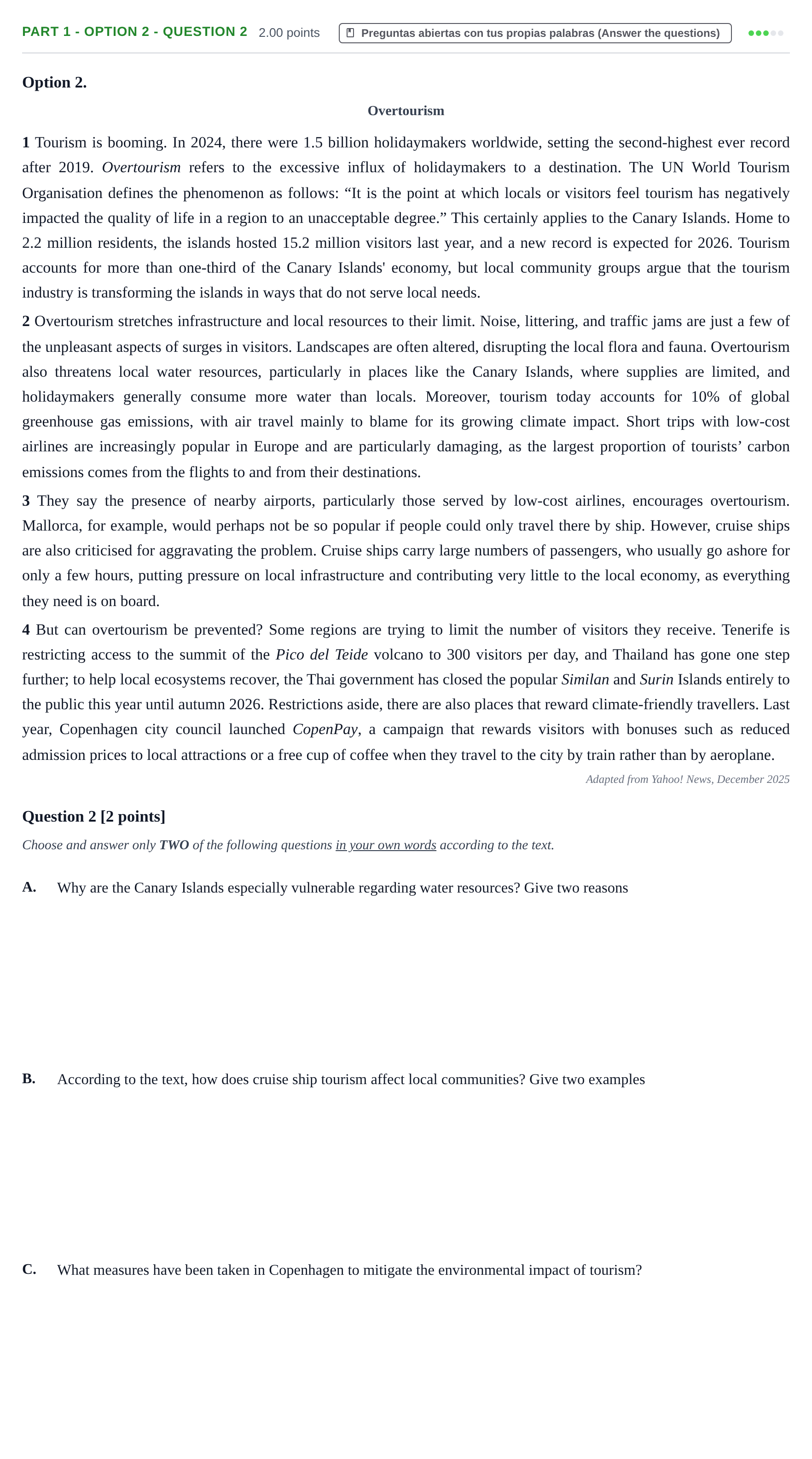
1 Tourism is booming. In 2024, there were 1.5 billion holidaymakers worldwide, setting the second-highest ever record after 2019. Overtourism refers to the excessive influx of holidaymakers to a destination. The UN World Tourism Organisation defines the phenomenon as follows: “It is the point at which locals or visitors feel tourism has negatively impacted the quality of life in a region to an unacceptable degree.” This certainly applies to the Canary Islands. Home to 2.2 million residents, the islands hosted 15.2 million visitors last year, and a new record is expected for 2026. Tourism accounts for more than one-third of the Canary Islands' economy, but local community groups argue that the tourism industry is transforming the islands in ways that do not serve local needs.
2 Overtourism stretches infrastructure and local resources to their limit. Noise, littering, and traffic jams are just a few of the unpleasant aspects of surges in visitors. Landscapes are often altered, disrupting the local flora and fauna. Overtourism also threatens local water resources, particularly in places like the Canary Islands, where supplies are limited, and holidaymakers generally consume more water than locals. Moreover, tourism today accounts for 10% of global greenhouse gas emissions, with air travel mainly to blame for its growing climate impact. Short trips with low-cost airlines are increasingly popular in Europe and are particularly damaging, as the largest proportion of tourists’ carbon emissions comes from the flights to and from their destinations.
3 They say the presence of nearby airports, particularly those served by low-cost airlines, encourages overtourism. Mallorca, for example, would perhaps not be so popular if people could only travel there by ship. However, cruise ships are also criticised for aggravating the problem. Cruise ships carry large numbers of passengers, who usually go ashore for only a few hours, putting pressure on local infrastructure and contributing very little to the local economy, as everything they need is on board.
4 But can overtourism be prevented? Some regions are trying to limit the number of visitors they receive. Tenerife is restricting access to the summit of the Pico del Teide volcano to 300 visitors per day, and Thailand has gone one step further; to help local ecosystems recover, the Thai government has closed the popular Similan and Surin Islands entirely to the public this year until autumn 2026. Restrictions aside, there are also places that reward climate-friendly travellers. Last year, Copenhagen city council launched CopenPay, a campaign that rewards visitors with bonuses such as reduced admission prices to local attractions or a free cup of coffee when they travel to the city by train rather than by aeroplane.
Adapted from Yahoo! News, December 2025
Question 2 [2 points]
Choose and answer only TWO of the following questions in your own words according to the text.
A.
Why are the Canary Islands especially vulnerable regarding water resources? Give two reasons
B.
According to the text, how does cruise ship tourism affect local communities? Give two examples
C.
What measures have been taken in Copenhagen to mitigate the environmental impact of tourism?
Solución
Según los criterios oficiales de corrección
A. Why are the Canary Islands especially vulnerable regarding water resources? Give two reasons
Solución: The Canary Islands are vulnerable because their water supplies are limited, and tourists generally consume more water than local residents.
B. According to the text, how does cruise ship tourism affect local communities? Give two examples
Solución: Cruise ships bring large crowds that put pressure on local infrastructure, and passengers usually spend very little time and money locally, contributing little to the economy.
C. What measures have been taken in Copenhagen to mitigate the environmental impact of tourism?
Solución: The Copenhagen city council launched CopenPay, a campaign that rewards tourists who travel by train instead of flying with perks such as cheaper entrance tickets to attractions or free coffee.
La explicación paso a paso, hecha con IA, es Premium. Premium
Resuélvelo aquí mismo: corrección automática, pistas y solución paso a paso.
‹ Part 1 - Option 1 - Question 2 · Extraordinaria 2026 · Part 1 - Option 1 - Question 2 · Ordinaria 2026 ›
Más ejercicios de Preguntas abiertas con tus propias palabras (Answer the questions)
- Part 1 - Option 1 - Question 2 · Extraordinaria 2026
- Part 1 - Option 1 - Question 2 · Ordinaria 2026
- Part 1 - Option 2 - Question 2 · Ordinaria 2026
- Ejercicio Option 1 - Question 2 · Extraordinaria 2025
- Ejercicio Option 2 - Question 2 · Extraordinaria 2025
- Ejercicio Option 1 - Question 2 · Ordinaria 2025
- Ejercicio Option 2 - Question 2 · Ordinaria 2025
- Ejercicio Option 1 - Question 2 · Extraordinaria 2024
- Ejercicio Option 2 - Question 2 · Extraordinaria 2024
- Ejercicio Option 1 - Question 2 · Ordinaria 2024