Ejercicio Grupo A - 3 · Inglés PAU Canarias Junio (Ciencias) 2021
Tema: Vocabulary: finding words or expressions in the text · Del examen Junio (Ciencias) (2021)
Enunciado
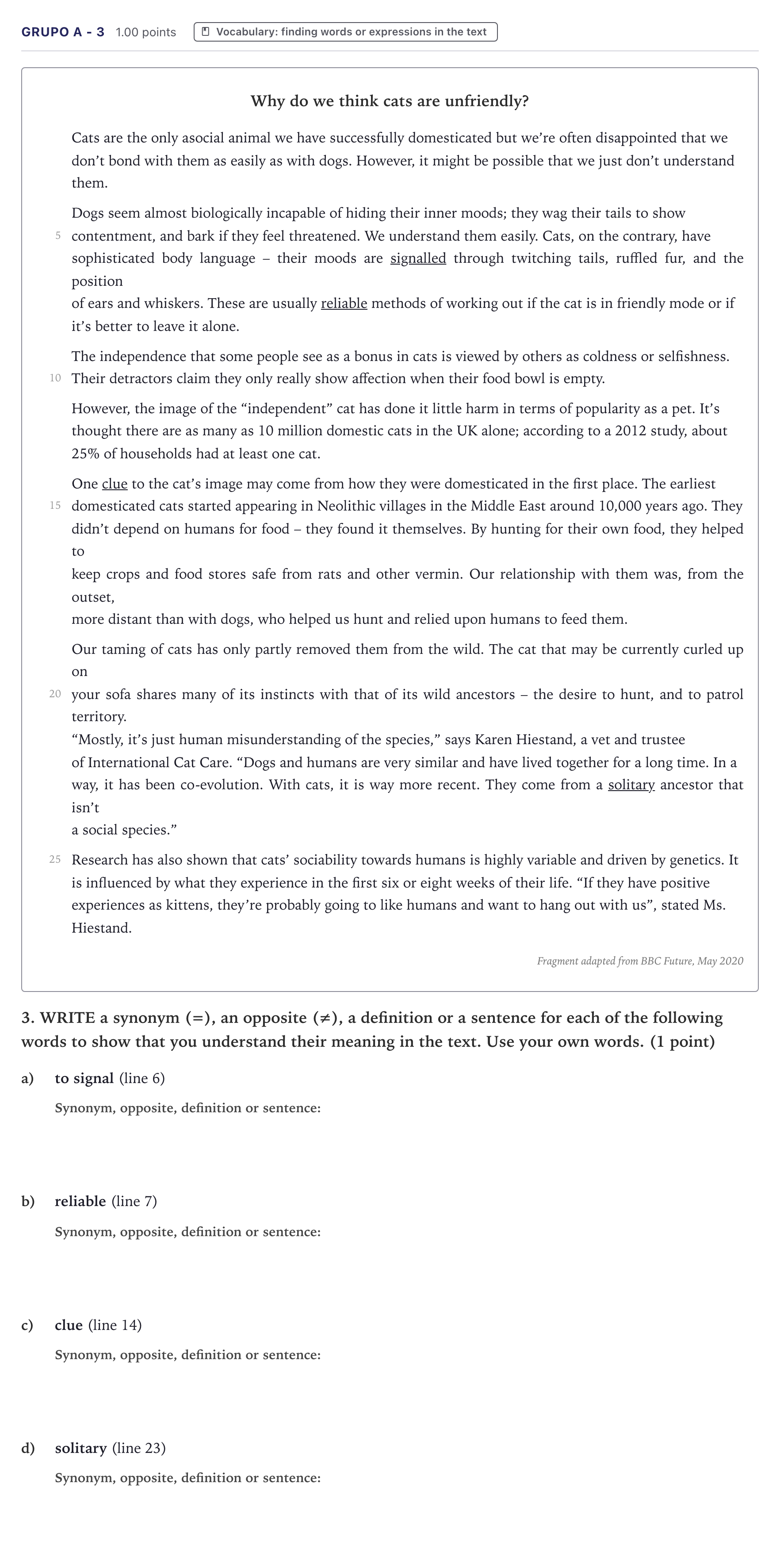
Why do we think cats are unfriendly?
Cats are the only asocial animal we have successfully domesticated but we’re often disappointed that we
don’t bond with them as easily as with dogs. However, it might be possible that we just don’t understand
them.
Dogs seem almost biologically incapable of hiding their inner moods; they wag their tails to show
5 contentment, and bark if they feel threatened. We understand them easily. Cats, on the contrary, have
sophisticated body language – their moods are signalled through twitching tails, ruffled fur, and the position
of ears and whiskers. These are usually reliable methods of working out if the cat is in friendly mode or if
it’s better to leave it alone.
The independence that some people see as a bonus in cats is viewed by others as coldness or selfishness.
10 Their detractors claim they only really show affection when their food bowl is empty.
However, the image of the “independent” cat has done it little harm in terms of popularity as a pet. It’s
thought there are as many as 10 million domestic cats in the UK alone; according to a 2012 study, about
25% of households had at least one cat.
One clue to the cat’s image may come from how they were domesticated in the first place. The earliest
15 domesticated cats started appearing in Neolithic villages in the Middle East around 10,000 years ago. They
didn’t depend on humans for food – they found it themselves. By hunting for their own food, they helped to
keep crops and food stores safe from rats and other vermin. Our relationship with them was, from the outset,
more distant than with dogs, who helped us hunt and relied upon humans to feed them.
Our taming of cats has only partly removed them from the wild. The cat that may be currently curled up on
20 your sofa shares many of its instincts with that of its wild ancestors – the desire to hunt, and to patrol territory.
“Mostly, it’s just human misunderstanding of the species,” says Karen Hiestand, a vet and trustee
of International Cat Care. “Dogs and humans are very similar and have lived together for a long time. In a
way, it has been co-evolution. With cats, it is way more recent. They come from a solitary ancestor that isn’t
a social species.”
25 Research has also shown that cats’ sociability towards humans is highly variable and driven by genetics. It
is influenced by what they experience in the first six or eight weeks of their life. “If they have positive
experiences as kittens, they’re probably going to like humans and want to hang out with us”, stated Ms.
Hiestand.
Fragment adapted from BBC Future, May 2020
3. WRITE a synonym (=), an opposite (≠), a definition or a sentence for each of the following words to show that you understand their meaning in the text. Use your own words. (1 point)
a)
b)
c)
d)
Solución
Según los criterios oficiales de corrección
a) to signal (line 6)
Solución: indicate / show / communicate / hide
b) reliable (line 7)
Solución: dependable / trustworthy / safe / unreliable
c) clue (line 14)
Solución: hint / sign / indication / evidence
d) solitary (line 23)
Solución: alone / lonely / isolated / social
La explicación paso a paso, hecha con IA, es Premium. Premium
Resuélvelo aquí mismo: corrección automática, pistas y solución paso a paso.
‹ Ejercicio Grupo B - 3 · Julio 2021 · Ejercicio Grupo B - 3 · Junio (Ciencias) 2021 ›
Más ejercicios de Vocabulary: finding words or expressions in the text
- Ejercicio Grupo B - 3 · Junio (Ciencias) 2022
- Ejercicio Grupo A - 3 · Junio (Humanidades) 2022
- Ejercicio Grupo B - 3 · Junio (Humanidades) 2022
- Ejercicio Grupo A - 3 · Julio 2021
- Ejercicio Grupo B - 3 · Julio 2021
- Ejercicio Grupo B - 3 · Junio (Ciencias) 2021
- Ejercicio Grupo A - 3 · Junio (Humanidades) 2021
- Ejercicio Grupo B - 3 · Junio (Humanidades) 2021