Ejercicio Grupo B - 3 · Inglés PAU Canarias Junio (Humanidades) 2021
Tema: Vocabulary: finding words or expressions in the text · Del examen Junio (Humanidades) (2021)
Enunciado
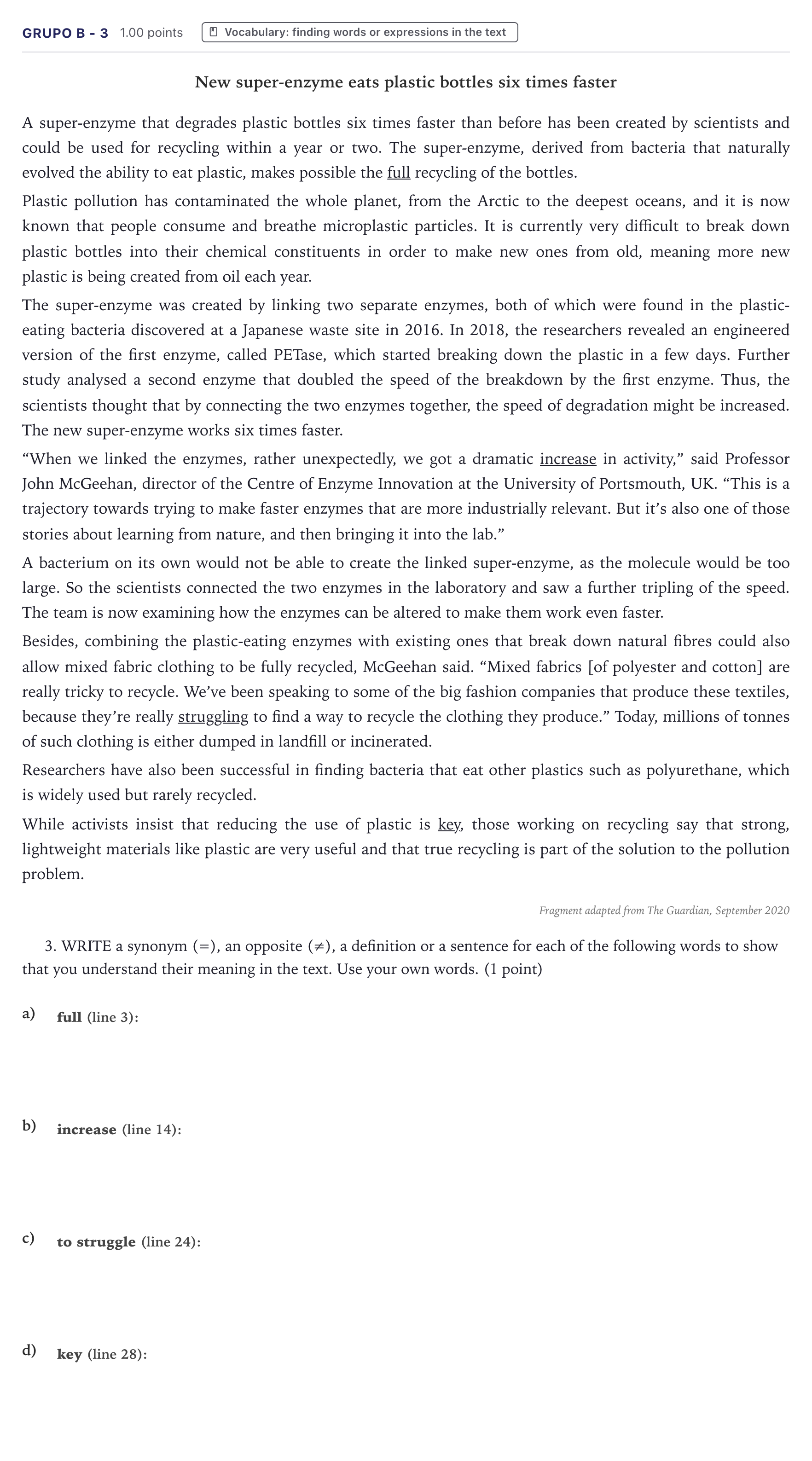
New super-enzyme eats plastic bottles six times faster
A super-enzyme that degrades plastic bottles six times faster than before has been created by scientists and could be used for recycling within a year or two. The super-enzyme, derived from bacteria that naturally evolved the ability to eat plastic, makes possible the full recycling of the bottles.
Plastic pollution has contaminated the whole planet, from the Arctic to the deepest oceans, and it is now known that people consume and breathe microplastic particles. It is currently very difficult to break down plastic bottles into their chemical constituents in order to make new ones from old, meaning more new plastic is being created from oil each year.
The super-enzyme was created by linking two separate enzymes, both of which were found in the plastic-eating bacteria discovered at a Japanese waste site in 2016. In 2018, the researchers revealed an engineered version of the first enzyme, called PETase, which started breaking down the plastic in a few days. Further study analysed a second enzyme that doubled the speed of the breakdown by the first enzyme. Thus, the scientists thought that by connecting the two enzymes together, the speed of degradation might be increased. The new super-enzyme works six times faster.
“When we linked the enzymes, rather unexpectedly, we got a dramatic increase in activity,” said Professor John McGeehan, director of the Centre of Enzyme Innovation at the University of Portsmouth, UK. “This is a trajectory towards trying to make faster enzymes that are more industrially relevant. But it’s also one of those stories about learning from nature, and then bringing it into the lab.”
A bacterium on its own would not be able to create the linked super-enzyme, as the molecule would be too large. So the scientists connected the two enzymes in the laboratory and saw a further tripling of the speed. The team is now examining how the enzymes can be altered to make them work even faster.
Besides, combining the plastic-eating enzymes with existing ones that break down natural fibres could also allow mixed fabric clothing to be fully recycled, McGeehan said. “Mixed fabrics [of polyester and cotton] are really tricky to recycle. We’ve been speaking to some of the big fashion companies that produce these textiles, because they’re really struggling to find a way to recycle the clothing they produce.” Today, millions of tonnes of such clothing is either dumped in landfill or incinerated.
Researchers have also been successful in finding bacteria that eat other plastics such as polyurethane, which is widely used but rarely recycled.
While activists insist that reducing the use of plastic is key, those working on recycling say that strong, lightweight materials like plastic are very useful and that true recycling is part of the solution to the pollution problem.
Fragment adapted from The Guardian, September 2020
3. WRITE a synonym (=), an opposite (≠), a definition or a sentence for each of the following words to show that you understand their meaning in the text. Use your own words. (1 point)
a)
b)
c)
d)
Solución
Según los criterios oficiales de corrección
a) full (line 3)
Solución: Synonyms: complete, total, entire / Opposites: partial, incomplete / Definition: containing all that is normal or possible; complete.
b) increase (line 14)
Solución: Synonyms: rise, growth, surge, boost / Opposites: decrease, reduction, fall / Definition: a rise in the size, amount, or degree of something.
c) to struggle (line 24)
Solución: Synonyms: to strive, to find it difficult, to labour / Opposites: to succeed easily, to manage effortlessly / Definition: to make forceful or strenuous efforts to overcome a difficulty.
d) key (line 28)
Solución: Synonyms: crucial, essential, vital, fundamental / Opposites: secondary, unimportant, irrelevant / Definition: of paramount or crucial importance.
La explicación paso a paso, hecha con IA, es Premium. Premium
Resuélvelo aquí mismo: corrección automática, pistas y solución paso a paso.
‹ Ejercicio Grupo A - 3 · Junio (Humanidades) 2021