Ejercicio Grupo A - 3 · Inglés PAU Canarias Junio (Humanidades) 2022
Tema: Vocabulary: finding words or expressions in the text · Del examen Junio (Humanidades) (2022)
Enunciado
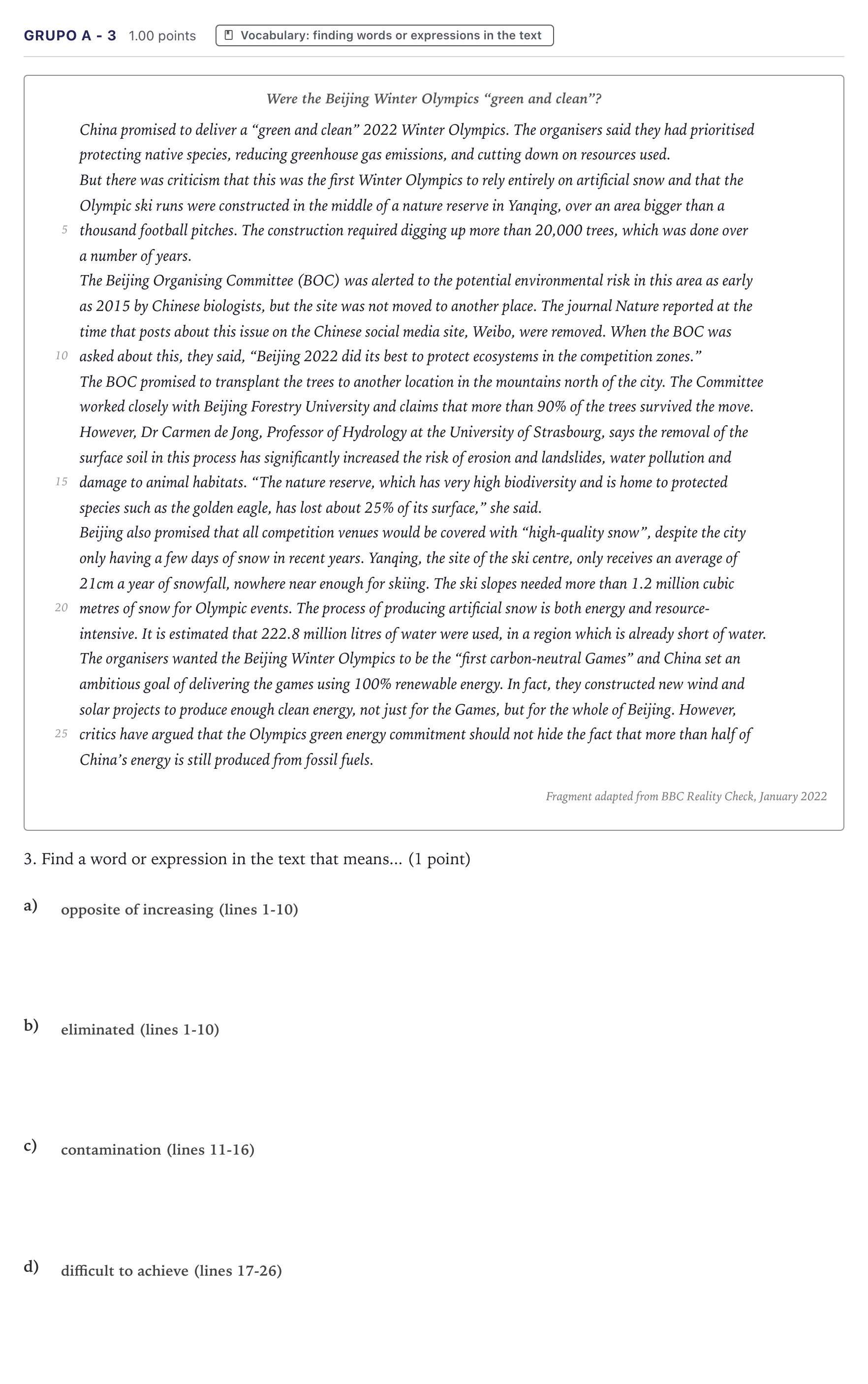
Were the Beijing Winter Olympics “green and clean”?
China promised to deliver a “green and clean” 2022 Winter Olympics. The organisers said they had prioritised
protecting native species, reducing greenhouse gas emissions, and cutting down on resources used.
But there was criticism that this was the first Winter Olympics to rely entirely on artificial snow and that the
Olympic ski runs were constructed in the middle of a nature reserve in Yanqing, over an area bigger than a
5 thousand football pitches. The construction required digging up more than 20,000 trees, which was done over
a number of years.
The Beijing Organising Committee (BOC) was alerted to the potential environmental risk in this area as early
as 2015 by Chinese biologists, but the site was not moved to another place. The journal Nature reported at the
time that posts about this issue on the Chinese social media site, Weibo, were removed. When the BOC was
10 asked about this, they said, “Beijing 2022 did its best to protect ecosystems in the competition zones.”
The BOC promised to transplant the trees to another location in the mountains north of the city. The Committee
worked closely with Beijing Forestry University and claims that more than 90% of the trees survived the move.
However, Dr Carmen de Jong, Professor of Hydrology at the University of Strasbourg, says the removal of the
surface soil in this process has significantly increased the risk of erosion and landslides, water pollution and
15 damage to animal habitats. “The nature reserve, which has very high biodiversity and is home to protected
species such as the golden eagle, has lost about 25% of its surface,” she said.
Beijing also promised that all competition venues would be covered with “high-quality snow”, despite the city
only having a few days of snow in recent years. Yanqing, the site of the ski centre, only receives an average of
21cm a year of snowfall, nowhere near enough for skiing. The ski slopes needed more than 1.2 million cubic
20 metres of snow for Olympic events. The process of producing artificial snow is both energy and resource-
intensive. It is estimated that 222.8 million litres of water were used, in a region which is already short of water.
The organisers wanted the Beijing Winter Olympics to be the “first carbon-neutral Games” and China set an
ambitious goal of delivering the games using 100% renewable energy. In fact, they constructed new wind and
solar projects to produce enough clean energy, not just for the Games, but for the whole of Beijing. However,
25 critics have argued that the Olympics green energy commitment should not hide the fact that more than half of
China’s energy is still produced from fossil fuels.
Fragment adapted from BBC Reality Check, January 2022
3. Find a word or expression in the text that means... (1 point)
a)
b)
c)
d)
Solución
Según los criterios oficiales de corrección
a) opposite of increasing (lines 1-10)
Solución: reducing / cutting down
b) eliminated (lines 1-10)
Solución: removed
c) contamination (lines 11-16)
Solución: pollution / water pollution
d) difficult to achieve (lines 17-26)
Solución: ambitious
La explicación paso a paso, hecha con IA, es Premium. Premium
Resuélvelo aquí mismo: corrección automática, pistas y solución paso a paso.
‹ Ejercicio Grupo B - 3 · Junio (Ciencias) 2022 · Ejercicio Grupo B - 3 · Junio (Humanidades) 2022 ›
Más ejercicios de Vocabulary: finding words or expressions in the text
- Ejercicio Grupo B - Pregunta 3 · Junio (Humanidades) 2023
- Ejercicio Grupo A - 3 · Julio 2022
- Ejercicio Grupo B - 3 · Julio 2022
- Ejercicio Grupo A - 3 · Junio (Ciencias) 2022
- Ejercicio Grupo B - 3 · Junio (Ciencias) 2022
- Ejercicio Grupo B - 3 · Junio (Humanidades) 2022
- Ejercicio Grupo A - 3 · Julio 2021
- Ejercicio Grupo B - 3 · Julio 2021
- Ejercicio Grupo A - 3 · Junio (Ciencias) 2021
- Ejercicio Grupo B - 3 · Junio (Ciencias) 2021