Ejercicio Texto A - Preguntas 1-4 · Inglés PAU Asturias Ordinaria 2021
Tema: Preguntas de comprensión con tus propias palabras (Questions on the text) · Del examen Ordinaria (2021)
Enunciado
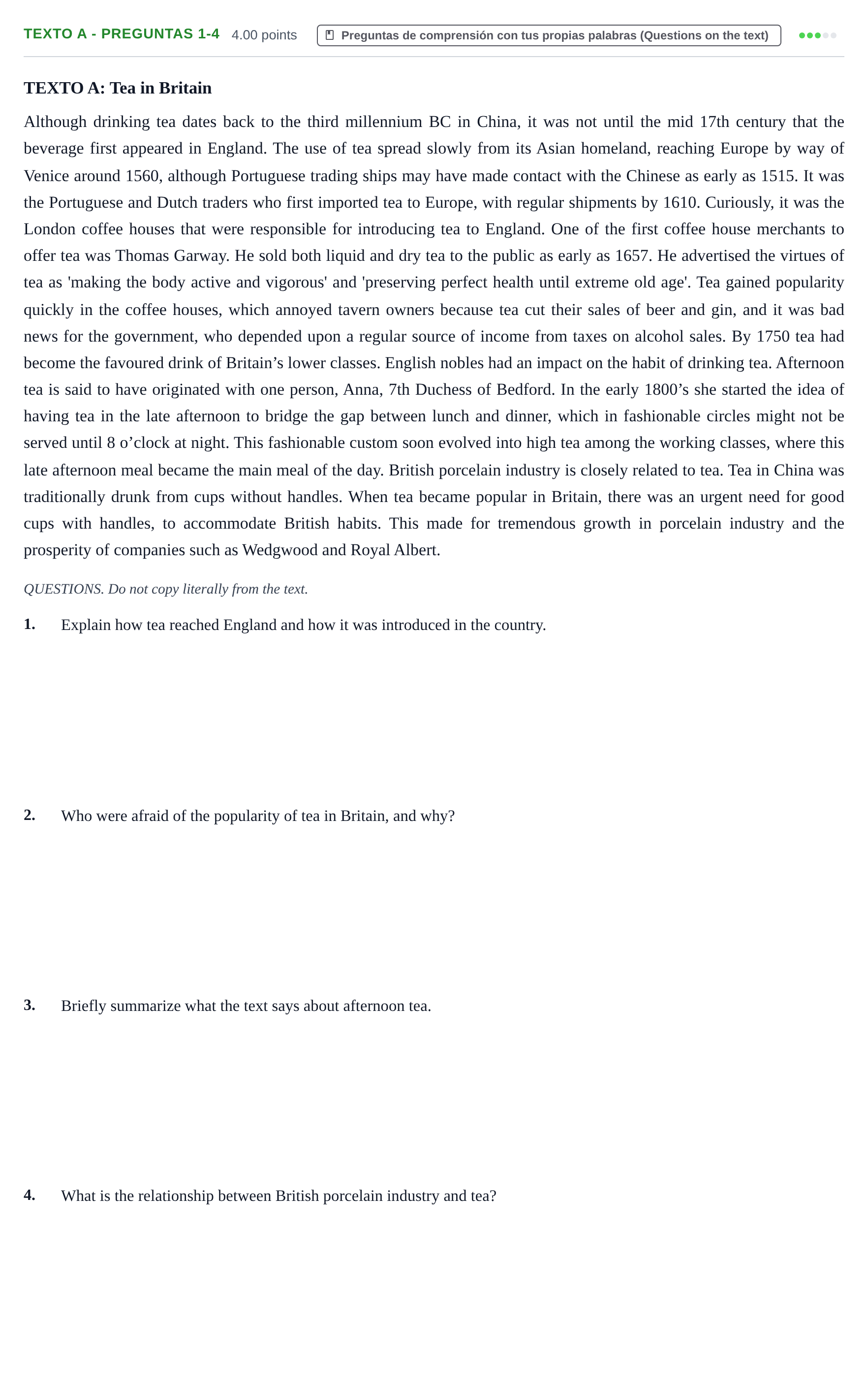
TEXTO A: Tea in Britain
Although drinking tea dates back to the third millennium BC in China, it was not until the mid 17th century that the beverage first appeared in England. The use of tea spread slowly from its Asian homeland, reaching Europe by way of Venice around 1560, although Portuguese trading ships may have made contact with the Chinese as early as 1515. It was the Portuguese and Dutch traders who first imported tea to Europe, with regular shipments by 1610. Curiously, it was the London coffee houses that were responsible for introducing tea to England. One of the first coffee house merchants to offer tea was Thomas Garway. He sold both liquid and dry tea to the public as early as 1657. He advertised the virtues of tea as 'making the body active and vigorous' and 'preserving perfect health until extreme old age'. Tea gained popularity quickly in the coffee houses, which annoyed tavern owners because tea cut their sales of beer and gin, and it was bad news for the government, who depended upon a regular source of income from taxes on alcohol sales. By 1750 tea had become the favoured drink of Britain’s lower classes. English nobles had an impact on the habit of drinking tea. Afternoon tea is said to have originated with one person, Anna, 7th Duchess of Bedford. In the early 1800’s she started the idea of having tea in the late afternoon to bridge the gap between lunch and dinner, which in fashionable circles might not be served until 8 o’clock at night. This fashionable custom soon evolved into high tea among the working classes, where this late afternoon meal became the main meal of the day. British porcelain industry is closely related to tea. Tea in China was traditionally drunk from cups without handles. When tea became popular in Britain, there was an urgent need for good cups with handles, to accommodate British habits. This made for tremendous growth in porcelain industry and the prosperity of companies such as Wedgwood and Royal Albert.
QUESTIONS. Do not copy literally from the text.
1.
Explain how tea reached England and how it was introduced in the country.
2.
Who were afraid of the popularity of tea in Britain, and why?
3.
Briefly summarize what the text says about afternoon tea.
4.
What is the relationship between British porcelain industry and tea?
Solución
Según los criterios oficiales de corrección
1. Explain how tea reached England and how it was introduced in the country.
Solución: Originally from China, tea got to Europe in the mid 17th century via Venice into the British Isles thanks to Portuguese ships, and Portuguese and Dutch traders. Tea was introduced in England through the London coffee houses. Thomas Garway, one of the first merchants to offer tea, advertised it as particularly healthy for the body.
2. Who were afraid of the popularity of tea in Britain, and why?
Solución: Tavern owners and the government were afraid of the popularity of tea in Britain. On the one hand, tavern owners saw a decrease in beer and gin sales; on the other hand, the government got a lower income from taxes on the selling of alcohol.
3. Briefly summarize what the text says about afternoon tea.
Solución: Its origin is found in Anna, 7th Duchess of Bedford, who invented the idea of having tea late in the afternoon between lunch time and dinner time. The working classes followed this stylish habit and made it into high tea, their main meal of the day.
4. What is the relationship between British porcelain industry and tea?
Solución: There is a strong link between the two. In China tea used to be drunk from cups without handles. However, the British habits of drinking tea required good cups with handles, which stimulated the growth of porcelain industry as well as the prosperity of companies such as Wedgwood and Royal Albert.
La explicación paso a paso, hecha con IA, es Premium. Premium
Resuélvelo aquí mismo: corrección automática, pistas y solución paso a paso.
‹ Ejercicio Texto B - Preguntas 1-4 · Extraordinaria (2ª lengua extranjera) 2021 · Ejercicio Texto B - Preguntas 1-4 · Ordinaria 2021 ›
Más ejercicios de Preguntas de comprensión con tus propias palabras (Questions on the text)
- Ejercicio Texto B - Preguntas 1-4 · Ordinaria (2ª lengua extranjera) 2022
- Ejercicio Texto A - Preguntas 1-4 · Extraordinaria 2021
- Ejercicio Texto B - Preguntas 1-4 · Extraordinaria 2021
- Ejercicio Texto A - Preguntas 1-4 · Extraordinaria (2ª lengua extranjera) 2021
- Ejercicio Texto B - Preguntas 1-4 · Extraordinaria (2ª lengua extranjera) 2021
- Ejercicio Texto B - Preguntas 1-4 · Ordinaria 2021
- Ejercicio Texto A - Questions 1-4 · Ordinaria (2ª lengua extranjera) 2021
- Ejercicio Texto B - Questions 1-4 · Ordinaria (2ª lengua extranjera) 2021