Bloque A · Inglés PAU Andalucía Extraordinaria Titular (Admisión) 2025
Tema: Comprensión Lectora · Del examen Extraordinaria Titular (Admisión) (2025)
Enunciado
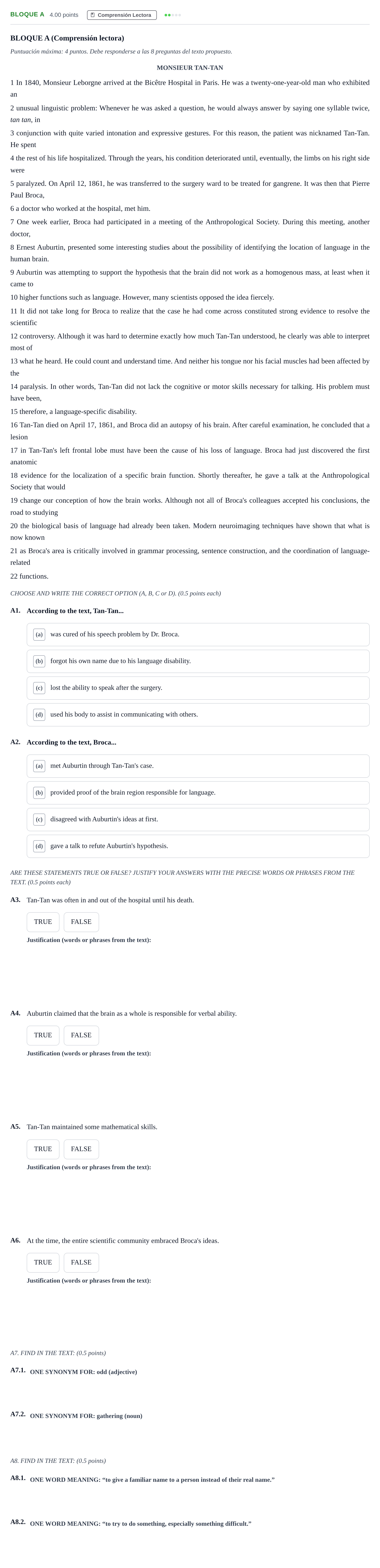
BLOQUE A (Comprensión lectora)
Puntuación máxima: 4 puntos. Debe responderse a las 8 preguntas del texto propuesto.
MONSIEUR TAN-TAN
1 In 1840, Monsieur Leborgne arrived at the Bicêtre Hospital in Paris. He was a twenty-one-year-old man who exhibited an
2 unusual linguistic problem: Whenever he was asked a question, he would always answer by saying one syllable twice, tan tan, in
3 conjunction with quite varied intonation and expressive gestures. For this reason, the patient was nicknamed Tan-Tan. He spent
4 the rest of his life hospitalized. Through the years, his condition deteriorated until, eventually, the limbs on his right side were
5 paralyzed. On April 12, 1861, he was transferred to the surgery ward to be treated for gangrene. It was then that Pierre Paul Broca,
6 a doctor who worked at the hospital, met him.
7 One week earlier, Broca had participated in a meeting of the Anthropological Society. During this meeting, another doctor,
8 Ernest Auburtin, presented some interesting studies about the possibility of identifying the location of language in the human brain.
9 Auburtin was attempting to support the hypothesis that the brain did not work as a homogenous mass, at least when it came to
10 higher functions such as language. However, many scientists opposed the idea fiercely.
11 It did not take long for Broca to realize that the case he had come across constituted strong evidence to resolve the scientific
12 controversy. Although it was hard to determine exactly how much Tan-Tan understood, he clearly was able to interpret most of
13 what he heard. He could count and understand time. And neither his tongue nor his facial muscles had been affected by the
14 paralysis. In other words, Tan-Tan did not lack the cognitive or motor skills necessary for talking. His problem must have been,
15 therefore, a language-specific disability.
16 Tan-Tan died on April 17, 1861, and Broca did an autopsy of his brain. After careful examination, he concluded that a lesion
17 in Tan-Tan's left frontal lobe must have been the cause of his loss of language. Broca had just discovered the first anatomic
18 evidence for the localization of a specific brain function. Shortly thereafter, he gave a talk at the Anthropological Society that would
19 change our conception of how the brain works. Although not all of Broca's colleagues accepted his conclusions, the road to studying
20 the biological basis of language had already been taken. Modern neuroimaging techniques have shown that what is now known
21 as Broca's area is critically involved in grammar processing, sentence construction, and the coordination of language-related
22 functions.
CHOOSE AND WRITE THE CORRECT OPTION (A, B, C or D). (0.5 points each)
A1.
According to the text, Tan-Tan...
A2.
According to the text, Broca...
ARE THESE STATEMENTS TRUE OR FALSE? JUSTIFY YOUR ANSWERS WITH THE PRECISE WORDS OR PHRASES FROM THE TEXT. (0.5 points each)
TRUE
FALSE
A7. FIND IN THE TEXT: (0.5 points)
A7.1.
A7.2.
A8. FIND IN THE TEXT: (0.5 points)
A8.1.
A8.2.
Solución
Según los criterios oficiales de corrección
A1. According to the text, Tan-Tan...
Solución: (d) used his body to assist in communicating with others.
A2. According to the text, Broca...
Solución: (b) provided proof of the brain region responsible for language.
A3. Tan-Tan was often in and out of the hospital until his death. (Justification)
Solución: "He spent the rest of his life hospitalized." (lines 3-4)
A4. Auburtin claimed that the brain as a whole is responsible for verbal ability. (Justification)
Solución: "Auburtin was attempting to support the hypothesis that the brain did not work as a homogenous mass, at least when it came to higher functions such as language." (lines 9-10)
A5. Tan-Tan maintained some mathematical skills. (Justification)
Solución: "He could count (and understand time)." (line 13)
A6. At the time, the entire scientific community embraced Broca's ideas. (Justification)
Solución: "Although not all of Broca's colleagues accepted his conclusions (, the road to studying the biological basis of language had already been taken)." (lines 19-20)
A7.1. ONE SYNONYM FOR: odd (adjective)
Solución: unusual
A7.2. ONE SYNONYM FOR: gathering (noun)
Solución: meeting
A8.1. ONE WORD MEANING: "to give a familiar name to a person instead of their real name."
Solución: nickname / nicknamed
A8.2. ONE WORD MEANING: "to try to do something, especially something difficult."
Solución: attempt / attempting
La explicación paso a paso, hecha con IA, es Premium. Premium
Resuélvelo aquí mismo: corrección automática, pistas y solución paso a paso.
‹ Bloque A · Extraordinaria Titular (Acceso) 2025 · Bloque A · Ordinaria Suplente 1 2025 ›
Más ejercicios de Comprensión Lectora
- Bloque A · Ordinaria Titular (Acceso) 2026
- Bloque A · Ordinaria Titular (Admisión) 2026
- Bloque A · Extraordinaria Suplente 1 2025
- Bloque A · Extraordinaria Suplente 2 2025
- Bloque A · Extraordinaria Titular (Acceso) 2025
- Bloque A · Ordinaria Suplente 1 2025
- Bloque A · Ordinaria Suplente 2 2025
- Bloque A · Ordinaria Titular (Acceso) 2025
- Bloque A · Ordinaria Titular (Admisión) 2025
- Bloque A - Text 1 · Extraordinaria Reserva 2024