Bloque A · Inglés PAU Andalucía Ordinaria Titular (Admisión) 2026
Tema: Comprensión Lectora · Del examen Ordinaria Titular (Admisión) (2026)
Enunciado
BLOQUE A (Comprensión lectora)
Puntuación máxima: 4 puntos. Debe responderse a las 8 preguntas del texto propuesto.
COMPREHENSION (4 points). READ THE TEXT AND ANSWER ALL THE QUESTIONS.
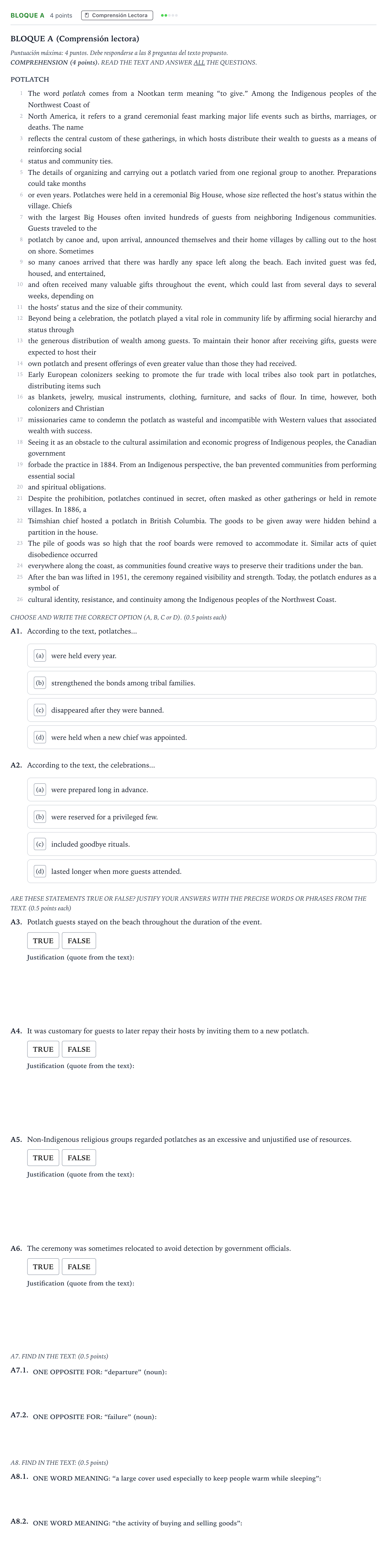
POTLATCH
1 The word potlatch comes from a Nootkan term meaning “to give.” Among the Indigenous peoples of the Northwest Coast of
2 North America, it refers to a grand ceremonial feast marking major life events such as births, marriages, or deaths. The name
3 reflects the central custom of these gatherings, in which hosts distribute their wealth to guests as a means of reinforcing social
4 status and community ties.
5 The details of organizing and carrying out a potlatch varied from one regional group to another. Preparations could take months
6 or even years. Potlatches were held in a ceremonial Big House, whose size reflected the host’s status within the village. Chiefs
7 with the largest Big Houses often invited hundreds of guests from neighboring Indigenous communities. Guests traveled to the
8 potlatch by canoe and, upon arrival, announced themselves and their home villages by calling out to the host on shore. Sometimes
9 so many canoes arrived that there was hardly any space left along the beach. Each invited guest was fed, housed, and entertained,
10 and often received many valuable gifts throughout the event, which could last from several days to several weeks, depending on
11 the hosts’ status and the size of their community.
12 Beyond being a celebration, the potlatch played a vital role in community life by affirming social hierarchy and status through
13 the generous distribution of wealth among guests. To maintain their honor after receiving gifts, guests were expected to host their
14 own potlatch and present offerings of even greater value than those they had received.
15 Early European colonizers seeking to promote the fur trade with local tribes also took part in potlatches, distributing items such
16 as blankets, jewelry, musical instruments, clothing, furniture, and sacks of flour. In time, however, both colonizers and Christian
17 missionaries came to condemn the potlatch as wasteful and incompatible with Western values that associated wealth with success.
18 Seeing it as an obstacle to the cultural assimilation and economic progress of Indigenous peoples, the Canadian government
19 forbade the practice in 1884. From an Indigenous perspective, the ban prevented communities from performing essential social
20 and spiritual obligations.
21 Despite the prohibition, potlatches continued in secret, often masked as other gatherings or held in remote villages. In 1886, a
22 Tsimshian chief hosted a potlatch in British Columbia. The goods to be given away were hidden behind a partition in the house.
23 The pile of goods was so high that the roof boards were removed to accommodate it. Similar acts of quiet disobedience occurred
24 everywhere along the coast, as communities found creative ways to preserve their traditions under the ban.
25 After the ban was lifted in 1951, the ceremony regained visibility and strength. Today, the potlatch endures as a symbol of
26 cultural identity, resistance, and continuity among the Indigenous peoples of the Northwest Coast.
CHOOSE AND WRITE THE CORRECT OPTION (A, B, C or D). (0.5 points each)
A1.
According to the text, potlatches...
A2.
According to the text, the celebrations...
ARE THESE STATEMENTS TRUE OR FALSE? JUSTIFY YOUR ANSWERS WITH THE PRECISE WORDS OR PHRASES FROM THE TEXT. (0.5 points each)
.
A7. FIND IN THE TEXT: (0.5 points)
A7.1.
A7.2.
A8. FIND IN THE TEXT: (0.5 points)
A8.1.
A8.2.
Solución
Solución de AprenAI (no es la oficial)
A1. According to the text, potlatches...
Solución: (b) strengthened the bonds among tribal families.
A2. According to the text, the celebrations...
Solución: (a) were prepared long in advance.
ARE THESE STATEMENTS TRUE OR FALSE? (A3 to A6)
Solución: A3: FALSE; A4: TRUE; A5: TRUE; A6: TRUE
A3. Justification: Potlatch guests stayed on the beach throughout the duration of the event.
Solución: "Each invited guest was fed, housed, and entertained, and often received many valuable gifts throughout the event, which could last from several days to several weeks, depending on the hosts' status and the size of their community." (lines 9-11)
A4. Justification: It was customary for guests to later repay their hosts by inviting them to a new potlatch.
Solución: "To maintain their honor after receiving gifts, guests were expected to host their own potlatch and present offerings of even greater value than those they had received." (lines 13-14)
A5. Justification: Non-Indigenous religious groups regarded potlatches as an excessive and unjustified use of resources.
Solución: "(In time, however, both colonizers and) Christian missionaries came to condemn the potlatch as wasteful (and incompatible with Western values that associated wealth with success)." (lines 16-17)
Las soluciones de los 5 apartados que faltan y la explicación paso a paso son Premium. Premium
Resuélvelo aquí mismo: corrección automática, pistas y solución paso a paso.
‹ Bloque A · Ordinaria Titular (Acceso) 2026 · Bloque A · Extraordinaria Suplente 1 2025 ›
Más ejercicios de Comprensión Lectora
- Bloque A · Extraordinaria Titular (Acceso) 2026
- Bloque A · Ordinaria Suplente 2 2026
- Bloque A · Ordinaria Titular (Acceso) 2026
- Bloque A · Extraordinaria Suplente 1 2025
- Bloque A · Extraordinaria Suplente 2 2025
- Bloque A · Extraordinaria Titular (Acceso) 2025
- Bloque A · Extraordinaria Titular (Admisión) 2025
- Bloque A · Ordinaria Suplente 1 2025
- Bloque A · Ordinaria Suplente 2 2025
- Bloque A · Ordinaria Titular (Acceso) 2025