Ejercicio Problem 9. Electron Orbital Transition and Deflec… · Física I URV Setembre
Tema: Forces centrals i camp gravitatori · Del examen Setembre
Enunciado
Problem 9. Electron Orbital Transition and Deflection Angle
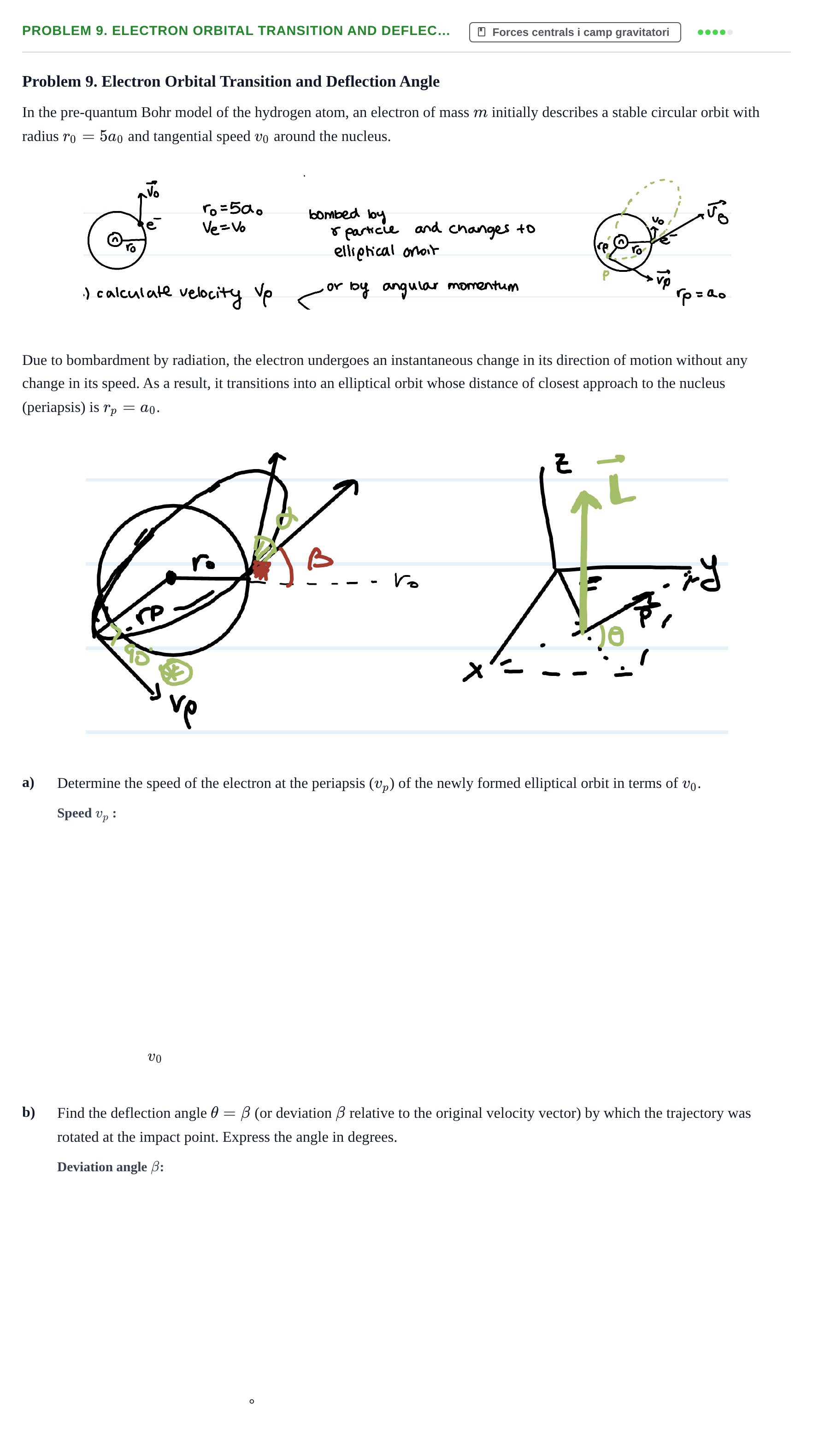
In the pre-quantum Bohr model of the hydrogen atom, an electron of mass initially describes a stable circular orbit with radius and tangential speed around the nucleus.
Due to bombardment by radiation, the electron undergoes an instantaneous change in its direction of motion without any change in its speed. As a result, it transitions into an elliptical orbit whose distance of closest approach to the nucleus (periapsis) is .
a)
Determine the speed of the electron at the periapsis () of the newly formed elliptical orbit in terms of .
b)
Find the deflection angle (or deviation relative to the original velocity vector) by which the trajectory was rotated at the impact point. Express the angle in degrees.
°
Solución
Según los criterios oficiales de corrección
a. Determine the speed of the electron at the periapsis () of the newly formed elliptical orbit in terms of .
Solución: 3 / 3v_0
b. Find the deflection angle (or deviation relative to the original velocity vector) by which the trajectory was rotated at the impact point.
Solución: 53.13° / 53.13 / arccos(0.6)
La explicación paso a paso, hecha con IA, es Premium. Premium
Resuélvelo aquí mismo: corrección automática, pistas y solución paso a paso.
‹ Ejercicio Qüestió Q2-B (Recuperació 2019-2020) · Recull d'exàmens de Física I · Ejercicio Exercise 2.b - Effective Central Potential Curves · Setembre ›
Más ejercicios de Forces centrals i camp gravitatori
- Ejercicio Abril 2014 - Problema · 2001
- Ejercicio Qüestió 2 · Examen de Física I
- Problema (10 punts) · Recull d'exàmens de Física I
- Ejercicio Qüestió 2 (Gener 2020) · Recull d'exàmens de Física I
- Ejercicio Qüestió Q2-B (Recuperació 2019-2020) · Recull d'exàmens de Física I
- Ejercicio Exercise 2.b - Effective Central Potential Curves · Setembre