Problema 4 · Biología URV Test Practice: Eukaryotes and Fungi
Tema: Protists: algues, protozous i paràsits · Del examen Test Practice: Eukaryotes and Fungi
Enunciado
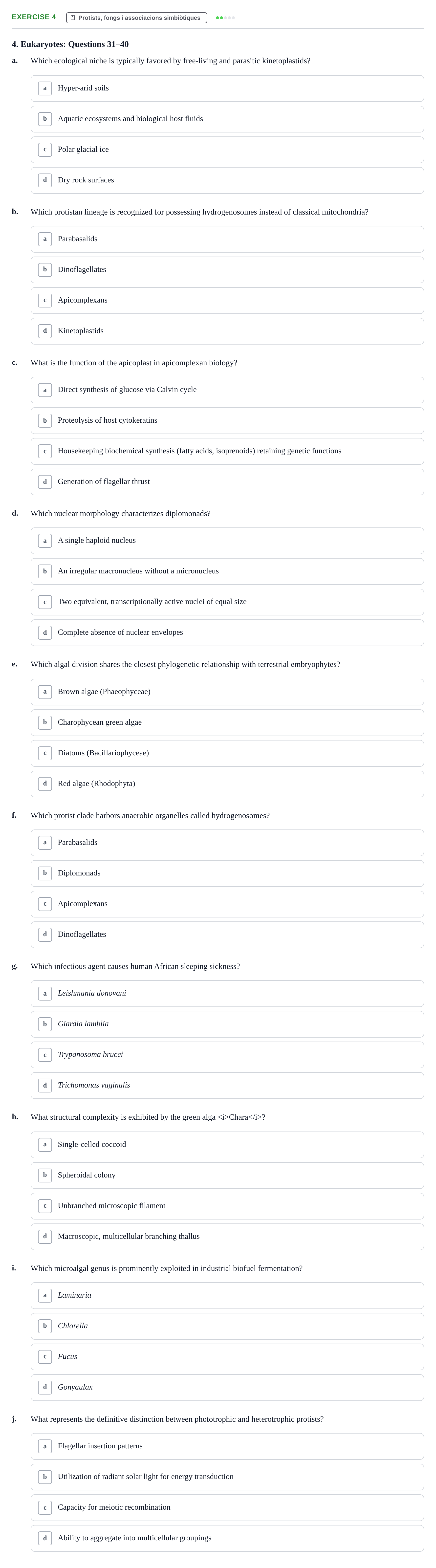
4. Eukaryotes: Questions 31–40
.
Solución
Según los criterios oficiales de corrección
a. Which ecological niche is typically favored by free-living and parasitic kinetoplastids?
Solución: b) Aquatic ecosystems and biological host fluids
b. Which protistan lineage is recognized for possessing hydrogenosomes instead of classical mitochondria?
Solución: a) Parabasalids
c. What is the function of the apicoplast in apicomplexan biology?
Solución: c) Housekeeping biochemical synthesis (fatty acids, isoprenoids) retaining genetic functions
d. Which nuclear morphology characterizes diplomonads?
Solución: c) Two equivalent, transcriptionally active nuclei of equal size
e. Which algal division shares the closest phylogenetic relationship with terrestrial embryophytes?
Solución: b) Charophycean green algae
f. Which protist clade harbors anaerobic organelles called hydrogenosomes?
Solución: a) Parabasalids
g. Which infectious agent causes human African sleeping sickness?
Solución: c) Trypanosoma brucei
h. What structural complexity is exhibited by the green alga Chara?
Solución: d) Macroscopic, multicellular branching thallus
i. Which microalgal genus is prominently exploited in industrial biofuel fermentation?
Solución: b) Chlorella
j. What represents the definitive distinction between phototrophic and heterotrophic protists?
Solución: b) Utilization of radiant solar light for energy transduction
La explicación paso a paso, hecha con IA, es Premium. Premium
Resuélvelo aquí mismo: corrección automática, pistas y solución paso a paso.
‹ Problema 3 · Test Practice: Eukaryotes and Fungi · Problema 5 · Test Practice: Eukaryotes and Fungi ›
Más ejercicios de Protists: algues, protozous i paràsits
- Ejercicio 5 - Protists, fongs i associacions simbiòtiques · Examen: Part 2 - Procariotes, Fongs i Origen de la Vida
- Ejercicio 6 - Protists, fongs i associacions simbiòtiques · Examen: Part 2 - Procariotes, Fongs i Origen de la Vida
- Problema 1 · Test Practice: Eukaryotes and Fungi
- Problema 2 · Test Practice: Eukaryotes and Fungi
- Problema 3 · Test Practice: Eukaryotes and Fungi
- Problema 5 · Test Practice: Eukaryotes and Fungi
- Problema 6 · Test Practice: Eukaryotes and Fungi