Problema 3 · Biología URV Test Practice: Eukaryotes and Fungi
Tema: Protists: algues, protozous i paràsits · Del examen Test Practice: Eukaryotes and Fungi
Enunciado
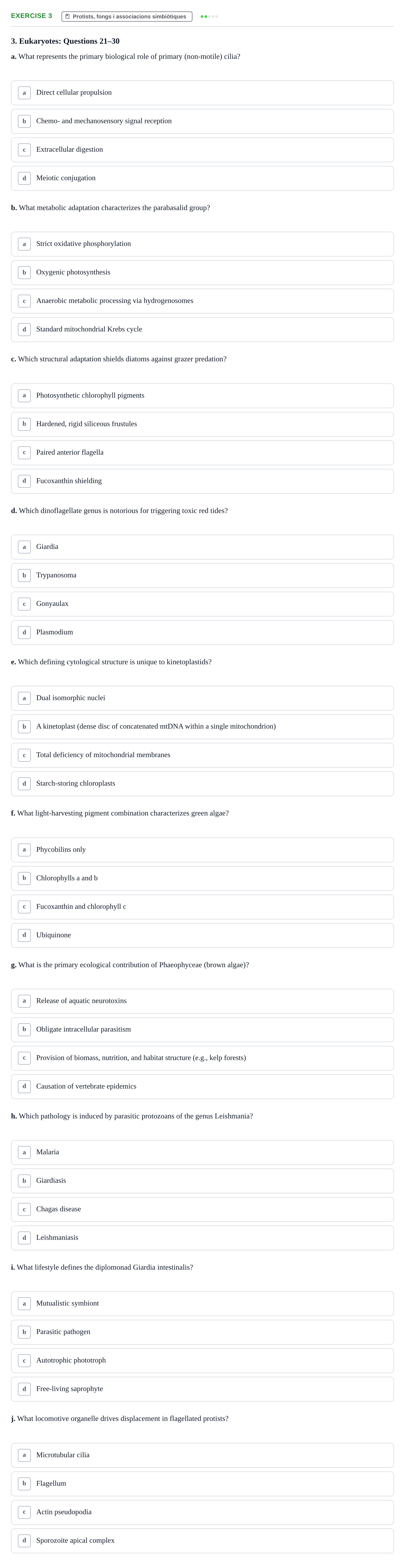
3. Eukaryotes: Questions 21–30
.
Solución
Según los criterios oficiales de corrección
a. What represents the primary biological role of primary (non-motile) cilia?
Solución: b) Chemo- and mechanosensory signal reception
b. What metabolic adaptation characterizes the parabasalid group?
Solución: c) Anaerobic metabolic processing via hydrogenosomes
c. Which structural adaptation shields diatoms against grazer predation?
Solución: b) Hardened, rigid siliceous frustules
d. Which dinoflagellate genus is notorious for triggering toxic red tides?
Solución: c) Gonyaulax
e. Which defining cytological structure is unique to kinetoplastids?
Solución: b) A kinetoplast (dense disc of concatenated mtDNA within a single mitochondrion)
f. What light-harvesting pigment combination characterizes green algae?
Solución: b) Chlorophylls a and b
g. What is the primary ecological contribution of Phaeophyceae (brown algae)?
Solución: c) Provision of biomass, nutrition, and habitat structure (e.g., kelp forests)
h. Which pathology is induced by parasitic protozoans of the genus Leishmania?
Solución: d) Leishmaniasis
i. What lifestyle defines the diplomonad Giardia intestinalis?
Solución: b) Parasitic pathogen
j. What locomotive organelle drives displacement in flagellated protists?
Solución: b) Flagellum
La explicación paso a paso, hecha con IA, es Premium. Premium
Resuélvelo aquí mismo: corrección automática, pistas y solución paso a paso.
‹ Problema 2 · Test Practice: Eukaryotes and Fungi · Problema 4 · Test Practice: Eukaryotes and Fungi ›
Más ejercicios de Protists: algues, protozous i paràsits
- Ejercicio 4 - Protists, fongs i associacions simbiòtiques · Examen: Part 2 - Procariotes, Fongs i Origen de la Vida
- Ejercicio 5 - Protists, fongs i associacions simbiòtiques · Examen: Part 2 - Procariotes, Fongs i Origen de la Vida
- Ejercicio 6 - Protists, fongs i associacions simbiòtiques · Examen: Part 2 - Procariotes, Fongs i Origen de la Vida
- Problema 1 · Test Practice: Eukaryotes and Fungi
- Problema 2 · Test Practice: Eukaryotes and Fungi
- Problema 4 · Test Practice: Eukaryotes and Fungi
- Problema 5 · Test Practice: Eukaryotes and Fungi
- Problema 6 · Test Practice: Eukaryotes and Fungi