Question 3 · Introducció a la Macroeconomia UPF 2021
Tema: Creixement a llarg termini: el model de Solow · Del examen Final Exam - March 2021 (2021)
Enunciado
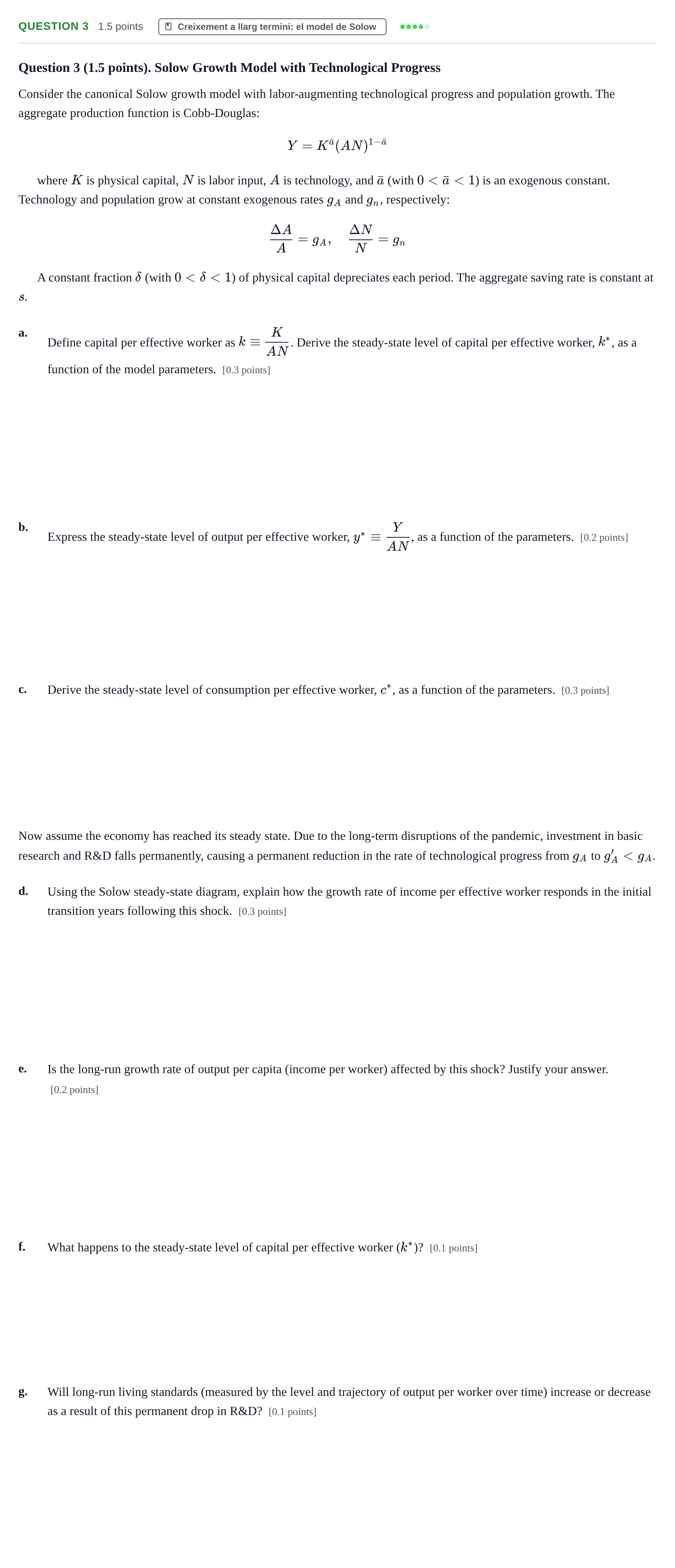
Question 3 (1.5 points). Solow Growth Model with Technological Progress
Consider the canonical Solow growth model with labor-augmenting technological progress and population growth. The aggregate production function is Cobb-Douglas:
where is physical capital, is labor input, is technology, and (with ) is an exogenous constant. Technology and population grow at constant exogenous rates and , respectively:
A constant fraction (with ) of physical capital depreciates each period. The aggregate saving rate is constant at .
a.
Define capital per effective worker as . Derive the steady-state level of capital per effective worker, , as a function of the model parameters. [0.3 points]
b.
Express the steady-state level of output per effective worker, , as a function of the parameters. [0.2 points]
c.
Derive the steady-state level of consumption per effective worker, , as a function of the parameters. [0.3 points]
Now assume the economy has reached its steady state. Due to the long-term disruptions of the pandemic, investment in basic research and R&D falls permanently, causing a permanent reduction in the rate of technological progress from to .
d.
Using the Solow steady-state diagram, explain how the growth rate of income per effective worker responds in the initial transition years following this shock. [0.3 points]
e.
Is the long-run growth rate of output per capita (income per worker) affected by this shock? Justify your answer. [0.2 points]
f.
What happens to the steady-state level of capital per effective worker ()? [0.1 points]
g.
Will long-run living standards (measured by the level and trajectory of output per worker over time) increase or decrease as a result of this permanent drop in R&D? [0.1 points]
Solución
Según los criterios oficiales de corrección
a. Define capital per effective worker as k ≡ K/(AN). Derive the steady-state level of capital per effective worker, k*, as a function of the model parameters.
Solución:
b. Express the steady-state level of output per effective worker, y* ≡ Y/(AN), as a function of the parameters.
Solución:
c. Derive the steady-state level of consumption per effective worker, c*, as a function of the parameters.
Solución:
a. (second part) Using the Solow steady-state diagram, explain how the growth rate of income per effective worker responds in the initial transition years following this shock.
Solución: The growth rate of income per effective worker temporarily becomes positive during the transition toward the new higher steady state.
b. (second part) Is the long-run growth rate of output per capita (income per worker) affected by this shock? Justify your answer.
Solución: Yes, it is permanently lowered from to .
c. (second part) What happens to the steady-state level of capital per effective worker (k*)?
Solución: The steady-state capital per effective worker increases ().
d. (second part) Will long-run living standards (measured by the level and trajectory of output per worker over time) increase or decrease as a result of this permanent drop in R&D?
Solución: Living standards will ultimately fall (decrease).
La explicación paso a paso, hecha con IA, es Premium. Premium
Resuélvelo aquí mismo: corrección automática, pistas y solución paso a paso.
‹ Part I - Creixement a llarg termini: el model de… · 2021 · Pregunta 7 · 2019 ›
Más ejercicios de Creixement a llarg termini: el model de Solow
- Ejercicio 2 - Creixement a llarg termini: el model de Solow · 2024
- Ejercicio 5 - Section C: The Solow growth model · 2024
- Part I - Creixement a llarg termini: el model de… · 2021
- Pregunta 7 · 2019
- Question 3 · 2019
- Question 18 · 2019
- Question 19 · 2019
- Question 20 · 2019
- Question 3 · 2019
- Part 1 - Question 3 · 2018