Question 3 · Introducció a la Macroeconomia UPF 2019
Tema: Creixement a llarg termini: el model de Solow · Del examen Final Exam - March 2019 (2019)
Enunciado
Question 3 (1.5 points). Solow-Swan growth model with technological progress
Consider the Solow-Swan model with labor-augmenting technical progress and population growth. The aggregate production function is given by:
where is physical capital, is labor, represents labor-augmenting technology, and is an exogenous parameter. The growth rate of technology is , the population/labor growth rate is , capital depreciates at constant rate , and the national saving rate is .
Part A (0.75 points, 0.15 points each): Express the steady-state values of the following variables in terms of exogenous parameters
a.
Capital per effective worker and output per effective worker .
b.
The long-run growth rate of aggregate GDP ().
c.
The long-run growth rate of output per worker ().
d.
The steady-state capital-output ratio ().
e.
Are standards of living improving while the economy is in steady state? Justify briefly.
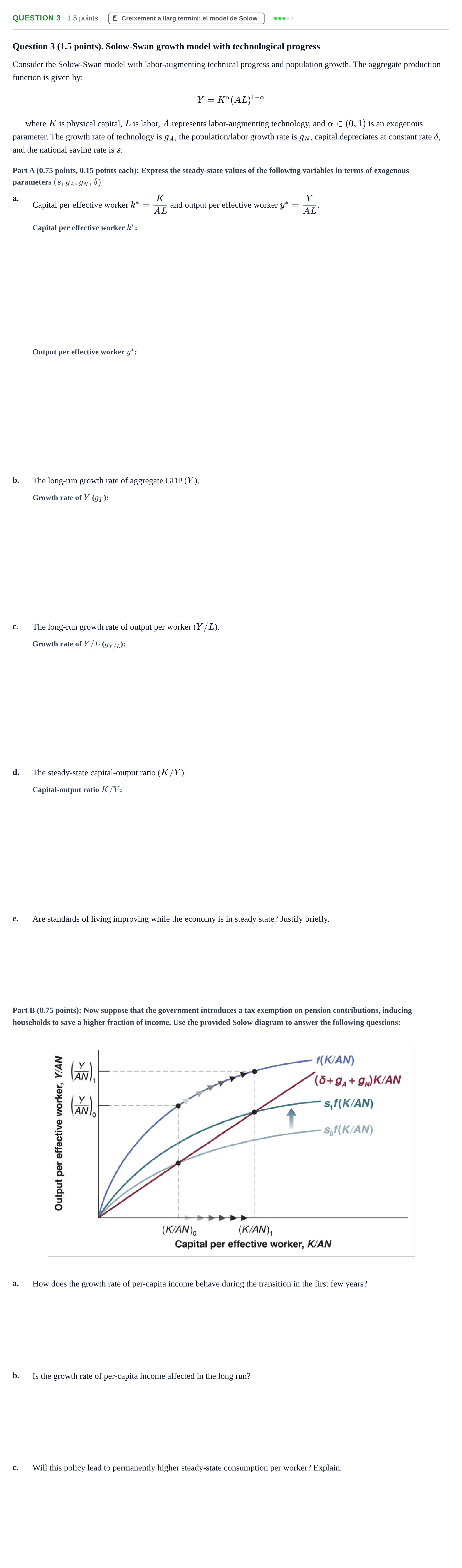
Part B (0.75 points): Now suppose that the government introduces a tax exemption on pension contributions, inducing households to save a higher fraction of income. Use the provided Solow diagram to answer the following questions:
a.
How does the growth rate of per-capita income behave during the transition in the first few years?
b.
Is the growth rate of per-capita income affected in the long run?
c.
Will this policy lead to permanently higher steady-state consumption per worker? Explain.
Solución
Según los criterios oficiales de corrección
a. Capital per effective worker
Solución:
a. Output per effective worker
Solución:
b. The long-run growth rate of aggregate GDP ()
Solución:
c. The long-run growth rate of output per worker ()
Solución:
d. The steady-state capital-output ratio ()
Solución:
e. Are standards of living improving while the economy is in steady state? Justify briefly.
Solución: Yes, because output per capita (and consequently per-capita consumption) grows continuously at the rate of technological progress .
Part B a. How does the growth rate of per-capita income behave during the transition in the first few years?
Solución: An increase from to shifts the saving curve upward to . Because investment exceeds break-even investment, capital deepening occurs. During the transitional years, the growth rate of per-capita income temporarily exceeds .
Part B b. Is the growth rate of per-capita income affected in the long run?
Solución: No. Once the economy reaches the new steady state , the growth rate of per-capita income returns to its original rate .
Part B c. Will this policy lead to permanently higher steady-state consumption per worker? Explain.
Solución: Not necessarily. While per-capita output is permanently higher, steady-state consumption per worker is . Consumption increases only if the original saving rate was below the Golden Rule level (); if the economy was already beyond the Golden Rule, higher saving reduces per-capita consumption.
La explicación paso a paso, hecha con IA, es Premium. Premium
Resuélvelo aquí mismo: corrección automática, pistas y solución paso a paso.
‹ Question 20 · 2019 · Part 1 - Question 3 · 2018 ›