Part 1 - Question 3 · Introducció a la Macroeconomia UPF 2018
Tema: Creixement a llarg termini: el model de Solow · Del examen Final Exam - April 2018 (2018)
Enunciado
Labor market, Phillips Curve, and IS-LM-PC model
Carefully analyze the article published in The New York Times (February 2018) under the headline “The Stock Market Is Worried About Inflation. Should It Be?” and answer the questions below.
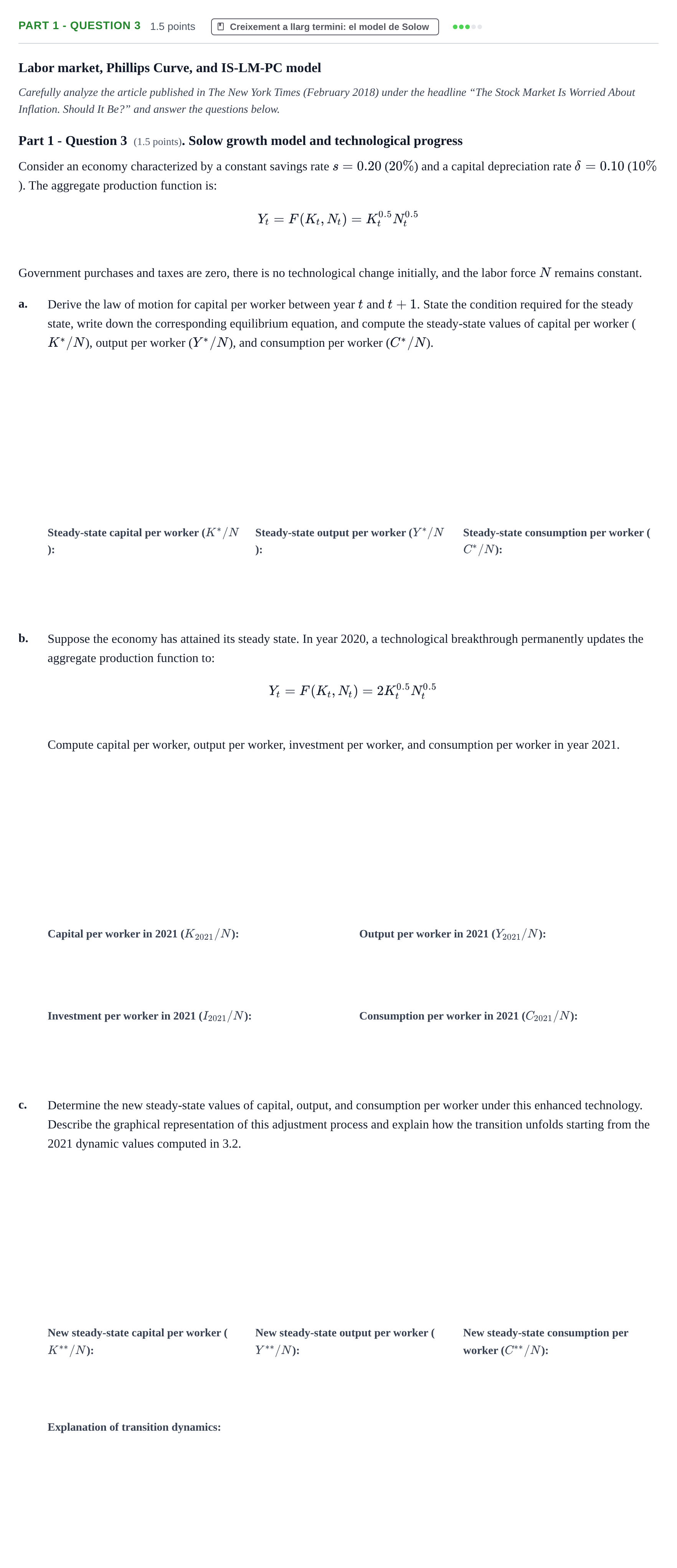
Part 1 - Question 3 (1.5 points). Solow growth model and technological progress
Consider an economy characterized by a constant savings rate () and a capital depreciation rate (). The aggregate production function is:
Government purchases and taxes are zero, there is no technological change initially, and the labor force remains constant.
a.
Derive the law of motion for capital per worker between year and . State the condition required for the steady state, write down the corresponding equilibrium equation, and compute the steady-state values of capital per worker (), output per worker (), and consumption per worker ().
b.
Suppose the economy has attained its steady state. In year 2020, a technological breakthrough permanently updates the aggregate production function to:
Compute capital per worker, output per worker, investment per worker, and consumption per worker in year 2021.
c.
Determine the new steady-state values of capital, output, and consumption per worker under this enhanced technology. Describe the graphical representation of this adjustment process and explain how the transition unfolds starting from the 2021 dynamic values computed in 3.2.
Solución
Según los criterios oficiales de corrección
Steady-state capital per worker (K*/N)
Solución: 4
Steady-state output per worker (Y*/N)
Solución: 2
Steady-state consumption per worker (C*/N)
Solución: 1.6
Capital per worker in year 2021 (K_2021/N)
Solución: 4.4
Output per worker in year 2021 (Y_2021/N)
Solución: 4.2
Investment per worker in year 2021 (I_2021/N)
Solución: 0.84
Consumption per worker in year 2021 (C_2021/N)
Solución: 3.36
New steady-state capital per worker (K**/N)
Solución: 16
New steady-state output per worker (Y**/N)
Solución: 8
New steady-state consumption per worker (C**/N)
Solución: 6.4
Transition dynamics description
Solución: Technological progress shifts both the production function and the investment per worker curve upward. In 2020-2021, at the initial capital stock of 4, investment per worker (0.84) exceeds capital depreciation (0.44), driving positive net capital accumulation (ΔK/N > 0). As capital deepens year after year, output per worker and consumption rise, but diminishing returns gradually compress the gap between investment and depreciation until the new steady state is attained at K/N = 16.
La explicación paso a paso, hecha con IA, es Premium. Premium
Resuélvelo aquí mismo: corrección automática, pistas y solución paso a paso.
‹ Question 3 · 2019 · Part 2 - Question 19 · 2018 ›