Sujet 1 - Partie 1 · Bac Anglais, monde contemporain Métropole remplacement 2022
Thème : Faire société – Libertés publiques et libertés individuelles · Tiré du sujet Métropole France remplacement (2022)
Énoncé
SUJET 1
Thématique: « Faire Société »
Partie 1 [16 pts]
Prenez connaissance du dossier proposé, composé des documents A, B et C non hiérarchisés et traitez en anglais le sujet suivant (500 mots environ):
Say what the documents reveal about the question of slavery reparations in the US, the issues it raises, and how it is – or could be – dealt with.
Document A
What slavery reparations from the federal government could look like
After decades of work from activists pushing the issue, presidential candidates, Congress members, local governments and private institutions have debated whether and how the federal government should issue reparations for Black Americans who are descendants of slaves. [...]
Proposals for reparations programs have been raised by reparations advocacy groups in recent decades. The National African American Reparations Commission, for example, has a 10-point reparations plan that includes calls for a national apology for slavery and subsequent discrimination; a repatriation program that would allow interested people to receive assistance when exercising their “right to return” to an African nation of their choice; affordable housing and education programs; and the preservation of Black monuments and sacred sites, with the proposals benefiting any person of African descent living in the US.
Other proposals, like one proposed by Andre Perry and Rashawn Ray for the Brookings Institution 1, would also specifically provide restitution to descendants with at least one ancestor enslaved in the U.S., coupling direct financial payment with plans for free college tuition, student loan forgiveness, grants for down payments 2 and housing revitalization and grants for Black-owned businesses.
“Making the American Dream an equitable reality demands the same U.S. government that denied wealth to Blacks restore that deferred wealth through reparations to their descendants,” they wrote last year.
The variety of proposals show that even among supporters of reparations, there is some disagreement about what a full program should look like and what exactly should be described as “true reparations.”
“I think we would be doing ourselves a huge disservice if we were just talking about financial compensation alone,” said Dreisen Heath, a racial justice researcher with Human Rights Watch.
While Heath said she did support and see the value in direct financial payments, she added that money alone “is not going to fix if you were wrongly convicted in a racist legal system. That’s not going to fix your access to preventative health care. All of these other harms are connected to the racial wealth gap but are not exclusively defined by or can be relieved by financial compensation.”
NBC News.com, May 12, 2021
1 an influential American research organization
2 initial payment to buy something on credit
Document B
Her family owned slaves. How can she make amend?
For almost three years now, with the fervor of the newly converted, Ms. Marshall has been on a quest that from the outside may seem quixotic 1 and even naïve. She is diving into her family’s past and trying to chip away at racism in the Deep South, where every white family with roots here benefited from slavery and almost every Black family had enslaved ancestors.
“I don’t have a lot of money, but I have property,” she said during a walk on her farm last winter. “How am I going to use that for the greater good, and not in like a paying-penance 2 sort of way but in an it’s-just-the-right-thing-to-do kind of way?” [...]
Farming, family and unspoken discrimination are braided together so tightly here that she can’t untwist them. She is aware that she sometimes stumbles across the line between doing antiracism work and playing the white savior, but she finds the history unavoidable.
“I can’t just go feed my cows and not be reminded of it,” she said.
Hers is the national soul-searching writ small 3: Should the descendants of people who kept others enslaved be held responsible for that wrong? What can they do to make things right? And what will it cost? [...]
She could set up an internship for young Black farmers, letting them work her land and keep the profit. Maybe her Black neighbors wanted preservation work done on their church cemetery.
Or maybe — and this is where the discussion gets complicated — she should give some land or money from the sale of it to descendants of the Black people who had helped her family build wealth, either as enslaved people in the 1800s or, later, as sharecroppers 4 who lived in two small shacks on her land. [...]
As the only young woman running a farm in the valley, Ms. Marshall already feels like a curiosity. She expects that people will turn on 5 her for telling the community’s story through the lens of slavery.
The New York Times, July 7, 2021
1 idealistic
2 an act showing you feel sorry for what you have done wrong
3 Her individual questioning echoes the national debate.
4 farmers who give part of what they cultivate as rent
5 criticize
Document C
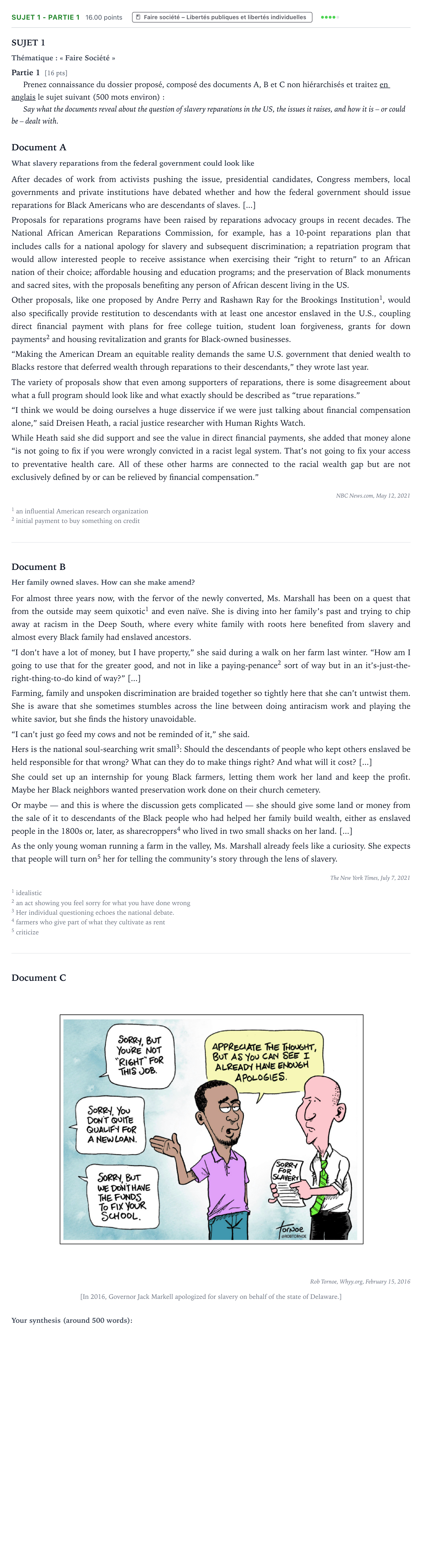
Rob Tornoe, Whyy.org, February 15, 2016
[In 2016, Governor Jack Markell apologized for slavery on behalf of the state of Delaware.]
Corrigé
Corrigé proposé par AprenAI (non officiel)
Say what the documents reveal about the question of slavery reparations in the US, the issues it raises, and how it is – or could be – dealt with.
Réponse : Sample synthesis (approx. 500 words): The legacy of slavery remains one of the most enduring and divisive wounds in the United States. Through an article on national policy debates (Document A), a portrait of a white landowner in the Deep South (Document B) and an editorial cartoon by Rob Tornoe (Document C), the dossier examines whether and how reparations should be granted to Black Americans. It highlights the systemic, financial and moral issues at stake. First, the documents reveal that the demand for reparations stems from the continuity between slavery and today's inequalities. Centuries of unpaid labour, and later exploitative sharecropping, allowed white families to accumulate wealth while Black Americans were deprived of it. As Perry and Ray put it, the government that "denied wealth to Blacks" must now "restore that deferred wealth" (Doc A). Ms. Marshall acknowledges that every white family with roots in the Deep South benefited from slavery (Doc B). The cartoon shows that discrimination persists in the present: a Black man is refused a job, denied a loan and told there is no money to fix his school (Doc C). Dreisen Heath likewise links the racial wealth gap to harms in the justice system and in health care (Doc A). Second, the dossier explores how reparations could be implemented, and it shows that there is no consensus even among supporters. The National African American Reparations Commission calls for a national apology, a repatriation program, housing and education programs, and the preservation of Black monuments. Its plan would benefit every person of African descent. The Brookings proposal targets descendants of enslaved people specifically. It combines direct payments with free college tuition, student loan forgiveness, down-payment grants and support for Black-owned businesses (Doc A). Reparations can also take shape at the individual level. Ms. Marshall considers several options: an internship letting young Black farmers work her land and keep the profit, restoring a Black church cemetery, or giving land or money to the descendants of those who built her family's wealth (Doc B). Finally, governments sometimes choose a purely symbolic gesture, as when Delaware's governor apologized for slavery in 2016 (Doc C). Finally, the issue raises intense dilemmas. The first is who should be held responsible: should descendants of slaveholders pay for their ancestors' wrong, and how much will it cost (Doc B)? The second concerns what counts as "true reparations". Heath warns that money alone cannot repair a wrongful conviction or poor access to health care (Doc A). Cartoonist Tornoe, by contrast, mocks apologies that are not followed by concrete action: the Black man already has "enough apologies" (Doc C). Individual initiatives are fragile too. Ms. Marshall fears sliding into the role of the "white savior", and she expects her community to turn on her for retelling its history through the lens of slavery (Doc B). In conclusion, the dossier shows that dealing with the legacy of slavery requires much more than symbolic repentance. Words must be matched by concrete, structural measures in wealth, housing, education, justice and health. These measures can come from the federal government, from local authorities or from individuals. Yet deciding who pays, who benefits and in what form remains a deeply controversial question for American society.
L’explication pas à pas, faite avec l’IA, est réservée aux membres Premium. Premium
Résous-le ici : correction automatique, indices et corrigé détaillé.
‹ Sujet 1 - Partie 1 · Métropole 2026