Sujet 1 - Partie 1 · Bac Anglais, monde contemporain Métropole 2026
Thème : Faire société – Libertés publiques et libertés individuelles · Tiré du sujet Métropole France (2026)
Énoncé
SUJET 1 — Thématique « Faire société »
Prenez connaissance du dossier proposé, composé des documents A, B, et C non hiérarchisés, et traitez en anglais le sujet suivant (500 mots environ):
Document A
Gen Zers are forced to redefine their own American dream
The traditional American Dream of Baby Boomers 1 is dramatically different from the experiences of Gen Zers. When it comes to jobs, careers, and lifestyles, the much younger cohort prioritizes purpose and social causes over climbing the ladder to the C-suite. 2 [...]
The break from tradition is due, in part, to the new harsh realities that Gen Zs need to cope with. The Boomers' American Dream of working hard will provide for a nice house with a white picket fence, new cars, a family, financial security, and pensions.
So far, by comparison, this hasn't worked out too well for Gen Zs. This cohort faces very different economic equations. They need to carry the burden of college student debt. Housing costs are out of reach. Inflation and high costs are hurting this generation financially.
Gen Z, born between 1997 and 2012, face an economic landscape far more daunting than that of previous generations. This entails skyrocketing housing costs, cumbersome student debt, a tough time finding and keeping a job, relegated to gig type jobs. 3 These travails contribute to derailing them from the traditional American Dream path.
In the current economy, it's harder for them to secure safe jobs. Many have lost faith in America's institutions, and feel somewhat cheated, compared to the older generations who seemed to have had it much easier.
They witnessed their parents getting laid off in the financial crisis of 2008, with some losing their homes. The Gen Zs came of age during the Covid crisis. Many young adults had to leave college and move back home for health safety reasons. These and other factors led to the Gen Zs feeling that their lives will be much different than their parents'. This may be the first generation in recent history that may not do better than their parents.
Psychologically, they're wired differently too. Growing up with smartphones and social media, they are constantly seeing the struggles of peers. They're not necessarily rejecting the American Dream out of laziness. They just can't catch a break. 4 [...]
Their adaptability offers hope. Culturally, they're poised to redefine the American Dream, focusing less on their parents' benchmarks 5 and more on sustainable, flexible paths that fit their realities. This generation could turn their skepticism into a new vision of success—one built on their terms rather than inherited expectation.
Forbes Magazine, March 5, 2025
1 people born between 1946 and 1964
2 the most important positions in a company
3 temporary jobs
4 They are not given every opportunity to succeed.
5 standards
Document B
Why dual citizenship is the new American dream
A growing number of Americans are looking at dual citizenship as a fallback 1 plan in times of widespread uncertainty and deepening political divisions, with young people leading the change. [...]
“For most of modern history, the American Dream was rooted in one place: America. But that's shifting,” Tim Osiecki, director of thought leadership and trends at The Harris Poll, told Newsweek.
“While dual citizenship used to be reserved for retirees, the wealthy, or those with strong family ties abroad, it's now a growing goal for middle-class Americans who want more control over their future,” he said. “It marks a real mindset shift—less about pledging allegiance to one nation, more about staying agile in a world that feels increasingly unstable.”
The American dream, which has fueled migration to the U.S. for the past century and more, was built on the idea that the U.S. was a land of opportunity offering freedom, financial stability, upward mobility, and personal success, as long as you were willing to work for it.
For many ordinary Americans, especially younger ones, that dream has died. It has been killed by the near impossibility of buying a home in the current market and the economic challenges that force them to scramble to keep up with the cost of living and delay their plans to form their own families. [...]
[Osiecki added:] “For these younger generations, dual citizenship isn't a luxury—it's a form of empowerment, a way to unlock better healthcare, more affordable living, and greater freedom to live life on their own terms.” [...]
“It's not about abandoning the U.S.—it's about creating options. A second passport gives people mobility, security, and the freedom to build a life on their own terms—wherever that may lead.” [...]
Experts agree that growing interest in dual citizenship won't bring forward a mass exodus of Americans any time soon.
Newsweek, May 24, 2025
1 de repli
Document C
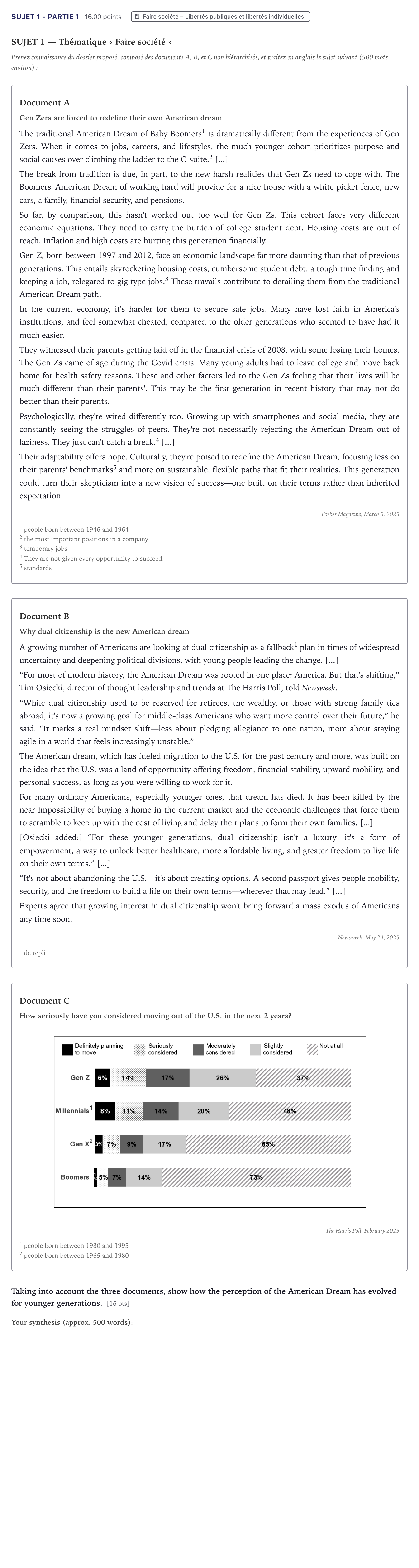
How seriously have you considered moving out of the U.S. in the next 2 years?
The Harris Poll, February 2025
1 people born between 1980 and 1995
2 people born between 1965 and 1980
Taking into account the three documents, show how the perception of the American Dream has evolved for younger generations. [16 pts]
Corrigé
Corrigé proposé par AprenAI (non officiel)
Taking into account the three documents, show how the perception of the American Dream has evolved for younger generations.
Réponse : Historically conceived as the promise that hard work guarantees upward social mobility, material prosperity and homeownership within the United States, the American Dream is currently undergoing a profound redefinition. As shown by the dossier, younger Americans, notably Generation Z and Millennials, are moving away from inherited benchmarks towards a more pragmatic, purpose-driven and globally mobile vision of success. The dossier comprises a Forbes article (Document A), a Newsweek report (Document B) and survey data from The Harris Poll (Document C). First and foremost, this shift stems from acute socio-economic disillusionment. As Document A highlights, the Boomers' ideal of a house with a white picket fence, new cars, a family, financial security and pensions has become largely out of reach. Gen Z faces skyrocketing housing costs, heavy student debt, inflation and precarious gig jobs. It may be the first generation in recent history not to do better than its parents. Document B confirms this grim reality: for many ordinary young Americans the dream "has died". It has been killed by the near impossibility of buying a home and by a cost of living that forces them to delay starting a family. Having witnessed the 2008 financial crisis and come of age during the Covid pandemic, young people have lost faith in America's institutions and feel somewhat cheated compared to older generations. Consequently, younger cohorts are redefining success itself. Document A stresses that this is not laziness but adaptability. Gen Z prioritizes purpose and social causes over climbing the corporate ladder to the C-suite. It favours sustainable, flexible paths that fit its realities. Success is no longer measured by wealth accumulation alone. It is measured by autonomy and by alignment with personal values, "built on their terms rather than inherited expectation". Most significantly, the American Dream is becoming detached from American soil. The myth was originally rooted in the idea of the U.S. as the ultimate land of opportunity, yet Document B shows that "that's shifting". Dual citizenship was once reserved for retirees, the wealthy or people with family ties abroad. It is now a growing goal for middle-class Americans, with young people leading the change. They see it not as a betrayal but as a fallback plan and a form of empowerment, giving access to better healthcare, more affordable living and greater freedom. The Harris Poll data in Document C clearly confirm this generational divide. 73% of Boomers and 65% of Gen X have not considered leaving the country at all. By contrast, 63% of Gen Z and 52% of Millennials have considered moving abroad within the next two years, and 20% of Gen Z have done so seriously or definitely. Nevertheless, Document B tempers this trend: experts do not expect a mass exodus. Young people want to create options rather than abandon the U.S. In conclusion, for younger generations the American Dream has evolved. It used to be a fixed, domestic promise of material prosperity rewarded by hard work. It is now a flexible, individualized quest for meaning, security and freedom. Rather than dying, the dream has been reinvented: it has become more personal, more pragmatic and no longer confined to the borders of the United States.
L’explication pas à pas, faite avec l’IA, est réservée aux membres Premium. Premium
Résous-le ici : correction automatique, indices et corrigé détaillé.
Sujet 1 - Partie 1 · Métropole remplacement 2022 ›