Sujet 2 - Partie 2 · Bac Anglais Métropole remplacement 2021
Thème : Traduction en français d'un passage du dossier · Tiré du sujet Métropole France remplacement (2021)
Énoncé
Document A
Why this is a golden age for children's literature: 'Children's books are one of the most important forms of writing we have'
The first book I read to myself was Dr Seuss's The Cat in the Hat – something I still recommend to learners – and the Cat's wild anarchic humour has always struck me as the perfect analogy for what happens to a child who discovers books. We think it's about being good – remember how the kids in the story are made to "sit-sit-sit-sit / And we did not like it / Not one little bit"? 9 Reading involves sitting, and getting a child to stay still is one of the most unattractive aspects. But once you master this, everything changes. People who love reading are often called bookworms 10 – but that's the wrong way around. It's not you that worms into a book, it's books that worm into you.
And worm into us they have. Children's books, new and old, are actually what is keeping publishers in business. They are what parents and grandparents, aunts and uncles, teachers and godparents actually buy, and go on buying. […]
Children's books are, paradoxically, one of the most important forms of writing we have, and the most overlooked. It is children's authors who are what Shelley called "the unacknowledged legislators of the world". From them, as much as from parents, a child receives an idea of how the world could or should be. They are the first real visual and literary culture that an unformed person receives, and this is one reason why we tend to remember children's books as our favourites. But they also give a child a lever 11 with which to prise open the world. They tell us that life is much bigger and more complex than we might have imagined, and that it contains people who are both like and unlike ourselves. This may seem daunting, but a great children's book portrays an environment in which the young are not powerless. Such books confront our deepest fears of being lost, hungry or in mortal danger, and they reinforce a child's inner ability to cope with this fearfulness and to discover where true strength lies. Almost any great story which people enjoy conforms to this model, whether it is about David and Goliath, Alice in Wonderland or Varjak Paw. Yet for most of the time, children's books are treated as infantile, escapist or easy to write. Believe me, they are not.
Amanda CRAIG (born in 1959), The Independent, June 24, 2015
9 A quote from The Cat in the Hat.
10 a bookworm: someone who enjoys reading
11 a lever: a tool; an iron bar used to open (or prise open) a door, for example
Document B
Coraline discovered the door a little while after they moved into the house.
It was a very old house – it had an attic under the roof and a cellar under the ground and an overgrown garden with huge old trees on it.
Coraline's family didn't own all of the house, it was too big for that. Instead they owned part of it.
There were other people who lived in the old house.
Miss Spink and Miss Forcible lived in the flat below Coraline's, on the ground floor. They were both old and round, and they lived in their flat with a number of ageing Highland terriers who had names like Hamish and Andrew and Jock. Once upon a time Miss Spink and Miss Forcible had been actresses, as Miss Spink told Coraline the first time she met her.
'You see, Caroline,' Miss Spink said, getting Coraline's name wrong, 'both myself and Miss Forcible were famous actresses, in our time. We trod the boards, lovey. Oh, don't let Hamish eat the fruitcake, or he'll be up all night with his tummy.'
'It's Coraline. Not Caroline. Coraline,' said Coraline.
In the flat above Coraline's, under the roof, was a crazy old man with a big moustache. He was training a mouse circus. He wouldn't let anyone see it.
'One day, little Caroline, when they are all ready, everyone in the whole world will see the wonders of my mouse circus. You ask me why you cannot see it now. Is that what you asked me?'
'No,' said Coraline quietly, 'I asked you not to call me Caroline. It's Coraline.'
[…]
Coraline didn't think there really was a mouse circus. She thought the old man was probably making it up.
The day after they moved in, Coraline went exploring.
She explored the garden. It was a big garden: at the very back was an old tennis court, but no one in the house played tennis and the fence around the court had holes in it and the net had mostly rotted away; there was an old rose garden […].
There was also a well. On the first day Coraline's family moved in, Miss Spink and Miss Forcible made a point of telling Coraline how dangerous the well was, and they warned her to be sure she kept away from it. So Coraline set off to explore for it, so that she knew where it was, to keep away from it properly.
She found it on the third day, in an overgrown meadow beside the tennis court, behind the clump of trees – a low brink circle almost hidden in the high grass. The well had been covered over by wooden boards, and Coraline spent an afternoon dropping pebbles and acorns through the hole, and waiting, and counting, until she heard the plop as they hit the water, far below.
Neil GAIMAN (born in 1960), Coraline, 2002
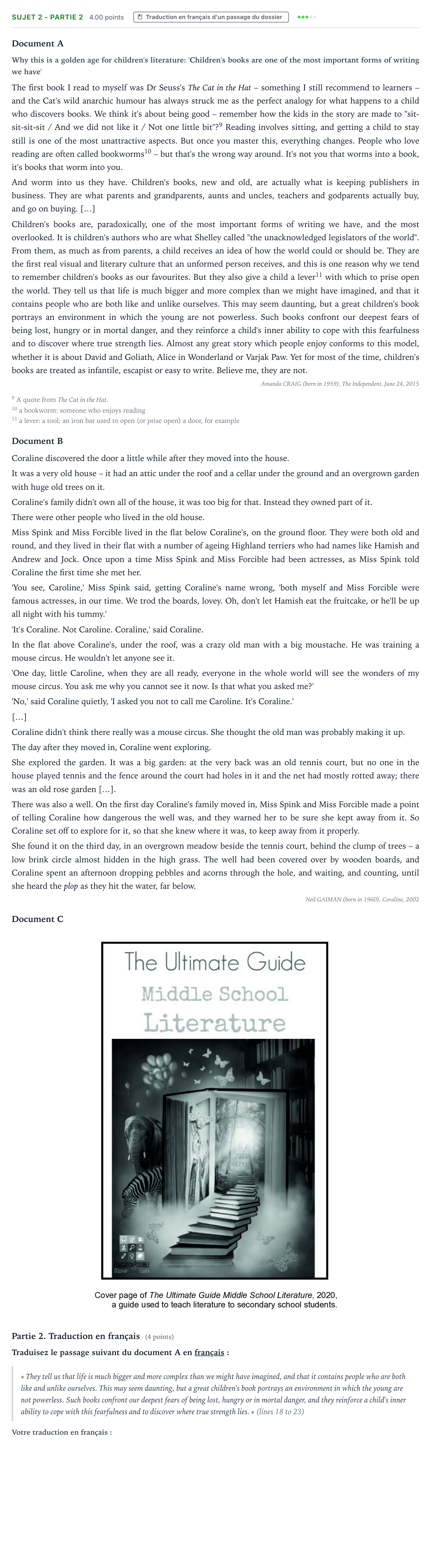
Document C
Partie 2. Traduction en français (4 points)
Traduisez le passage suivant du document A en français:
« They tell us that life is much bigger and more complex than we might have imagined, and that it contains people who are both like and unlike ourselves. This may seem daunting, but a great children's book portrays an environment in which the young are not powerless. Such books confront our deepest fears of being lost, hungry or in mortal danger, and they reinforce a child's inner ability to cope with this fearfulness and to discover where true strength lies. » (lines 18 to 23)
Corrigé
Corrigé proposé par AprenAI (non officiel)
Traduisez le passage suivant du document A en français : « They tell us that life is much bigger and more complex than we might have imagined, and that it contains people who are both like and unlike ourselves. This may seem daunting, but a great children's book portrays an environment in which the young are not powerless. Such books confront our deepest fears of being lost, hungry or in mortal danger, and they reinforce a child's inner ability to cope with this fearfulness and to discover where true strength lies. » (lines 18 to 23)
Réponse : Ils nous apprennent [ou : nous disent] que la vie est bien plus vaste et plus complexe que ce que nous aurions pu imaginer, et qu'elle est peuplée de gens [ou : qu'elle renferme des personnes] qui sont à la fois semblables à nous et différents de nous. Cela peut sembler intimidant [ou : paraître effrayant / décourageant], mais un grand livre pour enfants dépeint un environnement dans lequel les jeunes ne sont pas impuissants. De tels livres affrontent nos peurs les plus profondes d'être perdus, d'avoir faim ou d'être en danger de mort, et ils renforcent la capacité intérieure de l'enfant à faire face à cette angoisse [ou : ces craintes] et à découvrir où réside la véritable force.
L’explication pas à pas, faite avec l’IA, est réservée aux membres Premium. Premium
Résous-le ici : correction automatique, indices et corrigé détaillé.
‹ Sujet 1 - Partie 2 · Métropole remplacement 2021