Aufgabe HT 3 - Aufgabe 2 · Abitur NRW Englisch GK · Haupttermin · Weiterbildungskolleg 2022
Thema: Analyse nicht-literarischer Texte (Communicative strategies) · Aus der Prüfung GK · Haupttermin · Weiterbildungskolleg (2022)
Aufgabenstellung
Klausurteil A: Leseverstehen und Schreiben integriert
2.
Analyse in what way the author conveys her views on the situation of Black people in rural Britain. Take into account both communicative strategies and the language used. (Analysis) [16 Punkte]
Klausurteil A
VV Brown
To be black in the British countryside means being an outsider
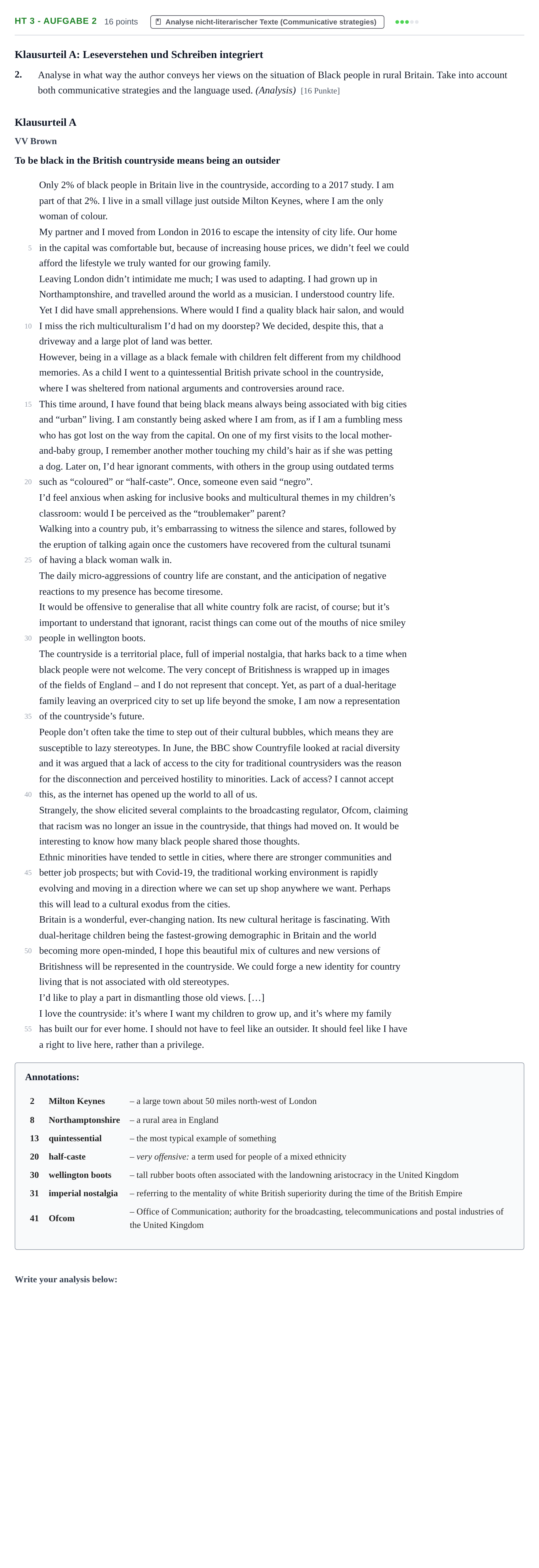
Only 2% of black people in Britain live in the countryside, according to a 2017 study. I am
part of that 2%. I live in a small village just outside Milton Keynes, where I am the only
woman of colour.
My partner and I moved from London in 2016 to escape the intensity of city life. Our home
5 in the capital was comfortable but, because of increasing house prices, we didn’t feel we could
afford the lifestyle we truly wanted for our growing family.
Leaving London didn’t intimidate me much; I was used to adapting. I had grown up in
Northamptonshire, and travelled around the world as a musician. I understood country life.
Yet I did have small apprehensions. Where would I find a quality black hair salon, and would
10 I miss the rich multiculturalism I’d had on my doorstep? We decided, despite this, that a
driveway and a large plot of land was better.
However, being in a village as a black female with children felt different from my childhood
memories. As a child I went to a quintessential British private school in the countryside,
where I was sheltered from national arguments and controversies around race.
15 This time around, I have found that being black means always being associated with big cities
and “urban” living. I am constantly being asked where I am from, as if I am a fumbling mess
who has got lost on the way from the capital. On one of my first visits to the local mother-
and-baby group, I remember another mother touching my child’s hair as if she was petting
a dog. Later on, I’d hear ignorant comments, with others in the group using outdated terms
20 such as “coloured” or “half-caste”. Once, someone even said “negro”.
I’d feel anxious when asking for inclusive books and multicultural themes in my children’s
classroom: would I be perceived as the “troublemaker” parent?
Walking into a country pub, it’s embarrassing to witness the silence and stares, followed by
the eruption of talking again once the customers have recovered from the cultural tsunami
25 of having a black woman walk in.
The daily micro-aggressions of country life are constant, and the anticipation of negative
reactions to my presence has become tiresome.
It would be offensive to generalise that all white country folk are racist, of course; but it’s
important to understand that ignorant, racist things can come out of the mouths of nice smiley
30 people in wellington boots.
The countryside is a territorial place, full of imperial nostalgia, that harks back to a time when
black people were not welcome. The very concept of Britishness is wrapped up in images
of the fields of England – and I do not represent that concept. Yet, as part of a dual-heritage
family leaving an overpriced city to set up life beyond the smoke, I am now a representation
35 of the countryside’s future.
People don’t often take the time to step out of their cultural bubbles, which means they are
susceptible to lazy stereotypes. In June, the BBC show Countryfile looked at racial diversity
and it was argued that a lack of access to the city for traditional countrysiders was the reason
for the disconnection and perceived hostility to minorities. Lack of access? I cannot accept
40 this, as the internet has opened up the world to all of us.
Strangely, the show elicited several complaints to the broadcasting regulator, Ofcom, claiming
that racism was no longer an issue in the countryside, that things had moved on. It would be
interesting to know how many black people shared those thoughts.
Ethnic minorities have tended to settle in cities, where there are stronger communities and
45 better job prospects; but with Covid-19, the traditional working environment is rapidly
evolving and moving in a direction where we can set up shop anywhere we want. Perhaps
this will lead to a cultural exodus from the cities.
Britain is a wonderful, ever-changing nation. Its new cultural heritage is fascinating. With
dual-heritage children being the fastest-growing demographic in Britain and the world
50 becoming more open-minded, I hope this beautiful mix of cultures and new versions of
Britishness will be represented in the countryside. We could forge a new identity for country
living that is not associated with old stereotypes.
I’d like to play a part in dismantling those old views. […]
I love the countryside: it’s where I want my children to grow up, and it’s where my family
55 has built our for ever home. I should not have to feel like an outsider. It should feel like I have
a right to live here, rather than a privilege.
Annotations:
2 · Milton Keynes · – a large town about 50 miles north-west of London
8 · Northamptonshire · – a rural area in England
13 · quintessential · – the most typical example of something
20 · half-caste · – very offensive: a term used for people of a mixed ethnicity
30 · wellington boots · – tall rubber boots often associated with the landowning aristocracy in the United Kingdom
31 · imperial nostalgia · – referring to the mentality of white British superiority during the time of the British Empire
41 · Ofcom · – Office of Communication; authority for the broadcasting, telecommunications and postal industries of the United Kingdom
Lösung
Nach den offiziellen Korrekturhinweisen
2. Analyse in what way the author conveys her views on the situation of Black people in rural Britain. Take into account both communicative strategies and the language used. (Analysis)
Lösung: Author's main intention: - Raising awareness of everyday racism in rural Britain. - Criticising the superficial discussion or denial of rural racism (e.g. reactions to Countryfile). - Advocating for a redefined, inclusive British identity in the countryside. Communicative strategies: - Autobiographical perspective / personal anecdotes (e.g. baby group, pub visit) to create authenticity and emotional empathy. - Juxtaposition of idyllic countryside images with harsh everyday micro-aggressions ('nice smiley people in wellington boots'). - Portraying multiculturalism as an asset and opportunity for the future of rural areas. - Direct appeals and forward-looking vision ('dismantling those old views', 'forge a new identity'). Use of language: - First-person singular ('I', 'my') to establish personal credibility and vulnerability. - Vivid imagery and metaphors (e.g. 'cultural tsunami', 'cultural bubbles', 'beyond the smoke'). - Emotive and evaluative diction ('imperial nostalgia', 'micro-aggressions', 'tiresome', 'outsider'). - Rhetorical questions ('Where would I find a quality black hair salon...?') to directly engage the reader's empathy.
Die ausführliche Erklärung Schritt für Schritt (mit KI) gibt es mit Premium. Premium
Löse sie direkt hier: automatische Korrektur, Hinweise und Lösung Schritt für Schritt.
‹ Aufgabe HT 2 - Aufgabe 2 · GK · Haupttermin · Weiterbildungskolleg 2022 · Aufgabe 2 (NT 2) · GK · Nachtermin 2022 ›
Mehr Aufgaben zu Analyse nicht-literarischer Texte (Communicative strategies)
- Aufgabe NT 2 - Aufgabe 2 · LK · Nachtermin · Weiterbildungskolleg 2023
- Aufgabe 2 · LK · Neem: Unbecoming American 2023
- Aufgabe HT 2 - Aufgabe 2 · GK · Haupttermin 2022
- Aufgabe HT 3 - Aufgabe 2 · GK · Haupttermin 2022
- Aufgabe HT 2 - Aufgabe 2 · GK · Haupttermin · Weiterbildungskolleg 2022
- Aufgabe 2 (NT 2) · GK · Nachtermin 2022
- Aufgabe 2 (NT 3) · GK · Nachtermin 2022
- Aufgabe NT 2 - Aufgabe 2 · GK · Nachtermin · Weiterbildungskolleg 2022
- Aufgabe NT 3 - Aufgabe 2 · GK · Nachtermin · Weiterbildungskolleg 2022
- Aufgabe HT 2 - Task 2 · LK · Haupttermin 2022