Aufgabe HT 2 - Task 2 · Abitur NRW Englisch LK · Haupttermin 2022
Thema: Analyse nicht-literarischer Texte (Communicative strategies) · Aus der Prüfung LK · Haupttermin (2022)
Aufgabenstellung
Klausurteil A
Keri Leigh Merritt
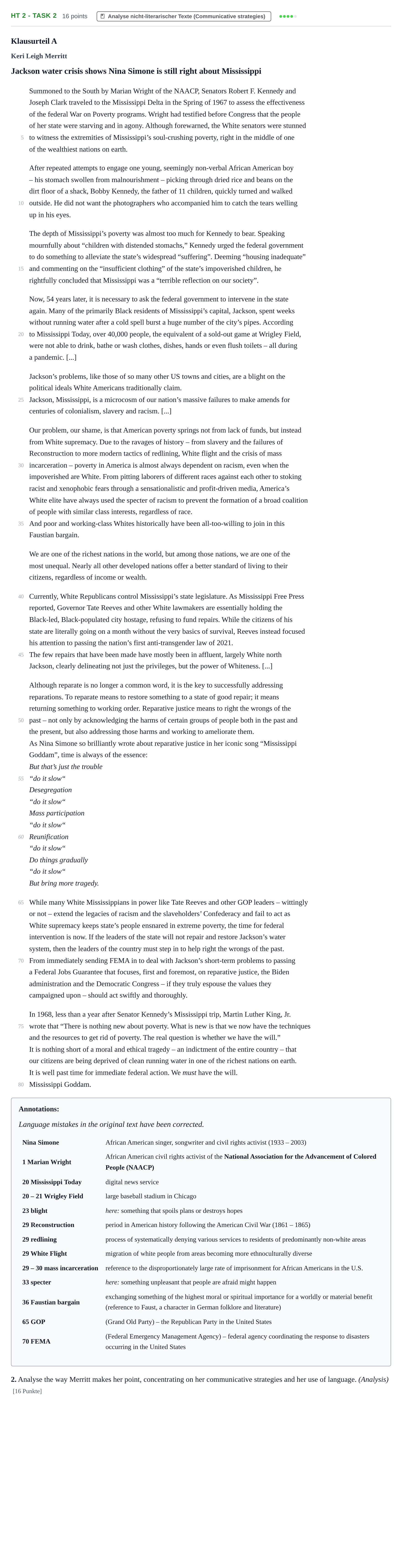
Jackson water crisis shows Nina Simone is still right about Mississippi
Summoned to the South by Marian Wright of the NAACP, Senators Robert F. Kennedy and
Joseph Clark traveled to the Mississippi Delta in the Spring of 1967 to assess the effectiveness
of the federal War on Poverty programs. Wright had testified before Congress that the people
of her state were starving and in agony. Although forewarned, the White senators were stunned
5 to witness the extremities of Mississippi’s soul-crushing poverty, right in the middle of one
of the wealthiest nations on earth.
After repeated attempts to engage one young, seemingly non-verbal African American boy
– his stomach swollen from malnourishment – picking through dried rice and beans on the
dirt floor of a shack, Bobby Kennedy, the father of 11 children, quickly turned and walked
10 outside. He did not want the photographers who accompanied him to catch the tears welling
up in his eyes.
The depth of Mississippi’s poverty was almost too much for Kennedy to bear. Speaking
mournfully about “children with distended stomachs,” Kennedy urged the federal government
to do something to alleviate the state’s widespread “suffering”. Deeming “housing inadequate”
15 and commenting on the “insufficient clothing” of the state’s impoverished children, he
rightfully concluded that Mississippi was a “terrible reflection on our society”.
Now, 54 years later, it is necessary to ask the federal government to intervene in the state
again. Many of the primarily Black residents of Mississippi’s capital, Jackson, spent weeks
without running water after a cold spell burst a huge number of the city’s pipes. According
20 to Mississippi Today, over 40,000 people, the equivalent of a sold-out game at Wrigley Field,
were not able to drink, bathe or wash clothes, dishes, hands or even flush toilets – all during
a pandemic. [...]
Jackson’s problems, like those of so many other US towns and cities, are a blight on the
political ideals White Americans traditionally claim.
25 Jackson, Mississippi, is a microcosm of our nation’s massive failures to make amends for
centuries of colonialism, slavery and racism. [...]
Our problem, our shame, is that American poverty springs not from lack of funds, but instead
from White supremacy. Due to the ravages of history – from slavery and the failures of
Reconstruction to more modern tactics of redlining, White flight and the crisis of mass
30 incarceration – poverty in America is almost always dependent on racism, even when the
impoverished are White. From pitting laborers of different races against each other to stoking
racist and xenophobic fears through a sensationalistic and profit-driven media, America’s
White elite have always used the specter of racism to prevent the formation of a broad coalition
of people with similar class interests, regardless of race.
35 And poor and working-class Whites historically have been all-too-willing to join in this
Faustian bargain.
We are one of the richest nations in the world, but among those nations, we are one of the
most unequal. Nearly all other developed nations offer a better standard of living to their
citizens, regardless of income or wealth.
40 Currently, White Republicans control Mississippi’s state legislature. As Mississippi Free Press
reported, Governor Tate Reeves and other White lawmakers are essentially holding the
Black-led, Black-populated city hostage, refusing to fund repairs. While the citizens of his
state are literally going on a month without the very basics of survival, Reeves instead focused
his attention to passing the nation’s first anti-transgender law of 2021.
45 The few repairs that have been made have mostly been in affluent, largely White north
Jackson, clearly delineating not just the privileges, but the power of Whiteness. [...]
Although reparate is no longer a common word, it is the key to successfully addressing
reparations. To reparate means to restore something to a state of good repair; it means
returning something to working order. Reparative justice means to right the wrongs of the
50 past – not only by acknowledging the harms of certain groups of people both in the past and
the present, but also addressing those harms and working to ameliorate them.
As Nina Simone so brilliantly wrote about reparative justice in her iconic song “Mississippi
Goddam”, time is always of the essence:
But that’s just the trouble
55 “do it slow“
Desegregation
“do it slow“
Mass participation
“do it slow“
60 Reunification
“do it slow“
Do things gradually
“do it slow“
But bring more tragedy.
65 While many White Mississippians in power like Tate Reeves and other GOP leaders – wittingly
or not – extend the legacies of racism and the slaveholders’ Confederacy and fail to act as
White supremacy keeps state’s people ensnared in extreme poverty, the time for federal
intervention is now. If the leaders of the state will not repair and restore Jackson’s water
system, then the leaders of the country must step in to help right the wrongs of the past.
70 From immediately sending FEMA in to deal with Jackson’s short-term problems to passing
a Federal Jobs Guarantee that focuses, first and foremost, on reparative justice, the Biden
administration and the Democratic Congress – if they truly espouse the values they
campaigned upon – should act swiftly and thoroughly.
In 1968, less than a year after Senator Kennedy’s Mississippi trip, Martin Luther King, Jr.
75 wrote that “There is nothing new about poverty. What is new is that we now have the techniques
and the resources to get rid of poverty. The real question is whether we have the will.”
It is nothing short of a moral and ethical tragedy – an indictment of the entire country – that
our citizens are being deprived of clean running water in one of the richest nations on earth.
It is well past time for immediate federal action. We must have the will.
80 Mississippi Goddam.
Annotations:
Language mistakes in the original text have been corrected.
Nina Simone · African American singer, songwriter and civil rights activist (1933 – 2003)
1 Marian Wright · African American civil rights activist of the National Association for the Advancement of Colored People (NAACP)
20 Mississippi Today · digital news service
20 – 21 Wrigley Field · large baseball stadium in Chicago
23 blight · here: something that spoils plans or destroys hopes
29 Reconstruction · period in American history following the American Civil War (1861 – 1865)
29 redlining · process of systematically denying various services to residents of predominantly non-white areas
29 White Flight · migration of white people from areas becoming more ethnoculturally diverse
29 – 30 mass incarceration · reference to the disproportionately large rate of imprisonment for African Americans in the U.S.
33 specter · here: something unpleasant that people are afraid might happen
36 Faustian bargain · exchanging something of the highest moral or spiritual importance for a worldly or material benefit (reference to Faust, a character in German folklore and literature)
65 GOP · (Grand Old Party) – the Republican Party in the United States
70 FEMA · (Federal Emergency Management Agency) – federal agency coordinating the response to disasters occurring in the United States
2. Analyse the way Merritt makes her point, concentrating on her communicative strategies and her use of language. (Analysis) [16 Punkte]
Lösung
Nach den offiziellen Korrekturhinweisen
2. Analyse the way Merritt makes her point, concentrating on her communicative strategies and her use of language.
Lösung: An in-depth analysis demonstrating: - Core thesis/intention: Merritt sharply condemns systemic racism and structural neglect, demanding decisive and immediate federal intervention and reparative justice. - Communicative strategies: * Juxtaposition/contrast of past (1960s Civil Rights era, Robert F. Kennedy's visit) and present (Jackson water crisis, Governor Reeves), showing a persistent lack of change. * Integration of prominent historical voices and cultural references: Robert F. Kennedy, Martin Luther King Jr., and Nina Simone's protest song "Mississippi Goddam". * Evocative, concrete examples (the starving boy on the dirt floor, 40,000 residents without running water likened to a sold-out Wrigley Field). * Inclusive pronouns ("our problem, our shame", "our citizens") establishing shared moral responsibility. * Persuasive appeal urging immediate action ("The time for federal intervention is now", "We must have the will"). - Stylistic and linguistic devices: * Imagery and metaphors ("soul-crushing poverty", "Faustian bargain", "blight", "holding ... hostage"). * Contrasts and antitheses ("richest nations on earth" vs. "extremities of Mississippi's ... poverty"). * Strong, emotive, and evaluative diction ("moral and ethical tragedy", "indictment", "ravages"). * Syntactical choices, such as repetitions, anaphora, parenthetical insertions, and emphatic sentence structures.
Die ausführliche Erklärung Schritt für Schritt (mit KI) gibt es mit Premium. Premium
Löse sie direkt hier: automatische Korrektur, Hinweise und Lösung Schritt für Schritt.
‹ Aufgabe NT 3 - Aufgabe 2 · GK · Nachtermin · Weiterbildungskolleg 2022 · Aufgabe HT 3 - Task 2 · LK · Haupttermin 2022 ›
Mehr Aufgaben zu Analyse nicht-literarischer Texte (Communicative strategies)
- Aufgabe HT 3 - Aufgabe 2 · GK · Haupttermin · Weiterbildungskolleg 2022
- Aufgabe 2 (NT 2) · GK · Nachtermin 2022
- Aufgabe 2 (NT 3) · GK · Nachtermin 2022
- Aufgabe NT 2 - Aufgabe 2 · GK · Nachtermin · Weiterbildungskolleg 2022
- Aufgabe NT 3 - Aufgabe 2 · GK · Nachtermin · Weiterbildungskolleg 2022
- Aufgabe HT 3 - Task 2 · LK · Haupttermin 2022
- Aufgabe HT 2 - Aufgabe 2 · LK · Haupttermin · Weiterbildungskolleg 2022
- Aufgabe HT 3 - Aufgabe 2 · LK · Haupttermin · Weiterbildungskolleg 2022
- Aufgabe NT 2 - Aufgabe 2 · LK · Nachtermin 2022
- Aufgabe NT 3 - Aufgabe 2 · LK · Nachtermin 2022