Aufgabe 2 · Abitur NRW Englisch LK · Neem: Unbecoming American 2023
Thema: Analyse nicht-literarischer Texte (Communicative strategies) · Aus der Prüfung LK · Neem: Unbecoming American (2023)
Aufgabenstellung
Material
Johann N. Neem: An American Childhood
In the 1970s, the author’s family emigrated from India to the USA when he was two years old. They were part of the first wave of immigrants after the removal of a law that favored European immigration in 1965.
Mine was an American childhood. We were middle class and lived on a cul-de-sac whose
residents were diverse in many of the usual American ways. There were Japanese-Americans
and Catholics and Protestants. There were people without college degrees, and others with
graduate degrees. There were Republicans and Democrats. There were immigrants from
5 Germany, and of course we were from India. […]
I imagined that I could become anybody. I had no awareness then that this belief was the result
of more than two centuries of activism on the part of African Americans, feminists, and their
allies to earn equality within the American nation-state. It was California. The American Dream
was alive. Of course, that dream had been deferred for so many Americans for too long. But
10 after 1965, it was hoped, those obstacles would be behind us. Immigrants would be welcome.
African Americans would be equal. And despite the thus-far unsuccessful effort to enact the
Equal Rights Amendment 1, I grew up in a world that took for granted that women too could be
whomever they wanted to be.
There was a kind of amnesia. Maybe that’s not the right word. We were new. So maybe it was
15 that I just didn’t know the history, and my parents had experienced a different history. Whatever
it was, America was, for us, a blank slate. But it was not fully blank. It had rituals and traditions
for us to learn, such as giving gifts and spending time with family and friends on Christmas or
having barbecues on the Fourth of July. We gathered with neighbors to hunt Easter eggs. It
had norms, like saying “thank you” for any kind of service, a sign of the respect each American
20 owed fellow Americans for their contributions to society. It had a creed, too – that the United
States promised all people a better, freer, more prosperous life.
No doubt, my parents sometimes faced challenges and encountered prejudice. For all that I
shared with my neighbors and schoolmates, my family was also Indian American. I grew up
surrounded by family friends who were immigrants like us. That was fine too. In America, my
25 Indianness was part of a pluralistic civil society and market in which ethnic and religious groups
could sustain their beliefs and folkways 2. Growing up, I experienced no tension between going
to Berkeley for masala dosas 3 in restaurants full of immigrants (and a few hippies), and learning
in school about my Pilgrim forebears. Nor was I told that my recent arrival in America exempted
me from responsibility for the evils of slavery and racism. As part of the imagined community
30 of the nation, I understood that the past was also a shared burden.
Most of us have multiple communities to which we belong – and which make claims on us –
and it is the relations between these sources of our identity that make us who we are. It is the
tensions between some of these obligations, furthermore, that enable invaluable self-criticism.
As the political theorist Michael Walzer has written, a self whose identity is made up of only
35 one source is shallow and totalizing. What makes our differences - our pluralism - sustainable
is that one of the communities that define us – America – is shared by most of us. We are
many, but also one. This was the ideal of the so-called hyphenated American. All Americans,
native born or immigrant, had their particular ethnic and religious identities, but we shared a
common American-ness.
40 As a child, I thought that to be American was to believe in individuality, to support pluralism
and equality, and also to celebrate common holidays and eat common foods, such as the oozy
grilled cheeses and bean burritos that the school cafeteria dished up for us, or the sloppy joes
and tacos that my mom learned to cook (even though my favorite food remained dahl and rice).
On Halloween, it meant carving jack-o-lanterns and, in the evening, heading out with friends
45 for trick-or-treating. On Thanksgiving, it meant gathering with other immigrant families and
friends to eat turkey and express gratitude. Being American meant that during the Christmas
season, we kids would live in anticipation, poring through the toy section of the Sears catalog.
On the Fourth of July, we’d watch fireworks. At school, we said the Pledge of Allegiance.
I lived in a world where we could all be American, not because of our cultural differences but
50 because of what we could share. This shared culture – this sense of being a people – is a
precondition to sustaining the universal ideals of American democracy. We like to pretend that
principles are enough, but abstract ideas are thin gruel for flesh-and-blood human beings. We
are not disembodied reasoners. We belong to groups. We have emotions. Culture connects
us to our country and to one another. But that culture depends on shared rituals and
55 experiences. Today, we are so afraid of offense that we risk privatizing the very culture we
once could share together.
My childhood memories of a diverse neighborhood and public school where we could all be
Americans reflect good fortune. There are many Americans who experience discrimination and
prejudice […]. Since the American Revolution 4, activists have struggled to overcome exclusion;
60 we are still struggling today. But there is a meaningful distinction between seeking access to
the common life of the nation and deciding that that common life is itself the problem. A shared
culture requires something. It cannot simply be an absence.
Shared holidays are essential parts of culture. They mark time and endow it with meaning.
That is why the so-called “war over Christmas,” 5 while overblown, is not silly. It reflects what
65 happens when rituals with collective meaning become contested and diminished. Just like so
much that once could be shared but now must belong to a “group,” Christmas has become
something that divides rather than unites. If everything and everyone belongs to a subgroup,
there can be no group, and with no group there can be no Americans.
997 words
Neem, J. N. (2020). Unbecoming American. Hedgehog Review. Spring 2020.
This excerpt is taken from “Unbecoming American” by Johann N. Neem, an essay that originally appeared in The Hedgehog Review, Spring 2020, volume 22, number 1. It appears here with permission of the publisher.
1 Equal Rights Amendment – proposed in 1923 to guarantee equal rights for men and women but not added to the U.S. Constitution as of 2021
2 folkways – traditional behavior and customs
3 masalas dosas – an Indian dish made from flat bread and stuffing
4 American Revolution – war (1775–1783) in which the British colonies broke free from British rule
5 “war over Christmas” – cultural debate whether the public display of Christmas symbols is politically correct
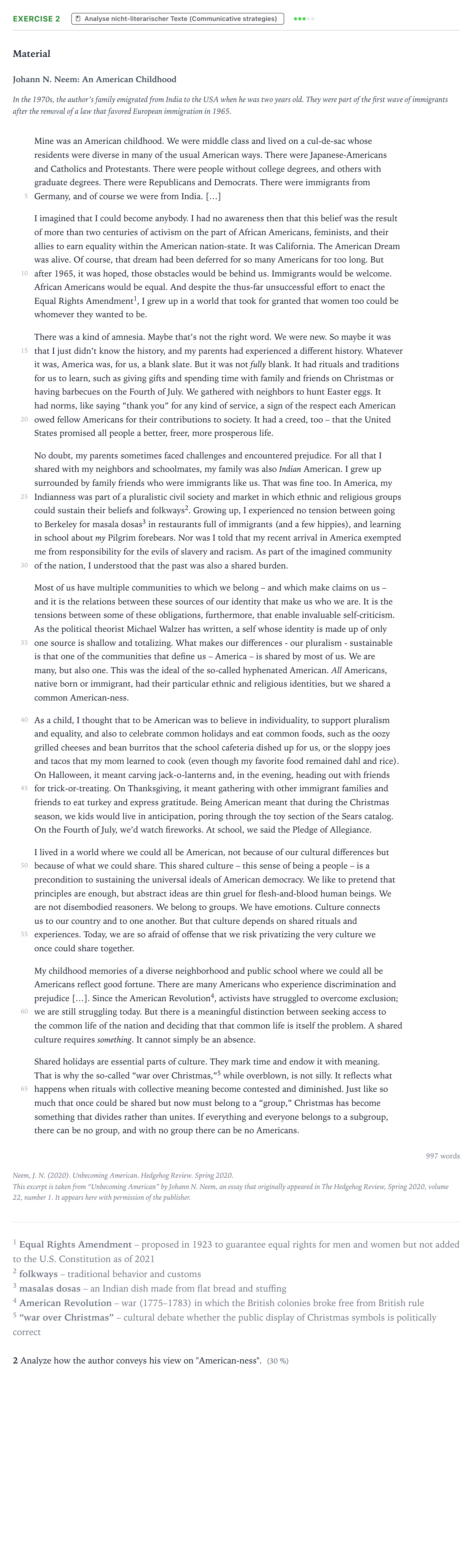
2 Analyze how the author conveys his view on "American-ness".
(30 %)
Lösung
Nach den offiziellen Korrekturhinweisen
2 Analyze how the author conveys his view on "American-ness".
Lösung: The analysis should show that Neem views 'American-ness' as a set of shared rituals, traditions, and values that unite a diverse, pluralistic society. He conveys this through rhetorical strategies (interweaving his personal memoir with national history to establish credibility, listing recognizable cultural practices), argumentative structure (moving from personal memories to philosophical reflection, antithetical contrasts, and ending with an urgent warning), and language devices (inclusive 'we', parallelisms, and key terminology of the American Dream).
Die ausführliche Erklärung Schritt für Schritt (mit KI) gibt es mit Premium. Premium
Löse sie direkt hier: automatische Korrektur, Hinweise und Lösung Schritt für Schritt.
‹ Aufgabe NT 2 - Aufgabe 2 · LK · Nachtermin · Weiterbildungskolleg 2023 · Aufgabe HT 2 - Aufgabe 2 · GK · Haupttermin 2022 ›
Mehr Aufgaben zu Analyse nicht-literarischer Texte (Communicative strategies)
- Aufgabe HT 2 - Aufgabe 2 · LK · Haupttermin 2023
- Aufgabe HT 2 - Task 2 · LK · Haupttermin · Weiterbildungskolleg 2023
- Aufgabe 2 · LK · Hunter: Don’t Believe the Lie That 2023
- Aufgabe NT 2 - Aufgabe 2 · LK · Nachtermin 2023
- Aufgabe NT 2 - Aufgabe 2 · LK · Nachtermin · Weiterbildungskolleg 2023
- Aufgabe HT 2 - Aufgabe 2 · GK · Haupttermin 2022
- Aufgabe HT 3 - Aufgabe 2 · GK · Haupttermin 2022
- Aufgabe HT 2 - Aufgabe 2 · GK · Haupttermin · Weiterbildungskolleg 2022
- Aufgabe HT 3 - Aufgabe 2 · GK · Haupttermin · Weiterbildungskolleg 2022
- Aufgabe 2 (NT 2) · GK · Nachtermin 2022