Aufgabe HT 3 - Task 3.2 · Abitur NRW Englisch LK · Haupttermin 2022
Thema: Adressatenbezogenes Schreiben: Artikel, Rede, Blog, Leserbrief · Aus der Prüfung LK · Haupttermin (2022)
Aufgabenstellung
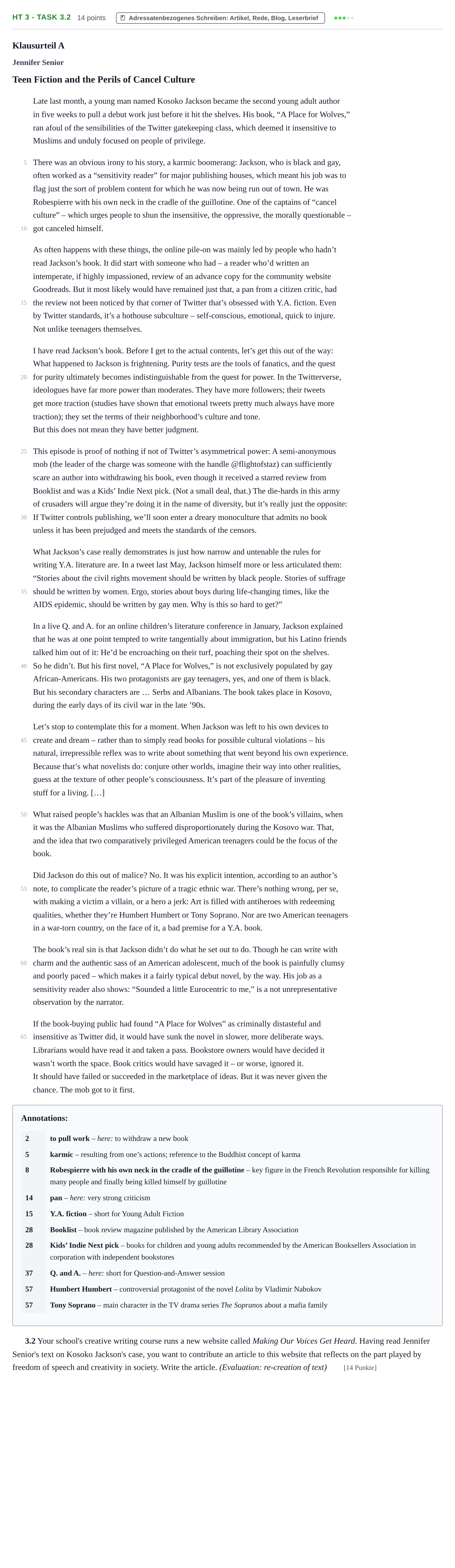
Klausurteil A
Jennifer Senior
Teen Fiction and the Perils of Cancel Culture
Late last month, a young man named Kosoko Jackson became the second young adult author
in five weeks to pull a debut work just before it hit the shelves. His book, “A Place for Wolves,”
ran afoul of the sensibilities of the Twitter gatekeeping class, which deemed it insensitive to
Muslims and unduly focused on people of privilege.
5 There was an obvious irony to his story, a karmic boomerang: Jackson, who is black and gay,
often worked as a “sensitivity reader” for major publishing houses, which meant his job was to
flag just the sort of problem content for which he was now being run out of town. He was
Robespierre with his own neck in the cradle of the guillotine. One of the captains of “cancel
culture” – which urges people to shun the insensitive, the oppressive, the morally questionable –
10 got canceled himself.
As often happens with these things, the online pile-on was mainly led by people who hadn’t
read Jackson’s book. It did start with someone who had – a reader who’d written an
intemperate, if highly impassioned, review of an advance copy for the community website
Goodreads. But it most likely would have remained just that, a pan from a citizen critic, had
15 the review not been noticed by that corner of Twitter that’s obsessed with Y.A. fiction. Even
by Twitter standards, it’s a hothouse subculture – self-conscious, emotional, quick to injure.
Not unlike teenagers themselves.
I have read Jackson’s book. Before I get to the actual contents, let’s get this out of the way:
What happened to Jackson is frightening. Purity tests are the tools of fanatics, and the quest
20 for purity ultimately becomes indistinguishable from the quest for power. In the Twitterverse,
ideologues have far more power than moderates. They have more followers; their tweets
get more traction (studies have shown that emotional tweets pretty much always have more
traction); they set the terms of their neighborhood’s culture and tone.
But this does not mean they have better judgment.
25 This episode is proof of nothing if not of Twitter’s asymmetrical power: A semi-anonymous
mob (the leader of the charge was someone with the handle @flightofstaz) can sufficiently
scare an author into withdrawing his book, even though it received a starred review from
Booklist and was a Kids’ Indie Next pick. (Not a small deal, that.) The die-hards in this army
of crusaders will argue they’re doing it in the name of diversity, but it’s really just the opposite:
30 If Twitter controls publishing, we’ll soon enter a dreary monoculture that admits no book
unless it has been prejudged and meets the standards of the censors.
What Jackson’s case really demonstrates is just how narrow and untenable the rules for
writing Y.A. literature are. In a tweet last May, Jackson himself more or less articulated them:
“Stories about the civil rights movement should be written by black people. Stories of suffrage
35 should be written by women. Ergo, stories about boys during life-changing times, like the
AIDS epidemic, should be written by gay men. Why is this so hard to get?”
In a live Q. and A. for an online children’s literature conference in January, Jackson explained
that he was at one point tempted to write tangentially about immigration, but his Latino friends
talked him out of it: He’d be encroaching on their turf, poaching their spot on the shelves.
40 So he didn’t. But his first novel, “A Place for Wolves,” is not exclusively populated by gay
African-Americans. His two protagonists are gay teenagers, yes, and one of them is black.
But his secondary characters are … Serbs and Albanians. The book takes place in Kosovo,
during the early days of its civil war in the late ’90s.
Let’s stop to contemplate this for a moment. When Jackson was left to his own devices to
45 create and dream – rather than to simply read books for possible cultural violations – his
natural, irrepressible reflex was to write about something that went beyond his own experience.
Because that’s what novelists do: conjure other worlds, imagine their way into other realities,
guess at the texture of other people’s consciousness. It’s part of the pleasure of inventing
stuff for a living. […]
50 What raised people’s hackles was that an Albanian Muslim is one of the book’s villains, when
it was the Albanian Muslims who suffered disproportionately during the Kosovo war. That,
and the idea that two comparatively privileged American teenagers could be the focus of the
book.
Did Jackson do this out of malice? No. It was his explicit intention, according to an author’s
55 note, to complicate the reader’s picture of a tragic ethnic war. There’s nothing wrong, per se,
with making a victim a villain, or a hero a jerk: Art is filled with antiheroes with redeeming
qualities, whether they’re Humbert Humbert or Tony Soprano. Nor are two American teenagers
in a war-torn country, on the face of it, a bad premise for a Y.A. book.
The book’s real sin is that Jackson didn’t do what he set out to do. Though he can write with
60 charm and the authentic sass of an American adolescent, much of the book is painfully clumsy
and poorly paced – which makes it a fairly typical debut novel, by the way. His job as a
sensitivity reader also shows: “Sounded a little Eurocentric to me,” is a not unrepresentative
observation by the narrator.
If the book-buying public had found “A Place for Wolves” as criminally distasteful and
65 insensitive as Twitter did, it would have sunk the novel in slower, more deliberate ways.
Librarians would have read it and taken a pass. Bookstore owners would have decided it
wasn’t worth the space. Book critics would have savaged it – or worse, ignored it.
It should have failed or succeeded in the marketplace of ideas. But it was never given the
chance. The mob got to it first.
Annotations:
2 · to pull work – here: to withdraw a new book
5 · karmic – resulting from one’s actions; reference to the Buddhist concept of karma
8 · Robespierre with his own neck in the cradle of the guillotine – key figure in the French Revolution responsible for killing many people and finally being killed himself by guillotine
14 · pan – here: very strong criticism
15 · Y.A. fiction – short for Young Adult Fiction
28 · Booklist – book review magazine published by the American Library Association
28 · Kids’ Indie Next pick – books for children and young adults recommended by the American Booksellers Association in corporation with independent bookstores
37 · Q. and A. – here: short for Question-and-Answer session
57 · Humbert Humbert – controversial protagonist of the novel Lolita by Vladimir Nabokov
57 · Tony Soprano – main character in the TV drama series The Sopranos about a mafia family
3.2 Your school's creative writing course runs a new website called Making Our Voices Get Heard. Having read Jennifer Senior's text on Kosoko Jackson's case, you want to contribute an article to this website that reflects on the part played by freedom of speech and creativity in society. Write the article. (Evaluation: re-creation of text) [14 Punkte]
Lösung
Nach den offiziellen Korrekturhinweisen
3.2 Your school's creative writing course runs a new website called Making Our Voices Get Heard. Having read Jennifer Senior's text on Kosoko Jackson's case, you want to contribute an article to this website that reflects on the part played by freedom of speech and creativity in society. Write the article. (Evaluation: re-creation of text)
Lösung: An appropriate website article comprises: 1. Form and audience awareness (up to 4 points): - Adheres to the conventions of an engaging online article (e.g., catching title, engaging intro, clear paragraphs, lively tone). - Consistently maintains the given role perspective (member of the school creative writing course writing for 'Making Our Voices Get Heard'). - Clearly establishes motivation and hooks reader interest. 2. Reflection on freedom of speech and creativity (up to 8 points): - Critically explores the importance of free expression and artistic liberty for society. - Highlights art's role in uncovering political and social problem areas. - Emphasizes exploring alternative worldviews and human experiences beyond an author's immediate demographic. - Discusses the value of open, differentiated, and even controversial public discourse. - Explores the balance between amplifying minority voices and avoiding rigid censorship or cultural gatekeeping. - Addresses the chilling effect on cultural creators when public discourse is dominated by performative outrage and cancel mobs, leading to cultural homogenization. 3. Conclusion (up to 2 points): - Concludes effectively with a pointed summary of the writer's position and an appeal or vision for safeguarding creative freedom and mutual tolerance.
Die ausführliche Erklärung Schritt für Schritt (mit KI) gibt es mit Premium. Premium
Löse sie direkt hier: automatische Korrektur, Hinweise und Lösung Schritt für Schritt.
‹ Aufgabe HT 2 - Task 3.2 · LK · Haupttermin 2022 · Aufgabe HT 2 - Aufgabe 3.2 · LK · Haupttermin · Weiterbildungskolleg 2022 ›
Mehr Aufgaben zu Adressatenbezogenes Schreiben: Artikel, Rede, Blog, Leserbrief
- Aufgabe 3.2 (NT 2) · GK · Nachtermin 2022
- Aufgabe 3.2 (NT 3) · GK · Nachtermin 2022
- Aufgabe NT 2 - Aufgabe 3.2 · GK · Nachtermin · Weiterbildungskolleg 2022
- Aufgabe NT 3 - Aufgabe 3.2 · GK · Nachtermin · Weiterbildungskolleg 2022
- Aufgabe HT 2 - Task 3.2 · LK · Haupttermin 2022
- Aufgabe HT 2 - Aufgabe 3.2 · LK · Haupttermin · Weiterbildungskolleg 2022
- Aufgabe HT 3 - Aufgabe 3.2 · LK · Haupttermin · Weiterbildungskolleg 2022
- Aufgabe NT 1 - Aufgabe 3.2 · LK · Nachtermin 2022
- Aufgabe NT 2 - Aufgabe 3.2 · LK · Nachtermin 2022
- Aufgabe NT 3 - Aufgabe 3.2 · LK · Nachtermin 2022